

OBJEKTE_ID
1705651
Edo designations
English designations
Relief Plaque
Categories
Palace Architecture & Ornamentation
Location
Johannispl. 5-11, 04103 Leipzig, Germany
Loading...

Iconographies

11 annotations
Iviawẹ
Stacked Beaded Anklet

Ọba gha ye Ivie gie ọwan, ẹ ghi tama rẹn ehe nọ gha bae yi (When the Ọba gifts you a bead, he doesn’t tell you how to wear it) (Daniel Inneh, pers. comm., 27 September 2025).

Iviawẹ (also spelled ĺvîowẹ) are coral-beaded anklets, often worn stacked together (Aigbe 1985, p. 28; Okpokunu, Agbontaen-Eghafona & Ojo 2005, p. 162; Ọbazee 2025, p. 279). Many of the figures depicted on the Emwin Arhe (royal treasures) in brass, bronze, ivory, and wood are shown wearing these. According to Daniel Inneh (pers. comm., 27 September 2025), beads were sent to people whom the Ọba wished to honour, although there was no directive on how to wear them.

Mostly, people who wear Iviawẹ are identified as palace chiefs or priests and priestesses. However, today anyone can wear them as cultural identifiers or fashion pieces.

1 annotation
Iviawẹ
Ẹkpẹn
Leopard

The Ẹkpẹn (leopard) is an animal that appears most often among the motifs decorating the Emwin Arhe (royal treasures). The Ẹkpẹn symbolises the valour and strength of the Ọba, as well as his political authority. The Benin people eulogise the Ọba as the ‘ẹkpẹn n'owa’ (leopard of the home).

When a hunter kills a leopard, he must say “ẹkpẹn n'oha” (I killed a bush leopard), as it is taboo to say that a hunter killed a leopard without specifying that it is a bush leopard, as otherwise this would “be tantamount to symbolically killing the king” (Nevadomsky 1988, p. 81). For this reason, leopards of the bush are called Atalakpa to distinguish them from those that represent the Ọba.

1 annotation
Ẹkpẹn
Uhanbọ & Ifẹnmwẹ
Bow & Arrow

Uhanbọ (bows) and Ifẹnmwẹ (arrows) were produced by members of the Iwifenmwen (guild of archers and manufacturers of poisoned arrows). Arrows, particularly poisoned arrows, were used in warfare. When depicted on Emwin Arhe (royal treasures), Uhanbọ and Ifẹnmwẹ are believed to represent Ake, the deity of archery. According to Aisien (in Plankensteiner 2007, cat. no. 218, p. 438), Ake was an expert marksman who lived during the reign of Ọba Ẹwuare (c. 1440–1473 AD) and is credited with inventing the poisoned arrow used in hunting and warfare.

1 annotation
Uhanbọ & Ifẹnmwẹ
Oro
Headdress/crown with single projection

Figures wearing a headdress with a single protrusion from the crown of the head, known as the Oro, are found only among the Ọba and a select category of palace dignitaries whose ancestors originated in ancient Ile Ife ( ; Ọbazee 2025, p. 407). Only the Osa and Osuan, custodians of the Uwen and Ora deities, as well as members of the Emuru, who are responsible for the care of Iru vessels, may wear a headdress with the Oro. The identification of different figures is therefore interpreted based on the combination of the Oro with other items of regalia. Artists in the Igun-Ẹrọnmwọn and Igbesamwan depicted figures with the Oro on Ama-Ẹrọnmwọn (bronze relief plaques) and Aken'ni Elao (carved tusks), respectively. The Oro would either be made of coral beads as part of the crown or headdress, or be woven from itoto fibre ( ).

1 annotation
Oro
Water fern
Ebe Amẹ
Water Fern

Ebe Amẹ refers to a wide variety of plants, particularly the leaves of the water fern or river leaf, found in riverine areas of southern Nigeria ( ). Artists from the Igun-Ẹrọnmwọn used these as a decorative motif in the background of most Ama-Ẹrọnmwọn (bronze relief plaques). The petals of the Ebe Amẹ, like the points of the ἀghàdàgháda (crossroads), represent the four cardinal directions: north, east, south, and west. The number four plays a foundational role in the Edo calendar, which is structured around four market days ( ).

1 annotation
Ebe Amẹ
Abuwa
Hand of Wealth

Abuwa ornaments are made from red ododo cloth and are a symbol of wealth (Inneh 2007, pp. 110–111). ‘Abuwa’ is understood to translate directly as “hand of wealth” (Ezra 1992, p. 313). The Abuwa is worn at the waist by high-ranking chiefs as part of their ‘pangolin skin’ ceremonial regalia (Inneh 2007, p. 110) and continues to be worn today.

1 annotation
Abuwa
Ukpan obọ ọkpa
Single Beaded Baldric

Ukpan obọ ọkpa is a single baldric worn diagonally across the torso, from the left shoulder to the right hip. Barbara Blackmun described these baldrics as an “Ẹkpẹn band,” worn by figures as “a sign of distinction” ( ).

1 annotation
Ukpan obọ ọkpa
Colar Bead
Odigba
Coral beaded collar

Odigba (coral-beaded collar) is a rigid neck collar made of coral beads, worn as part of ceremonial attire only by senior princes who have been made Enigie (Inneh 2007, p. 107). Although Ibafe (2007, p. 43) argued that the Odigba was introduced during the Ogiso period (c. 900–c. 1170 AD) by Ogiso Ere, along with other symbolically important Emwin Arhe, such as the Ada (ceremonial sword) and the Ẹbẹn (ceremonial sword), this seems unlikely, as coral was only introduced in the late 15th century through trade with Portuguese merchants.

1 annotation
Odigba
Ikharo
Forehead markings

Ikharo are linear keloid markings depicted on the forehead of Uhunmwu-Elao (commemorative heads) in groups of three or four above each eye. The exact meaning of Ikharo is debated; some have argued that they relate to the gender or tribal identification of the person on whom they are depicted. For example, has argued that they were worn only by men; however, their use in depictions is not consistent with this, and the Iy’Ọba are also shown wearing them. argued that they are instead a stylistic feature employed by artists that varied over time.

The naming of these markings differs between publications. For example, describe these markings as “agbaguda n'ehae”, which they write translates literally as “blades of the forehead”. However, later went on to call these “ikharo”, as used here. referred to these forehead markings as ikharo, meaning “tribal mark [of eye]”.

1 annotation
Ikharo
Ititi ako
Star beads

The Ititi ako is a cluster of coral beads, usually three or four, attached to a pin and used to embellish the royal crowns on Uhunmwu-Elao (commemorative heads) and Uhunmwu-Ẹkuẹ (pendant masks). These bead clusters are also known as star beads, which indicate the prosperous destiny of an individual or wearer. Apart from enhancing the appearance of the wearer, they also represent the individual’s high social status. Judging from their presence on a variety of head sculptures, both men and women wore Ititi ako.

1 annotation
Ititi ako
alligator
Ẹghughu
Crocodile

In the riverine area surrounding Benin City, there are two types of crocodile. The Ẹghughu, known in English as the dwarf or bush crocodile, is believed to be more docile ( ; Ọbazee 2025, p. 133). The second type is the Àgbákà, the aggressive Nile crocodile ( ; Ọbazee 2025, p. 11).

Crocodiles are one of the important animals represented in the historical Emwin Arhe, and they are known as Olokun’s guards or the “policemen” of the waters. The powerful and ferocious qualities of these animals might explain why warrior figures are often depicted wearing Uhunmwu-Ẹkuẹ (pendant masks) in the shape of crocodile heads on Ama-Ẹrọnmwọn (bronze relief plaques) ( ). Olokun devotees use crocodiles as sacrificial animals in offerings during the worship of Olokun.

1 annotation
Ẹghughu

Provenance

5 events
Production
1504 (approximate) to 1550 (approximate)
The object was produced by Unknown member(s) of the Igun-Ẹrọnmwọn guild in Benin City.
Looted
February 22, 1897 (day approximate) to June 1899 (year approximate)
The object was looted by Unknown member of the British colonial military campaign on Benin - February 1897 from Benin Kingdom.
Unknown
February 22, 1897 (day approximate) to 1899
The object is known to have come into contact with William Downing Webster, later in Bicester.
Purchase
1899
The object was purchased by Arthur Baessler from William Downing Webster from Bicester to Berlin.
Donation
1899
The object was donated by Arthur Baessler to the Staatliche Ethnographische Sammlungen Sachsen und Staatliche Kunstsammlungen Dresden from Berlin to Dresden.

Related archival documents

3 documents
See all
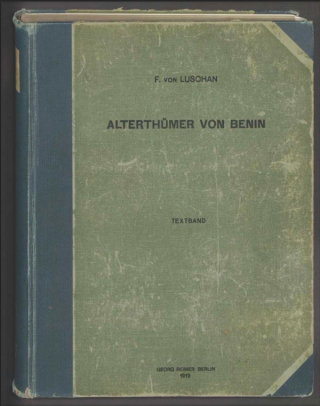
Museum Catalogue
Staatsbibliothek zu Berlin
Die Altertümer von Benin
Date
January 1, 1919 at 12:00:00 AM
An archival document representing a Inventories of 404 page(s)
Inventory
Museum of New Zealand Te Papa Tongarewa
Stock books
Date
January 18, 1897 to March 26, 1900
An archival document representing a Photograph Album of 2 page(s)
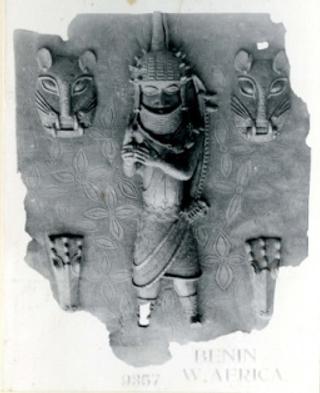
Photograph Album
British Museum
W. D. Webster photograph album
Date
January 1, 1898 to December 31, 1899

Institution data

Staatliche Ethnographische Sammlungen Sachsen und Staatliche Kunstsammlungen Dresden
The data was transferred directly by the institution.
Last updated: 2021-09-28
Language: german
Institution fieldValue
INV_NR
object id
16064
OBJEKTE_ID
object id
1705651
KURZTITEL
designation
Reliefplatte Königlicher Würdenträger
Object-name-and-materials
designation
material
Reliefplatte Königlicher Würdenträger mit Rassel Gelbguss
TITEL
designation
Reliefplatte Königlicher Würdenträger mit Rassel;Bronzeplatte mit 1 Figur, Mann mit kugelförmiger Rassel, in der Ecke Tierdarstellungen
INTERNETKOMMENTAR
description
notes
Die Kalebassenrassel wurde bei bestimmten Zeremonien benutzt. Sowohl die typische Haltung, Gürtel- und Schärpenschmuck als auch die Perlenkrone sollen sich auf Oba Esigie beziehen, der Anfang des 16. Jh. durch den Handel mit den Portugiesen viele Veränderungen in der höfischen Kleidung und im Schmuck einführte. (MVD, S. D.)
KATALOGTEXT
description
MATERIAL
material
Metall
MASSEBEMERKUNG
dimensions
48,5 x 48,5 cm|(lt. Karteikarte) --> prüfen
MASSETABANGABE
dimensions
MASSETABBEMERKUNG
dimensions
MASSETABBREITE
dimensions
MASSETABDURCHMESSER
dimensions
MASSETABEINHEITLAENGE
dimensions
MASSETABEINHEITLAENGE_IDS
dimensions
MASSETABHOEHE
dimensions
MASSETABTIEFE
dimensions
Dimensions_weight
weight
H: 48,5 cm W: 48,5 cm
MASSETABEINHEITGEWICHT
weight
MASSETABEINHEITGEWICHT_ID
weight
MASSETABGEWICHT
weight
OBJEKTBEZ
object type
Plastik
KONVOLUT
provenance
object count
Sammlung Arthur Baessler; SES Benin-Objekte; William D. Webster, London; SES Dossier Benin-Objekte, Überlieferung an die Kontaktstelle für Sammlungsgut aus kolonialen Kontexten
ORT_DATUM_BIS
date made
1897;1899
ORT_DATUM_KONKRET
date made
';'
ORT_DATUM_VON
date made
;
MATTECHBEMERKUNG
production technique
Gelbguss
TECHNIK
production technique
gegossen
ORTE
production place
Federal Republic of Nigeria;Benin City
ORTZEITBEMERKUNG
production place
Königreich Benin, vor 1897
Ort_Zeit-Bemerkung
production place
Königreich Benin, vor 1897
REGIONEN
production place
Benin
Collector/Previous-owner
prior source
Arthur Baessler, Berlin, purchased from William D. Webster, London, in 1899
ERWERBUNG
prior source
Schenkung 1899 von Arthur Baessler, Berlin
PERSON
prior source
unbekannt;Baessler, Arthur;Webster, William Downing
Acquisition-Details
provenance
Donated by Arthur Baessler, Berlin
EIGENTUEMER
provenance
SES/Freistaat Sachsen
PROVENIENZ
provenance
William D. Webster, London (bis 1899); Arthur Baessler, Berlin (erworben 1899 von William D. Webster, bis 1899)
PROVENIENZSTATUS
provenance
SKD-Eigentum
EREIGNISSE
event
Herstellung;Provenienz;Provenienz
ETHNIEN
ethnic attribution
Institution
department and institution
Staatliche Ethnographische Sammlungen Sachsen - Museum für Völkerkunde Dresden
MUSEUM
department and institution
MVD
Institutional-acquisition-date
accession date
1899
Comments
notes
Arthur Baessler, 1857-1907, German Ethnologist and Athropologist; William Downing Webster, 1868-1913, English Dealer and Collector of Ethnographica
PRAESENZ
display status
nicht ausgestellt
BIBLIOGRAPHIE
bibliography
Museum für Völkerkunde Dresden (Hrsg.): Schätze aus Afrika: Benin. Die Schenkung Baessler [Ausst.Kat.]. Dresden, 2006|Falgayrettes, Christiane (Hrsg.): Arts d'Afrique. Paris, 2000|Luschan, Felix von: Die Altertümer von Benin. 3 Bd. In: Veröffentlichungen aus dem Museum für Völkerkunde, Staatliche Museen zu Berlin, Bd. VIII-X. Berlin/Leipzig, 1919
ERWAEHNTIN
bibliography
MVD, 2006, S. 23 u. Abb. 32|Falgayrettes, 2000, S. 38|Luschan, 1919, S. 293
LITERATUR
bibliography
Gunsch, K.W.: The Benin Plaques: A Singular Monument. in: Art. N° 88 Summer 2018. S. 98-113|
LIT_LITERATUR
bibliography
Deimel 2006 [Schätze aus Afrika, ...];Luschan 1919;Gunsch 2018;Wysocki Gunsch 2018;Falgayrettes 2000
BILDUNTERSCHRIFT
images
Übernahme Altdaten|Region original: Großregion => Westafrika; Land => Nigeria; Gebiet => Benin|Ethnie original: kein Eintrag|Region bei Datenübergabe: Afrika>Westafrika>Nigeria>Benin
ALTINVENTARE
AUTHENTIZITAETSZUSATZ
;;
AUTHZUSAETZE_IDS
;;
Additional-IDs
9357 (original number)
Dokumentname
16064_1
EREIGNISSE_IDS
12;15;15
ETHNIEN_IDS
ETH_AUTHZUSAETZE
ETH_AUTHZUSAETZE_IDS
ETH_EREIGNISSE
ETH_EREIGNIS_IDS
FERTIG
1
FLAG
EXP
FOTOFELD
Neg.Tasche Nr. 322/67,68
FUNKTION
Hersteller;Schenker;Händler
GEAENDERT_AM
14.06.2021
GLEICHRANGIG
GND_ID_OBEZ
22955
GND_ID_SCHLAGWORT
18315;344413;21285;22976;24148;134379
GRUNDDATEN
1
INTERNETFREIGABE
1
INVENTURDATUM
INVNR_MERKMALE_IDS
581
KONVOLUTE_IDS
582;959;1409;1191
KOORDINATEN
(10 8);(6,33504 5,62749)
LEIHVERKEHR
LIT_ABBILDUNG
32;;;Fig. 6.62 4A;
LIT_BAND_SEITE
Seite 41;S. 293;S. 98-113;S. 168;S. 38
LIT_BEMERKUNG
farbig;;;s/w;
LIT_LITERATUR_IDS
821;703;2783;3121;3122
LIT_NUMMERE
;;;;
LIT_STA_INETFREIGABE
1;1;1;1;1
MAND_ID
1
MATERIALIEN_IDS
1233
MERKMAL
Originalnummer
MUSEEN_ID
35
ORTE_IDS
2328926;2347283
ORT_AUTHZUSAETZE
;
ORT_AUTHZUSAETZE_IDS
;
ORT_BEZUG
;
ORT_EREIGNISSE
Herstellung;Erwerbung
ORT_EREIGNISSE_IDS
12;9
PND_BEZUG
;;
PND_FUNKTIONEN_IDS
-2;133;645
PND_INETFREIGABE
1;0;1
PND_PERSONEN_IDS
12797488;12106249;12821279
PRAESENZEN_WERT_ID
-67
PROVSTATUS_WERT_ID
-43
REGIONEN_IDS
612
REG_EREIGNISSE
Erwerbung
REG_EREIGNIS_IDS
9
SAMMLUNG
Afrika
SAMMLUNGEN_ID
535
SCHLAGWORT
König;Leopard <Motiv>;Musikinstrument;Platte;Relief;Tier <Motiv>
TECHNIKEN_IDS
75
UNTERGEORDNET
VORLAGEN
WEITERE_NUMMERN
9357
WISSENSCHAFT
1
XRAY
###
Sensitive Content

Digital Benin collates digital material from institutions, and some of this material is inherently colonial and contains words, terms and phrases that are inaccurate, derogatory and harmful towards African and African diasporic communities. Catalogue transcriptions, book titles, exhibition titles and museum titles may contain harmful terms. We recognise the potential for the material to cause physical and mental distress as well as evoke strong emotions. Owing to the scale of the collection’s data, a process to implement sensitive-content warnings in the displayed data is still incomplete. The material within the catalogue does not represent Digital Benin’s views. Digital Benin maintains a strong anti-colonial, anti-racist position and affirms its support for centring the humanity of historically marginalised and disenfranchised communities. Read more about the background of this statement here