
Reg No.
5281
Edo designations
English designations
Altar of the Hand
Categories
Altar & Shrine Objects
Location
1 Adesogbe (Plymouth) Road, P.M.B. 1115, Benin City , Edo State
Loading...
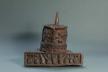
Altar of the Hand
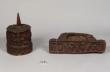
Altar of the Hand
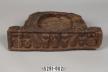
Altar of the Hand

Iconographies

6 annotations
Umọmọ
Hammer

The Umọmọ is an L-shaped hammer made of iron that holds profound importance, symbolising power, transformation, and spiritual efficacy. The hammer is fundamentally associated with Ogun, the god of iron, embodying “the force inherent in metal, [with] a mystical power with the potential to create or destroy” ( ). This dual aspect of the hammer—its capacity for both shaping and destruction—mirrors the formidable power of the Ọba. The L-shaped hammer is often associated specifically with Ọba Eresonyẹn, as it most commonly appears within the visual language of Emwin Arhe (royal treasures) that he commissioned, for example, held by Ewua figures and on one ornate cast Ẹrhẹ, thought to have been Ọba Eresonyẹn’s throne (id. no. 209779) ( ).

The hammer is notably held by figures identified as Ewua palace officials or Ohensa priests, who also wear a cross pendant on their chests. The consistent portrayal of these figures holding the Umọmọ underscores its connection to the origins of the Benin dynasty and the spiritual authority of the Ọba. Ọba Esigie, the powerful 16th-century “warrior king”, is credited with encouraging ironworking, further solidifying the hammer’s link to royal martial strength and divine kingship.

Appearing on Aken'ni Elao (carved ivory tusks), Ama-Ẹrọnmwọn (bronze relief plaques), and even as a charm, the hammer symbolises the Ọba’s ability to “mold and transform” events, to overcome challenges, and to provide spiritual protection ( ). Its presence thus reinforces the complex interplay of hierarchy, spiritual authority, and military might within the Benin Kingdom, consistent with other potent symbols such as the Akọn Ẹkpẹn (leopard’s tooth neck ornament). The Umọmọ often appears on Emwin Arhe (royal treasures) believed to have been commissioned during the reign of Ọba Eresonyẹn ( ; ).

Other terms for hammer in Edo are Avan or Avalaka ( ), which are used interchangeably with Umọmọ by members of the Igun-Ẹrọnmwọn.

1 annotation
Umọmọ
Iru
Sacred jug

On the Ama-Ẹrọnmwọn (bronze relief plaques) and Aken'ni Elao (carved tusks), a particularly sacred type of brass Iru is shown being carried by members of the Emuru. These are globular jug-like vessels cast in brass with a long neck, topped with a ram’s head form. However, fragments of a similarly shaped bronze object (E 1902.457) have been identified, suggesting that this may have been a rattle rather than a vessel ( ).

Members of the Emuru guild, which dates back to the reign of Ọba Ẹwuare I, are shown holding Iru, particularly on the Ama-Ẹrọnmwọn. According to oral tradition, these Iru were taken by Ọba Ewuare from Olokun’s palace. Their spiritual powers were manifested through voices chanting “ise,” the affirmation used in Edo prayers. However, when Olua succeeded Ẹwuare I, he smashed the Uru and found nothing inside them. Only afterwards were the Emuru instructed to carry Uru resembling those taken by Ewuare ( ; ; Chief Osuma in Bradbury 1958, B.S. 113).

1 annotation
Iru
Ogho
Ram

The Ogho (ram) is associated with masculine and aggressive qualities, bravery and agility in Edo belief, as well as with conflict and trouble ( ). Due to these symbolic associations, the Ogho is one of the animals often used for sacrifice, particularly at the Ikẹgobọ (altar to the hand), as an offering associated with physical strength and power. Rams, particularly ram’s heads, are a common motif used to decorate the flanges of Uhunmwu-Elao (commemorative heads), as well as serving as the central decorative motif on pendant plaques. These Ogho pendant plaques are believed to have been worn by the Ọba, based on evidence from depictions of a figure interpreted as Ọba Ewuakpe ( ; ). According to Barbara Blackmun ( ), the Ogho head motif was one of the dynastic motifs that were revived during the 18th century. The widespread use of the ram’s head motif suggests connections with other southern Nigerian casting centres, such as Ife, Owo, and the Lower Niger Bronzes.

In addition to the ram’s head motif, two unusual aquamaniles in the form of whole Ogho figures were also cast by artists from the Igun-Ẹrọnmwọn.

1 annotation
Ogho
Ubanu'hi / Obanu'hi
Ubanu'hi / Obanu'hi
Inifinity Symbol

The Ubanu'hi (infinity symbol) is a kind of guilloche or interlaced strapwork motif that can be angular or rounded. It was used by Edo artists in the decoration of many Emwin Arhe (royal treasures) and is ubiquitous in Benin royal arts. Ubanu'hi is a shortened form of “uba no Ọba ya de agbon ke ehimwin yi”, which means “the rope with which the Ọba ties the heaven and earth together” (pers. comm. Chief John Igbineweka Inneh n’Igbesawman, 2022). Similarly, Paula Ben-Amos Girshick (in Plankensteiner 2007, pp. 339, 341) described this as “Ọba n’iri agbon”, or the “rope of the world” pattern.

According to Ọbabanmu Ineh (in Blackmun 1984, p. 51), the use of this motif indicates that objects were carved by members of the Igbesanmwan. However, the motif is found on all types of Emwin Arhe (royal treasures), not only those made of ivory or wood. On the flanges of the Ama (relief plaques) alone, Kathryn Gunsch (2018, pp. 75–77) identified three different versions of the Ubanu'hi and, through her analysis of over 850 plaques, found that these different Ubanu'hi forms align with other characteristics, such as dimensions, the prevalence of ornamental motifs, and stylistic qualities. Together, these provide evidence, she argues, of different production groups among the plaque makers .

Kate Ezra (1992, pp. 209, 264) went on to argue that the use of these motifs indicates that certain objects were used in a “royal context” and were associated with “royal patronage”.

1 annotation
Ubanu'hi / Obanu'hi
Ẹbẹn
Ceremonial Sword

Ẹbẹn are a type of ceremonial sword of significant importance in the Benin Kingdom. During ceremonies, titled chiefs would hold them or toss them during dances, thereby paying homage to the Ọba at these public events, particularly when a chief receives a certain status. It is forbidden for Ẹbẹn to touch the ground, so the chief must take extra precautions to avoid dropping the Ẹbẹn during the dance. Therefore, the Okae-Odionmwan (head of executioners) dances with the Umozo (warfare or executioner’s sword) behind the dancing chief.

There are two central ceremonial swords used in the royal court of the Benin Kingdom, one of which is the Ẹbẹn, along with the Ada (ceremonial swords). They are distinguished by their blades: the Ẹbẹn blade reflects the shape of a leaf or an oar. Sometimes, it is decorated with openwork designs and/or brass inlays, most commonly shaped as small Ẹbẹn and Ẹkpẹn (leopards). The handle of the Ẹbẹn also has an unusual ring-shaped form, which further differentiates it from the Ada.

1 annotation
Ẹbẹn
Ukpan obọ eva
Crossed Beaded Baldrics

The Ukpan obọ eva (coral-bead crossed baldrics) were worn as part of the ehaingbehia, the full ceremonial regalia, by only high-ranking members of the palace, including the Ọba himself, the Iy’Ọba, the Edaiken, and the Ezọmọ (Ben-Amos 1999, pp. 68, 141; Osadolor in Plankensteiner 2007, cat. no. 70, pp. 322–323).

1 annotation
Ukpan obọ eva

Provenance

6 events
Production
unknown to February 22, 1897 (year approximate)
The object was produced by Unknown member(s) of the Igbesamwan guild in Benin City.
Looted
February 22, 1897 (day approximate) to June 1899 (year approximate)
The object was looted by February 1897 Unknown member of the British colonial military campaign on Benin from Benin Kingdom.
Auction
1901
The object was auctioned to William Downing Webster through Stevens Auction Rooms in London.
Auction
June 30, 1902
The object was auctioned to Theodor 'Theo' Rautenstrauch by William Downing Webster through Stevens Auction Rooms in London.
Donation
November 21, 1902
The object was donated by Theodor 'Theo' Rautenstrauch to the Rautenstrauch-Joest-Museum in Cologne.
Restitution
December 8, 2022
The object was restituted by the Rautenstrauch-Joest-Museum to the Omo n'Oba n'Edo Uku Akpolokpolo, Ọba of Benin & National Commission for Museums and Monuments, Nigeria from Cologne to Nigeria.

Related archival documents

3 documents
See all
Date
Date
Date

Institution data

Rautenstrauch-Joest-Museum
The data was transferred directly by the institution.
Last updated: 2022-07-27
Language: english
Institution fieldValue
Additional Ids
object id
190219
Additional Ids / bundle
object id
RJM 1902/19
Other numbers
object id
11446 (old inventory number)
Reg No.
object id
5281
Reg. No / Inventory number
object id
RJM 5281
Object name
designation
object type
altar of the right hand
Object name / Title
designation
Altar of the Hand (ikegobo)
materials
material
wood
Dimension/s
dimensions
001 H.36cm W.23cm X.22,50cm 002 H.12,50cm W.51cm X.29,70cm
previous owner/collector
prior source
Theodor Rautenstrauch, son of Adele and Eugen Rautenstrauch, Member of Deutsche Kolonialgesellschaft - Dep. Köln Collection Wilhelm Joest 1911
provenance
provenance
30.06.1902 to 21.11.1902, Theodor Rautenstrauch (1873-1907) (auction); from 21.11.1902, Rautenstrauch-Joest Museum (donation); 1902 - 30.06.1902, J.C. Stevens, London (location), Stevens' Auction Rooms; auction in 1901, W. D. Webster, London, Bicester (commission)
Institution
department and institution
Rautenstrauch-Joest Museum - Cultures of the World, Cologne
Institution acquisition date
accession date
11/21/02
Acquisition details
accession method
donation
comments
notes
Theodor Rautenstrauch got the objects at an auction of Mr. J.C. Stevens on 03.06.1902 in London. The auction named "Benin brass" and embraced a collection of the British Punitive from 1897.
Copyright
license
© Museumsgesellschaft RJM Köln, Foto Uli Grohs
notes concerning "other numbers"
Probably inventory number W.D. Webster
Sensitive Content

Digital Benin collates digital material from institutions, and some of this material is inherently colonial and contains words, terms and phrases that are inaccurate, derogatory and harmful towards African and African diasporic communities. Catalogue transcriptions, book titles, exhibition titles and museum titles may contain harmful terms. We recognise the potential for the material to cause physical and mental distress as well as evoke strong emotions. Owing to the scale of the collection’s data, a process to implement sensitive-content warnings in the displayed data is still incomplete. The material within the catalogue does not represent Digital Benin’s views. Digital Benin maintains a strong anti-colonial, anti-racist position and affirms its support for centring the humanity of historically marginalised and disenfranchised communities. Read more about the background of this statement here