
object_number
A.1902.475
English designations
Pendant Plaque
Categories
Ceremonial Regalia
Location
Chambers St, Edinburgh EH1 1JF, United Kingdom
Loading...
Pendant Plaque
Pendant Plaque
Pendant Plaque
Pendant Plaque
Pendant Plaque

Iconographies

8 annotations
Ukpan obọ eva
Crossed Beaded Baldrics

The Ukpan obọ eva (coral-bead crossed baldrics) were worn as part of the ehaingbehia, the full ceremonial regalia, by only high-ranking members of the palace, including the Ọba himself, the Iy’Ọba, the Edaiken, and the Ezọmọ (Ben-Amos 1999, pp. 68, 141; Osadolor in Plankensteiner 2007, cat. no. 70, pp. 322–323).

1 annotation
Ukpan obọ eva
tribal marks
Iwu
Facial and Body Markings

Iwu are facial and body markings (scarifications) that were historically worn by Edo men and women. However, since the 1960s, the practice has been nearly extinct (Aisien 2011). In the past, Iwu were used as a way of proving that one was an Edo citizen, and the ceremony of having Iwu completed was an important rite of passage for men and women. The Osiwu, who also practised circumcision and other surgical procedures, would carry out the procedure of adding Iwu. There are different types of Iwu: ‘blades’ worn on the torso (Iwu-eko), and those worn on the face, such as Ikharo (three or four markings above the eyebrows), Irho (two narrow ‘blades’ worn on each cheek), Ovbihue (nasal ‘blades’), Ovbi-agbanmwen (chin ‘blade’), and Igho-okpa/Ukpgho (three forehead ‘blades’) (Aisien 2011, p. 22).

The number of Iwu also varied depending on the identity of the person wearing them. For example, royal men would wear six ‘blades’ on their torso, whilst men who were not royal would wear seven ‘blades’. Meanwhile, the Ọba’s female children would wear fifteen ‘blades’, and all other women would wear sixteen (Aisien 2011).

1 annotation
Iwu
Emada
Palace Page

The Emada (singular: Omada) are palace pages who serve the Ọba and belong to the Iwegue Palace Society. Standing at the Ọba’s side, they carry the stately Ada (ceremonial sword) during public appearances and are therefore sometimes referred to as “Ada bearers” ( ). Emada typically served the Ọba for between six and twenty years, beginning in childhood. At the end of their service, the Ọba would provide each Omada with a wife and a plot of land, formally releasing him from palace service and marking his transition into adulthood (Kaplan 2007, p. 149).

Although the institution of the Emada predates his reign, Ọba Adolo was the first to allow his palace pages to train in woodcarving. This led to the development of a distinctive carving style and visual language that differed from that of the Igbesamwan, the royal guild of wood and ivory carvers.

Emada are consistently depicted naked, signifying their unmarried status ( ; ), and are most commonly shown accompanying representations of the Ọba. In addition to carrying the Ada, they may hold Ẹzuzu (fans), used to cool the Ọba, or Ugianranran (manillas), which signal wealth and overseas trade ( ). Emada appear across several types of Emwin Arhe (royal treasures), particularly Ama-Ẹrọnmwọn (bronze relief plaques), Aken'ni Elao (carved tusks), and Urhotọ (altar tableaux).

1 annotation
Emada
Ada
Ceremonial sword

The Ada is a symbol of authority usually borne in the presence of the Ọba by a designated holder, the Omada, which translates as ‘Ada bearer’. The Ọba has almost exclusive rights to the use of the Ada, except when he permits titled chiefs, such as the Oliha, to possess one. During the Ogiso period, predating the current Ọba dynasty, the Ada is said to have been a symbol of ancestral power, with the ability to control the future (Ben-Amos 1995, p. 25). The Ada is ranked higher than the Ẹbẹn, another symbolically important ceremonial sword.

1 annotation
Ada
Round Neck Bead
Ikele
Coral bead circlet

Ikele is a single stiff string or circlet of coral beads. It is worn by chiefs, such as senior chiefs who have been made Enigie (Inneh 2007, p.107), and is a sign of nobility and rank. The Ikele may only be worn once the Ọba has conferred a person with the right to wear the beads, and the Ikele must always be worn when appearing before the Ọba. According to Ekhaguosa Aisien (in Plankensteiner 2007, cat. nr. 301, p.512) when a chief is wearing the Ikele, they may not eat nor drink in public, and they “constitute an embassy of the Benin Palace wherever he might be.”

1 annotation
Ikele
Ititi ako
Star beads

The Ititi ako is a cluster of coral beads, usually three or four, attached to a pin and used to embellish the royal crowns on Uhunmwu-Elao (commemorative heads) and Uhunmwu-Ẹkuẹ (pendant masks). These bead clusters are also known as star beads, which indicate the prosperous destiny of an individual or wearer. Apart from enhancing the appearance of the wearer, they also represent the individual’s high social status. Judging from their presence on a variety of head sculptures, both men and women wore Ititi ako.

1 annotation
Ititi ako
Udahae
Beaded forehead band

The Udahae is a forehead band made from coral beads and worn by chiefs. Sometimes a white Igan (feather) from the Oɛɣohɔ (vulturine fish eagle) is tucked into the left side of the Udahae. According to Benin oral tradition, the Udahae was introduced by Ọba Ezoti, the first son of Ọba Ewuare I. During his coronation, Ezoti was shot in the forehead with a poisoned arrow. To stop the bleeding, a band of red beads was wrapped around his forehead while he made public appearances. Fourteen days later, he died from his wound. Since then, Benin chiefs have worn the red-beaded Udahae around their foreheads to commemorate the cap used by Ezoti to stop the bleeding (Egharevba 1968, p. 21).

1 annotation
Udahae
Ọba
King

The Ọba is the monarch of the Edo people and Kingdom. The current reigning monarch, Ọba Ẹwuare II, is the fortieth Ọba of the current dynasty, which is traditionally understood to have begun around 1170 AD ( ). Over the centuries, the role and conception of the monarch have shifted, and the Emwin Arre (royal treasures) and the visual language they carry provide important evidence for understanding these developments. Although Emwin Arhe served a variety of functions within court life and ritual, “their primary purpose was to glorify the godlike king and the history of the powerful empire” (Plankensteiner 2007, p. 25). Representations of the Ọba are therefore ubiquitous across Benin court arts and frequently occupy a central position within their visual language.

Representations of the Ọba can be recognised through a combination of characteristics, including his size, as he is usually depicted larger than other figures, and his position within compositions, where he may appear in front of or be supported by other figures, as in the Royal Triad motif. The Ọba is also distinguished by particular items of regalia, including the Oro projection from his crown, the distinctive beaded swag extending from his right hip, the Ewu ivie (coral-beaded shirt), and Ukpan obọ eva (crossed coral-beaded baldrics).

Since the early 20th century, scholars have sought to identify individual Ọbas represented on Emwin Arhe by analysing the regalia and other attributes of figures identified as monarchs, as well as the combinations of motifs and figures appearing on particular objects. Oral traditions and historical accounts, alongside European archival sources, have also played an important role in determining the identities of specific Ọbas (e.g., , ; ). Just as the institution of the monarchy developed and changed over time, so too did the ways in which Ọbas were represented by artists working within the royal guilds, including the Igun-Ẹrọnmwọn and Igbesamwan.

1 annotation
Ọba

Provenance

4 events
Production
unknown to February 22, 1897 (day approximate)
The object was produced by Unknown member(s) of the Igun-Ẹrọnmwọn guild in Benin City.
Looted
February 22, 1897 (day approximate) to June 1899 (year approximate)
The object was looted by February 1897 Unknown member of the British colonial military campaign on Benin from Benin Kingdom.
Unknown
February 22, 1897 (day approximate) to 1902
The object is known to have come into contact with William Downing Webster, later in London.
Gift
1902
The object was given as a gift by William Downing Webster to the National Museums Scotland from London to Edinburgh.

Institution data

National Museums Scotland
The data was transferred directly by the institution.
Last updated: 2021-05-26
Language: english
Institution fieldValue
alternative_number
object id
object_number
object id
A.1902.475
object_name
designation
object type
Hip pendant
description
description
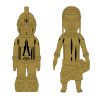
Pendant of cast brass/bronze, of the royal triad, the king and two attendants in relief: West Africa, Nigeria, Edo State, Benin
material
material
Bronze || Brass
dimensions
dimensions
9.38" H
production.period
date made
technique
production technique
Lost wax cast
production.place
production place
Benin City, Edo State, Nigeria, Western Africa
acquisition.source
prior source
Webster, William Downing, 1863 - 1913
association.subject
event
British Punitive to Benin City, 1897
acquisition.date
accession date
1902
acquisition.method
accession method
GIFT
notes
notes
WEST AFRICA. SOUTHERN NIGERIA. BENIN. BRONZES. GROUP of Chief and two nude attendants holding swords, rudely cast in bronze. Benin City, Midwestern State, West Africa.
exhibition
exhibition history
references
bibliography
image_ref_no
images
alternative_number.type
association.person
association.person.association
association.person.note
school_style
Benin
Sensitive Content

Digital Benin collates digital material from institutions, and some of this material is inherently colonial and contains words, terms and phrases that are inaccurate, derogatory and harmful towards African and African diasporic communities. Catalogue transcriptions, book titles, exhibition titles and museum titles may contain harmful terms. We recognise the potential for the material to cause physical and mental distress as well as evoke strong emotions. Owing to the scale of the collection’s data, a process to implement sensitive-content warnings in the displayed data is still incomplete. The material within the catalogue does not represent Digital Benin’s views. Digital Benin maintains a strong anti-colonial, anti-racist position and affirms its support for centring the humanity of historically marginalised and disenfranchised communities. Read more about the background of this statement here