
Accession/Inventory No.
BIRRC-D0084
Edo designations
English designations
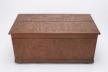
Chest
Categories
Containers
Contextual Objects: Post-1930s
Location
University of Birmingham, Muirhead Tower, Birmingham, B15 2TT, England, UK
Loading...
Box
Box

Iconographies

5 annotations
Ukpan obọ eva
Crossed Beaded Baldrics

The Ukpan obọ eva (coral-bead crossed baldrics) were worn as part of the ehaingbehia, the full ceremonial regalia, by only high-ranking members of the palace, including the Ọba himself, the Iy’Ọba, the Edaiken, and the Ezọmọ (Ben-Amos 1999, pp. 68, 141; Osadolor in Plankensteiner 2007, cat. no. 70, pp. 322–323).

1 annotation
Ukpan obọ eva
Ada
Ceremonial sword

The Ada is a symbol of authority usually borne in the presence of the Ọba by a designated holder, the Omada, which translates as ‘Ada bearer’. The Ọba has almost exclusive rights to the use of the Ada, except when he permits titled chiefs, such as the Oliha, to possess one. During the Ogiso period, predating the current Ọba dynasty, the Ada is said to have been a symbol of ancestral power, with the ability to control the future (Ben-Amos 1995, p. 25). The Ada is ranked higher than the Ẹbẹn, another symbolically important ceremonial sword.

1 annotation
Ada
Fan
Ẹzuzu
Hand fan

Ẹzuzu (round hand fans) are usually carried by attendants to the Ọba or Iy’Ọba. On the Ama-Ẹrọnmwọn (bronze relief plaques), male attendants to the Ọba carry fans, whereas on Urhotọ (altar tableaux), female attendants carrying fans are depicted flanking the Iy’Ọba. Ẹzuzu connote the status of both the person being fanned and the holder, who is usually an attendant fanning the superior Ọba or Iy’Ọba. Usually, male attendants—members of the Emada—would be represented with the Ọba, while young women would attend to the Iy’Ọba. Ẹzuzu have an important function in cooling; however, the wafting of the fans can also calm spiritual energy, thus making the fan a symbol of peace ( ).

A further symbolic use for the Ẹzuzu includes blowing medicine across the surface of a fan and using mirrored fans by ritual specialists to make predictions about the future ( ). The symbolic importance of fans in Edo belief is reflected in their use as one of a small group of inanimate objects that are the focal subjects of some Ama-Ẹrọnmwọn.

1 annotation
Ẹzuzu
Ekhara
Umbrella

Ekhara (umbrellas) play a multifaceted role in Benin art, reflecting both their function as status symbols and their association with European visitors. On some Ama-Ẹrọnmwọn (bronze relief plaques), sunshades resembling Asa are held by the Ọba’s attendants to protect him from the sun. European-style Ekhara, as we know them today, are also depicted in late 19th-century wooden carvings produced by the Emada. In her analysis of the Aken'ni Elao, Barbara Blackmun ( ) observed that on earlier objects, umbrellas were generally depicted only in the hands of foreign figures rather than those identified as members of the Benin Kingdom.

On later objects, particularly those dating to the late 19th century, this changes. The Ọba and high-ranking chiefs such as the Ezọmọ are depicted being shielded from the sun by attendants carrying Ekhara, a practice also described by Europeans visiting Benin City (e.g., ). Like many imported luxury goods, the Ekhara was incorporated into the visual language of royal power and became an important status symbol, associated with the wealth, authority, and elevated position of those permitted to use it.

1 annotation
Ekhara
Ẹbẹn
Ceremonial Sword

Ẹbẹn are a type of ceremonial sword of significant importance in the Benin Kingdom. During ceremonies, titled chiefs would hold them or toss them during dances, thereby paying homage to the Ọba at these public events, particularly when a chief receives a certain status. It is forbidden for Ẹbẹn to touch the ground, so the chief must take extra precautions to avoid dropping the Ẹbẹn during the dance. Therefore, the Okae-Odionmwan (head of executioners) dances with the Umozo (warfare or executioner’s sword) behind the dancing chief.

There are two central ceremonial swords used in the royal court of the Benin Kingdom, one of which is the Ẹbẹn, along with the Ada (ceremonial swords). They are distinguished by their blades: the Ẹbẹn blade reflects the shape of a leaf or an oar. Sometimes, it is decorated with openwork designs and/or brass inlays, most commonly shaped as small Ẹbẹn and Ẹkpẹn (leopards). The handle of the Ẹbẹn also has an unusual ring-shaped form, which further differentiates it from the Ada.

1 annotation
Ẹbẹn

Provenance

4 events
Production
1949
The object was produced by H. I. Erhabor in Benin City.
Purchase
1949 (approximate)
The object was purchased by John Danford in Nigeria.
Loan
1964 to 1975
The object was loaned by John Danford to the Research and Cultural Collections, University of Birmingham in Birmingham.
Purchase
1975
The object was purchased by the Research and Cultural Collections, University of Birmingham from John Danford in Birmingham.

Institution data

Research and Cultural Collections, University of Birmingham
The data was transferred directly by the institution.
Last updated: 2022-07-27
Language: english
Institution fieldValue
Accession/Inventory No.
object id
BIRRC-D0084
Title/Object name
designation
Carved chest
Description
description
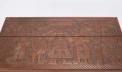
Wooden chest with relief carvings. Top: The Oba of Benin with attendents. Front: An execution scene. Side panels: River gods and traditional ceremonies.
Materials
material
Iroko wood
Measurements
dimensions
45 x 99 x 52 cm
Object type
object type
Furniture
Mobius inscriptions
inscriptions
Date made
date made
Artist/Maker
provenance
producer
Possibly Erhabor, H. I.
Place made
production place
Benin City, Nigeria
Collector
prior source
Danford, John
Culture
ethnic attribution
Edo (Bini)
Institution
department and institution
Research and Cultural Collections
Named collection
department and institution
Danford Collection of West African Art and Artefacts
Acquisition
accession date
accession method
Danford Collection purchased in 1975.
Digital Benin note
notes
Note
notes
Bibliography
bibliography
See 1957 Ibadan catalogue no. 7.
Legal status
legal status
PERMANENT COLLECTION
Copyright statement
license
© Copyright holder unknown. Photo credit: Research and Cultural Collections, University of Birmingham
Category
Decorative art
Create Date
2/5/99
Created By
HAMILTJH
External Mobius publish?
N
ID Prefix
BIRRC
ID Sort1
D
ID Sort2
84
ID Sort3
0
ID Sort4
0
ID Sort5
0
ID Sort6
0
Internal Mobius publish?
Y
Item count
1
Loan allowed?
Y
Location date
4/18/19
MKEY
102314
Miscellaneous
Lent by J. Danford 1964. Purchased 1957.Acquired in 1943. Possibly by H.I.Erhabor.
Offsite?
N
Update Date
5/27/21
Updated By
AYOUNG
Whole/Part
Whole
XG_STATE
0
Sensitive Content

Digital Benin collates digital material from institutions, and some of this material is inherently colonial and contains words, terms and phrases that are inaccurate, derogatory and harmful towards African and African diasporic communities. Catalogue transcriptions, book titles, exhibition titles and museum titles may contain harmful terms. We recognise the potential for the material to cause physical and mental distress as well as evoke strong emotions. Owing to the scale of the collection’s data, a process to implement sensitive-content warnings in the displayed data is still incomplete. The material within the catalogue does not represent Digital Benin’s views. Digital Benin maintains a strong anti-colonial, anti-racist position and affirms its support for centring the humanity of historically marginalised and disenfranchised communities. Read more about the background of this statement here