
Object Number
1996.11
Edo designations
English designations
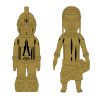
Altar of the Hand
Categories
Altar & Shrine Objects
Location
1000 5th Ave, New York, NY 10028, United States
Loading...
Altar of the Hand
Altar of the Hand
Altar of the Hand
Altar of the Hand
Altar of the Hand
Altar of the Hand

Iconographies

7 annotations
Ikpotoki
Portuguese Figure

Ikpotoki figures (Portuguese figures) are easily distinguished by their European-style clothing, including hats and helmets, as well as by their facial features, particularly their thin, straight noses and straight hair. The objects Ikpotoki figures are shown wearing or holding provide further indications of their relationship with the Benin Kingdom. When they hold or are positioned alongside Ugianran (manillas), for example, they indicate trade, commerce, and wealth, while weaponry such as firearms, swords, or spears indicates their role as mercenaries in the service of the Ọba. In 1515, Ọba Ẹsigie went to war against the Attah of Idah, the ruler of a neighbouring kingdom. Portuguese mercenaries and weapons assisted the Edo in winning the battle, enabling the further expansion of the Kingdom. Ẹsigie’s reign was particularly important for strengthening ties between the Benin Kingdom and the Portuguese Empire, and he is believed to have spoken fluent Portuguese. With Ẹsigie’s encouragement, Portuguese missionaries established churches in the Benin Kingdom ( ; ), while Portuguese trading factories were also established ( ). Ọba Ẹsigie allowed his son to be baptised and sent him to Portugal to be educated; following his return, he became Ọba Orhogbua ( ).

1 annotation
Ikpotoki
Osisi
Gun

Osisi is the general Edo word for guns. Osisi were initially introduced to the Benin Kingdom by the Portuguese from the late 16th century onwards and were again traded by the Dutch from the early 17th century (Osadolor 2007, p. 80). Osisi are usually represented as being carried by, or positioned close to, figures identified as Portuguese based on their attire and hairstyles. There are a small number of exceptions, including two wooden carved examples. One is a possible chair seat where a figure is holding a gun upright, and another is a carved wooden panel where a gun is shown next to an Edo dignitary. Additionally, a more recent work produced by the artist H. I. Erhabor includes an Edo figure holding a gun.

These weapons quickly became a potent symbol in the work of artists from the royal guilds, representing the Ọba’s military might, expansionist policies, and the wealth derived from foreign trade (Plankensteiner 2007, p. 208). Three different kinds of European-manufactured guns were used by the Edo army: the flintlock, the wheellock, and later the matchlock, which was used from the 1600s until around 1850. However, Ọba Akengbuda became increasingly wary of Edo dependence on European firearms and encouraged the production of firearms by the Igun Ematon. During the 19th century, the trade in firearms from Europe resumed, with Dane guns, so named because they were made in Denmark. However, from 1890, European imperial powers banned the trade in firearms to West Africa (Osadolor 2007, pp. 80–81).

1 annotation
Osisi
Agbada
Sword

Agbada is a type of short sword with a double-edged blade, used by warriors in hand-to-hand combat ( ; ; Ọbazee 2025, p. 10). Warrior figures carrying Agbada are often depicted on the Ama-Ẹrọnmwọn (bronze relief plaques), both in scenes of combat and in ceremonial contexts.

1 annotation
Agbada
tribal marks
Iwu
Facial and Body Markings

Iwu are facial and body markings (scarifications) that were historically worn by Edo men and women. However, since the 1960s, the practice has been nearly extinct (Aisien 2011). In the past, Iwu were used as a way of proving that one was an Edo citizen, and the ceremony of having Iwu completed was an important rite of passage for men and women. The Osiwu, who also practised circumcision and other surgical procedures, would carry out the procedure of adding Iwu. There are different types of Iwu: ‘blades’ worn on the torso (Iwu-eko), and those worn on the face, such as Ikharo (three or four markings above the eyebrows), Irho (two narrow ‘blades’ worn on each cheek), Ovbihue (nasal ‘blades’), Ovbi-agbanmwen (chin ‘blade’), and Igho-okpa/Ukpgho (three forehead ‘blades’) (Aisien 2011, p. 22).

The number of Iwu also varied depending on the identity of the person wearing them. For example, royal men would wear six ‘blades’ on their torso, whilst men who were not royal would wear seven ‘blades’. Meanwhile, the Ọba’s female children would wear fifteen ‘blades’, and all other women would wear sixteen (Aisien 2011).

1 annotation
Iwu
Ẹgogo
Gong

Ẹgogo (gongs) hold significant importance in Benin art and ritual, serving as powerful instruments with both practical and symbolic roles. Ivory gongs, especially “double-bell” types, were highly prized and reserved for the royal court, particularly those made entirely of ivory, which were used exclusively by the Ọba. The whiteness of ivory Ẹgogo symbolises purity and peace and is linked to sacred Orhue (white kaolin chalk) and the deity Olokun (Blackmun 2007, cat. no. 60, p. 315).

When depicted in the imagery of the Emwin Arhe (royal treasures), Ẹgogo are usually held by figures such as the Ọba or high-ranking chiefs, illustrating their historical and ongoing use as idiophones during ceremonies and festivals. The Ọba dances with an ornately carved ivory Ẹgogo during the Emobo festival, which takes place three days after the Iguẹ festival (Ben-Amos 1995, p. 108).

1 annotation
Ẹgogo
Ikharo
Forehead markings

Ikharo are linear keloid markings depicted on the forehead of Uhunmwu-Elao (commemorative heads) in groups of three or four above each eye. The exact meaning of Ikharo is debated; some have argued that they relate to the gender or tribal identification of the person on whom they are depicted. For example, has argued that they were worn only by men; however, their use in depictions is not consistent with this, and the Iy’Ọba are also shown wearing them. argued that they are instead a stylistic feature employed by artists that varied over time.

The naming of these markings differs between publications. For example, describe these markings as “agbaguda n'ehae”, which they write translates literally as “blades of the forehead”. However, later went on to call these “ikharo”, as used here. referred to these forehead markings as ikharo, meaning “tribal mark [of eye]”.

1 annotation
Ikharo
Round Neck Bead
Ikele
Coral bead circlet

Ikele is a single stiff string or circlet of coral beads. It is worn by chiefs, such as senior chiefs who have been made Enigie (Inneh 2007, p.107), and is a sign of nobility and rank. The Ikele may only be worn once the Ọba has conferred a person with the right to wear the beads, and the Ikele must always be worn when appearing before the Ọba. According to Ekhaguosa Aisien (in Plankensteiner 2007, cat. nr. 301, p.512) when a chief is wearing the Ikele, they may not eat nor drink in public, and they “constitute an embassy of the Benin Palace wherever he might be.”

1 annotation
Ikele

Related oral histories

1 interviews

Provenance

7 events
Production
unknown to 1960
The object was produced by Unknown member(s) of the Igun-Ẹrọnmwọn guild in Benin City.
Collection
1914 to 1960
The object was added to the collection of Omoruyi in Benin City.
Inheritance
1960
The object was inherited by Asemwota from Omoruyi in Benin City.
Inheritance
1961
The object was inherited by Chief H. A. from Asemwota in Benin City.
Unknown
1994
The object is known to have come into contact with Abdullaha Ibrahim, in Benin City and later Cotonou.
Purchase
1995
The object was purchased by Charles B. Davis from Abdullaha Ibrahim from Cotonou to New Orleans.
Purchase
1996
The object was purchased by the Metropolitan Museum of Art from Davis Gallery, Charles B. Davis and Kent Davis through Jacob S. Rogers Fund from New Orleans to New York City.

Institution data

Metropolitan Museum of Art
The data was transferred directly by the institution.
Last updated: 2021-07-30
Language: english
Institution fieldValue
Object Number
object id
1996.11
Object Sort Number
object id
1996 11
Primary Rendition No
object id
DP234641
Title
designation
object type
Altar to the Hand of Ezomo Ehenua (Ikegobo)
Medium
material
Brass
Dimensions
dimensions
H. 13 × W. 14 × D. 14 in. (33 × 35.6 × 35.6 cm)
Classification
object type
Metal-Sculpture
Date
date made
18th–19th century
Geo: City
production place
Court of Benin
Geo: Country
production place
Nigeria
Credit Line
prior source
Rogers Fund, 1996
Provenance
provenance
Ezomo Omoruyi, Benin, until (d.)1960; by descent, Chief H.A. Ezomo of Benin, Benin City, Edo, Nigeria, until1994; [Abdullaha Ibrahim, Cotonou, Benin, 1994–1995]; [Charles B. Davis III, Davis Gallery, New Orleans, LA, 1995–1996
Dynasty
reign associated name
Oranmiyan
Culture
ethnic attribution
Edo peoples
ExhibitionHistory
exhibition history
Heroic Africans: Legendary Leaders, IconicSculptures Museum Rietberg, February 26, 2012–June 3, 2012
Bibliography
bibliography
Bradbury, R.E. Benin Studies. London: Thames & Hudson Inc., 1973. LaGamma, Alisa. Heroic Africans: Legendary Leaders, Iconic Sculptures. New York: The Metropolitan Museum of Art, 2011, pp. 32–34.
Published References
bibliography
LaGamma, A. Recent Acquisitions: A Selection 1995-1996. The Metropolitan Museum of Art Bulletin, Fall 1996, New York.
Sensitive Content

Digital Benin collates digital material from institutions, and some of this material is inherently colonial and contains words, terms and phrases that are inaccurate, derogatory and harmful towards African and African diasporic communities. Catalogue transcriptions, book titles, exhibition titles and museum titles may contain harmful terms. We recognise the potential for the material to cause physical and mental distress as well as evoke strong emotions. Owing to the scale of the collection’s data, a process to implement sensitive-content warnings in the displayed data is still incomplete. The material within the catalogue does not represent Digital Benin’s views. Digital Benin maintains a strong anti-colonial, anti-racist position and affirms its support for centring the humanity of historically marginalised and disenfranchised communities. Read more about the background of this statement here