
ID
210679
Edo designations
English designations
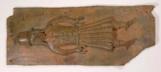
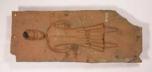
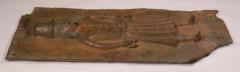
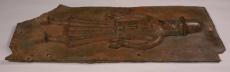
Relief Plaque
Categories
Palace Architecture & Ornamentation
Location
1 Adesogbe (Plymouth) Road, P.M.B. 1115, Benin City , Edo State
Loading...
Relief Plaque
Relief Plaque
Relief Plaque
Relief Plaque
Relief Plaque
Relief Plaque
Relief Plaque
Relief Plaque

Iconographies

4 annotations
Ẹrhu
Headwear

Many different kinds of Ẹrhu (headwear) are worn by the various figures depicted in the imagery of Benin royal artefacts. Through comparisons with ceremonial regalia still worn by chiefs and members of the royal court, including the Ọba himself, some Ẹrhu have been used to identify the different figures depicted. For example, the conical hat worn by high-ranking town chiefs as part of the pangolin regalia, still worn at ceremonies, is also visible on figures on some Ama-Ẹrọnmwọn (bronze relief plaques) ( ). Other examples include the distinctive bell-shaped helmet associated with the Iyasẹ ( ). Figures who wear a shallow-brimmed hat and a cross have been identified as Ewua or Ohensa priests ( ).

Different kinds of helmets and headwear were worn by warriors, reflecting the many different ranks and roles in the army at any given time, as well as developing trends that were in turn represented on Emwin Arhe created at different points in time. Warrior figures wearing helmets covered in cowrie shells were carved on the Aken'ni Elao (carved tusks) (Blackmun 1984, p. 330), yet on the brass Ama, warriors are sometimes depicted wearing helmets made from crocodile hide or horsehair with a front plate (Osadolor in Plankensteiner 2007, cat. no. 238, p. 457). Helmets made from horsehair with a front plate are one of the more common types represented on the Ama-Ẹrọnmwọn, and the demand for black horse tails was noted by both Portuguese and British traders during the late 17th and 18th centuries (Osadolor in Plankensteiner 2007, cat. no. 238, p. 457). Other warriors depicted on Ama-Ẹrọnmwọn wear helmets with a rounded top, chinstrap, and sometimes also a feather tucked into the left side. These types of headwear are known as Ẹrhu Iyokuo.

Attire worn for battle also differed from that worn for ceremonial occasions, such as the pointed headwear worn in combination with an ornate leopard-head tunic by war chiefs. Depictions of figures wearing this attire on brass Ama-Ẹrọnmwọn (bronze relief plaques) have been interpreted as representing the war chiefs’ participation in the war-ritual Isiokuo festival (Osadolor in Plankensteiner 2007, cat. no. 238, p. 457).

Another distinctive form of headwear is that worn by figures identified as leopard hunters on the brass Ama-Ẹrọnmwọn (relief plaques). These large helmets cover almost all of the leopard hunters’ faces except for their noses, eyes, and upper lips, and are made of an unusual material that remains unidentifiable (Plankensteiner 2007, cat. nos. 68–69, p. 322).

European figures are also portrayed with distinctive hats, such as Portuguese three-cornered hats. These depictions reflect the artists’ keen observation and highlight the impact of European trade and military assistance (Ezra 1992).

1 annotation
Ẹrhu
Water fern
Ebe Amẹ
Water Fern

Ebe Amẹ refers to a wide variety of plants, particularly the leaves of the water fern or river leaf, found in riverine areas of southern Nigeria ( ). Artists from the Igun-Ẹrọnmwọn used these as a decorative motif in the background of most Ama-Ẹrọnmwọn (bronze relief plaques). The petals of the Ebe Amẹ, like the points of the ἀghàdàgháda (crossroads), represent the four cardinal directions: north, east, south, and west. The number four plays a foundational role in the Edo calendar, which is structured around four market days ( ).

1 annotation
Ebe Amẹ
Ugianranran
Manilla

Ugianranran (manillas) are highly important objects in the visual language of the Emwin Arhe (royal treasures). Although Ugianranran were made in a variety of sizes, forms, and weights, they share the characteristics of being made from copper or copper alloys, namely brass or bronze, and having a curved, ring- or horseshoe-shaped form.

In the early years of trade between the Portuguese and Edo, during the late 15th and early 16th centuries, manillas were made primarily of copper. During the early 16th century, Edo traders increasingly sought manillas made of brass. This changing preference is believed to have corresponded with the growing demand for brass among artists of the Igun-Ẹrọnmwọn ( ). During the 17th and early 18th centuries, the Dutch also traded manillas with the Edo, although to a lesser extent than the Portuguese. Recent scientific analysis has shown similarities between the composition of metals in manillas from the southern Rhineland region of Germany and the copper alloys used in some Emwin Arhe, supporting earlier scholarship suggesting that manillas were used by casters to produce Emwin Arhe (Skowronek et al. 2023).

When depicted on objects, Ugianranran are often shown alongside or being held by figures identified as Portuguese. In one case, figures identified as Benin traders or royal emissaries are shown holding manillas in their hands ( ). This is particularly the case on the Ama-Ẹrọnmwọn (bronze relief plaques), which are believed to have been commissioned by Ọba Esigie. Esigie is understood to have encouraged the production of artworks, made possible in part by the increased supply of manillas and other copper-alloy objects resulting from trade ( ). Ugianranran are therefore associated with overseas trade, wealth, and Olokun, the deity of the seas ( ). In addition to being held by figures or appearing alongside them on artworks, Ugianranran sometimes serve as focal decorative motifs, further indicating their symbolic and economic potency.

1 annotation
Ugianranran
Ikpotoki
Portuguese Figure

Ikpotoki figures (Portuguese figures) are easily distinguished by their European-style clothing, including hats and helmets, as well as by their facial features, particularly their thin, straight noses and straight hair. The objects Ikpotoki figures are shown wearing or holding provide further indications of their relationship with the Benin Kingdom. When they hold or are positioned alongside Ugianran (manillas), for example, they indicate trade, commerce, and wealth, while weaponry such as firearms, swords, or spears indicates their role as mercenaries in the service of the Ọba. In 1515, Ọba Ẹsigie went to war against the Attah of Idah, the ruler of a neighbouring kingdom. Portuguese mercenaries and weapons assisted the Edo in winning the battle, enabling the further expansion of the Kingdom. Ẹsigie’s reign was particularly important for strengthening ties between the Benin Kingdom and the Portuguese Empire, and he is believed to have spoken fluent Portuguese. With Ẹsigie’s encouragement, Portuguese missionaries established churches in the Benin Kingdom ( ; ), while Portuguese trading factories were also established ( ). Ọba Ẹsigie allowed his son to be baptised and sent him to Portugal to be educated; following his return, he became Ọba Orhogbua ( ).

1 annotation
Ikpotoki

Provenance

4 events
Production
1504 (approximate) to 1550 (approximate)
The object was produced by Unknown member(s) of the Igun-Ẹrọnmwọn guild in Benin City.
Looted
February 22, 1897 (day approximate) to June 1899 (year approximate)
The object was looted by February 1897 Unknown member of the British colonial military campaign on Benin from Benin Kingdom.
Auction
August 18, 1897
The object was auctioned to the Ethnologisches Museum, Staatliche Museen zu Berlin through Hale & Son in London.
Restitution
August 25, 2022
The object was restituted by the Ethnologisches Museum, Staatliche Museen zu Berlin to the Omo n'Oba n'Edo Uku Akpolokpolo, Ọba of Benin & National Commission for Museums and Monuments, Nigeria through Hermann Parzinger and Abba Isa Tijani from Berlin to Nigeria.

Related archival documents

1 documents
See all
Date

Institution data

Ethnologisches Museum, Staatliche Museen zu Berlin
The data was transferred directly by the institution.
Last updated: 2021-06-14
Language: german
Institution fieldValue
ID
object id
210679
Sachbegriff
designation
Sachbegriff: Reliefplatte
Titel
designation
Titel: Portugiese mit Manillas
Objektref.
description
E 132/1898, Erwerbung: a.) I/49/1898 b.) I/55/1898 + c.) I/129/1898: a.) III C 7638-7670, Ethnogr. (Zähne, Bronzen etc.) (Benin), [Ankauf] Hale & Son + b.) III C 7761, Abguss eines Elephantenzahns (Benin), Original im Besitz von Dr. H. Meyer in Leipzig + c.) VIII 6094 a-c - 6099, Photogr. (BNenin), bei Hale&Son angefertigt, 1898, Hale & Son (1887); VIII A 10794, Positiv, SW, Reliefplatte, Bronze, Kurt Grunst (*04.04.1921); VIII A 12073, Positiv, SW, Rückseite der Bronzeplatte ""Europäer mit Geldringen"", Kurt Grunst (*04.04.1921)
Texte Online
description
Online Beschreibung, [Benin_Königreich]
Material / Technik
material
Material: Messing; Ausgabe: Messing
Material / Technik // Alle
material
Messing, Messing
Maße
dimensions
48,50 x 19,10 x 3,50 cm; 4,70 kg
Objekttyp
object type
Allgemein
Sachbegr. Ausgabe
object type
Reliefplatte (Relief plaque)
Anzahl Teile
object count
1
Datierung
date made
16. Jh.
Geogr. Bezüge
production place
Nigeria ( Land ); Benin ( Königreich )
Geogr. Bezüge // Alle
production place
Nigeria, Benin
Beteiligte
prior source
Hale & Son (1887), Veräußerer
Beteiligte // (Name, Sortierung=kleinste)
prior source
Hale & Son
Veräußerer
prior source
null
Erwerb. Notiz
provenance
Erwerbung von: Hale & Son; Notiz: Rückführung Wiesbaden; Ausgabe: 16. Jh., im Auftrag von Oba Esigie (reg. 1517-1550) oder seines Sohnes Oba Orhogbua (reg. 1550-1570), Königspalast, Benin-Stadt; durch Erbschaft an Oba Ovonramwen (ca. 1857-1914; reg. 1888-97), Königspalast, Benin-Stadt; geplündert im Zusammenhang mit der britischen Eroberung von Benin, 1897; versteigert von der Firma Hale & Son, 1897; ersteigert vom Königlichen Museum für Völkerkunde, 1897.
Verw. Institution
department and institution
Ethnologisches Museum, Staatliche Museen zu Berlin
Erwerb. Datum
accession date
1898
Besitzart
accession method
Eigentum
Erwerbungsart
accession method
Ankauf
Digital Assets
images
Vorlage; Vorlage; Vorlage; Vorlage; Vorlage; Vorlage; Vorlage; Vorlage; Vervielfältigung; Vorlage; Vervielfältigung; Vorlage; Vervielfältigung; Vorlage; III C 7656-A.jpg, Repro Digitalisat; III C 7656-B.JPG, Repro Digitalisat; III C 7656 -B.JPG, Repro Digitalisat; III C 7656 -C.JPG, Repro Digitalisat; III C 7656 -D.JPG, Repro Digitalisat; III C 7656 -E.JPG, Repro Digitalisat; III C 7656 -F.JPG, Repro Digitalisat; III C 7656 -G.JPG, Repro Digitalisat
Erwerb. Nr.
I/49/1898
Ident. Nr.
III C 7656
Ident. Nr. // (Sortiernr.)
0003 C 07656
Obj. Status
vorhanden
Sensitive Content

Digital Benin collates digital material from institutions, and some of this material is inherently colonial and contains words, terms and phrases that are inaccurate, derogatory and harmful towards African and African diasporic communities. Catalogue transcriptions, book titles, exhibition titles and museum titles may contain harmful terms. We recognise the potential for the material to cause physical and mental distress as well as evoke strong emotions. Owing to the scale of the collection’s data, a process to implement sensitive-content warnings in the displayed data is still incomplete. The material within the catalogue does not represent Digital Benin’s views. Digital Benin maintains a strong anti-colonial, anti-racist position and affirms its support for centring the humanity of historically marginalised and disenfranchised communities. Read more about the background of this statement here