Registration number
Af1934,1025.1
Institution
British Museum
English designations
Pendant Plaque
Categories
Ceremonial Regalia
Location
Great Russell St, Bloomsbury, London WC1B 3DG, United Kingdom
Loading...
Pendant Plaque
Pendant Plaque
Pendant Plaque

Iconographies

3 annotations
Iviawẹ
Stacked Beaded Anklet

Ọba gha ye Ivie gie ọwan, ẹ ghi tama rẹn ehe nọ gha bae yi (When the Ọba gifts you a bead, he doesn’t tell you how to wear it) (Daniel Inneh, pers. comm., 27 September 2025).

Iviawẹ (also spelled ĺvîowẹ) are coral-beaded anklets, often worn stacked together (Aigbe 1985, p. 28; Okpokunu, Agbontaen-Eghafona & Ojo 2005, p. 162; Ọbazee 2025, p. 279). Many of the figures depicted on the Emwin Arhe (royal treasures) in brass, bronze, ivory, and wood are shown wearing these. According to Daniel Inneh (pers. comm., 27 September 2025), beads were sent to people whom the Ọba wished to honour, although there was no directive on how to wear them.

Mostly, people who wear Iviawẹ are identified as palace chiefs or priests and priestesses. However, today anyone can wear them as cultural identifiers or fashion pieces.

1 annotation
Iviawẹ
Ẹkirẹ
Frog

Ẹkirẹ is the Edo term for frog ( ; Ọbazee 2025, p. 135). The Ẹkirẹ carries significant and often ambiguous symbolic importance, primarily linked to its liminal nature and association with spiritual and magical powers. As an amphibian that lives on the threshold between water and land, the Ẹkirẹ is seen as a messenger of Olokun. This connection reinforces the Ọba’s (king’s) ability to bridge the human and spiritual realms, a concept consistently present in Benin art.

While not as common as the mudfish, frogs appear on various Benin artworks, including Aken'ni Elao (carved tusks), pendant plaques, and Ẹrhẹ (royal stools). Their presence often relates to medicinal and occult practices. Frogs can be used in powerful curses, with a jumping frog signifying failure, and a frog, along with a coiled fish, used in rituals to release such curses. They are also associated with Osun, the deity of medicine, and scenes of snakes swallowing frogs can represent supernatural attacks or strong spiritual powers. For warriors, the Ẹkirẹ could even symbolise an aspect of their protective equipment and was used in palace rituals to encourage success in battle ( ).

1 annotation
Ẹkirẹ
Pot
Akhẹ
Clay pot

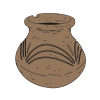
Akhẹ (clay pots) are made by the Imakhe (guild of potters). Pots were used for a variety of purposes, including everyday storage of water in simple, undecorated or minimally decorated vessels, while others served ritual purposes. Akhẹ Osun, for example, are often highly decorated with animal motifs such as lizards, frogs, and snakes, all of which are associated with the deity Osun. Rounded Akhẹ with open tops are depicted on both the Ama-Ẹrọnmwọn (bronze relief plaques) and pendant plaques. They are usually shown being carried either on the heads of figures or propped on their left shoulders.

1 annotation
Akhẹ

Provenance

5 events
Production
unknown to February 22, 1897 (day approximate)
The object was produced by Unknown member(s) of the Igun-Ẹrọnmwọn guild in Benin City.
Looted
February 22, 1897 (day approximate) to June 1899 (year approximate)
The object was looted by February 1897 Unknown member of the British colonial military campaign on Benin from Benin Kingdom.
Unknown
1933 (approximate) to October 25, 1934
The object is known to have come into contact with Edward Croft-Murray, later in London.
Donation
October 25, 1934
The object was donated by Edward Croft-Murray to the British Museum in London.
Exhibition
1970 to 1973
The object was exhibited at London.

Institution data

British Museum
The data was transferred directly by the institution.
Last updated: 2025-06-10
Language: english
Institution fieldValue
Registration number
object id
Af1934,1025.1
PRN
object id
EAF17369
Object Type
designation
waist-pendant
Description
description
Waist-pendant; lost-wax cast in brass. Single large suspension loop at back. Series of small suspension loops around outer edge. Depicts single female figure in high relief wearing curved, conical coral bead headdress, coral bead armlets, anklets and collar. Figure holds circular ?vessel at left proper shoulder. Flanked by frog in low relief on either side.
Ethnic name (made by)
ethnic attribution
Edo
Date
16thC - 19thC
Production place
production place
Made in: Benin City
Materials
material
brass
Technique
production technique
lost-wax cast
Dimensions
dimensions
Height: 12.80 cm~Width: 8.90 cm~Depth: 4.30 cm~Weight: 227.00 g
Curator’s comments
provenance
Female figure on waist-pendant probably represents an Iyoba (Queen Mother), mother of an Oba (king).
Exhibition history
exhibition history
Exhibited: 1970-1973, London, Museum of Mankind, Divine Kingship in Africa
Condition
condition
Good; small suspension loops bent and damaged in places.
Acquisition name (acquisition)
provenance
Edward Croft-Murray
Acquisition date
accession date
1934.0
Sensitive Content

Digital Benin collates digital material from institutions, and some of this material is inherently colonial and contains words, terms and phrases that are inaccurate, derogatory and harmful towards African and African diasporic communities. Catalogue transcriptions, book titles, exhibition titles and museum titles may contain harmful terms. We recognise the potential for the material to cause physical and mental distress as well as evoke strong emotions. Owing to the scale of the collection’s data, a process to implement sensitive-content warnings in the displayed data is still incomplete. The material within the catalogue does not represent Digital Benin’s views. Digital Benin maintains a strong anti-colonial, anti-racist position and affirms its support for centring the humanity of historically marginalised and disenfranchised communities. Read more about the background of this statement here