
Registration number
Af1898,0115.12
Institution
British Museum
Edo designations
English designations
Relief Plaque
Categories
Palace Architecture & Ornamentation
Location
Great Russell St, Bloomsbury, London WC1B 3DG, United Kingdom
Loading...
Relief Plaque
Relief Plaque
Relief Plaque
Relief Plaque
Relief Plaque
Relief Plaque

Iconographies

5 annotations
Ebo
European Figures

During the late 15th century, European visitors began arriving in Benin City and subsequently played important roles in trade, the military, religion, and belief. Edo artists incorporated a range of figures understood to represent Europeans into the visual language of Emwin Arre (royal treasures). These depictions served in part to communicate the power and reach of the Benin monarchy, making the “greatness of ruler and realm more palpable” and demonstrating that the Ọba’s authority extended beyond his own people to those who came from distant lands ( ).

European visitors came from a number of countries, including the Netherlands, Britain, France, and Italy. Portuguese visitors, however, had the most extensive and enduring influence, which is particularly evident in the visual language of Benin royal arts ( ).

European figures were incorporated into Ama-Ẹrọnmwọn (bronze relief plaques), dating primarily to the 16th and 17th centuries, and Aken'ni Elao (carved tusks), dating from the 17th to the 19th centuries. They are typically depicted with straight, shoulder-length hair and/or beards, rounded cap-like headwear, heavily pleated skirts, and jerkins ( ). These figures often appear alongside other motifs associated with European trade and contact, such as Ugianranran (manillas) and horses, or with warfare, such as firearms. In addition to full-length figures, the Uhunmwu Ikpotoki (Portuguese head) was incorporated into a wide range of objects, most likely as a symbol of power and wealth associated with overseas trade and, by extension, with Olokun, the deity of the sea.

European figures also became part of the visual language developed by the Emada, palace pages whose carving tradition differed from that of the royal guild of wood and ivory carvers, the Igbesamwan. Although the precise origins of the Emada carving tradition are uncertain, it is thought to have developed during the reign of Ọba Adolo, and many surviving examples are therefore dated to the 19th century. Their representations of Europeans differ from the conventions used in earlier depictions understood to represent Portuguese visitors. Rather than wearing pleated skirts and jerkins, these later figures are typically shown in suits, wide-brimmed hats, and smoking pipes, and may carry straighter, sabre-like swords, guns, or umbrellas.

1 annotation
Ebo
Osisi
Gun

Osisi is the general Edo word for guns. Osisi were initially introduced to the Benin Kingdom by the Portuguese from the late 16th century onwards and were again traded by the Dutch from the early 17th century (Osadolor 2007, p. 80). Osisi are usually represented as being carried by, or positioned close to, figures identified as Portuguese based on their attire and hairstyles. There are a small number of exceptions, including two wooden carved examples. One is a possible chair seat where a figure is holding a gun upright, and another is a carved wooden panel where a gun is shown next to an Edo dignitary. Additionally, a more recent work produced by the artist H. I. Erhabor includes an Edo figure holding a gun.

These weapons quickly became a potent symbol in the work of artists from the royal guilds, representing the Ọba’s military might, expansionist policies, and the wealth derived from foreign trade (Plankensteiner 2007, p. 208). Three different kinds of European-manufactured guns were used by the Edo army: the flintlock, the wheellock, and later the matchlock, which was used from the 1600s until around 1850. However, Ọba Akengbuda became increasingly wary of Edo dependence on European firearms and encouraged the production of firearms by the Igun Ematon. During the 19th century, the trade in firearms from Europe resumed, with Dane guns, so named because they were made in Denmark. However, from 1890, European imperial powers banned the trade in firearms to West Africa (Osadolor 2007, pp. 80–81).

1 annotation
Osisi
Water fern
Ebe Amẹ
Water Fern

Ebe Amẹ refers to a wide variety of plants, particularly the leaves of the water fern or river leaf, found in riverine areas of southern Nigeria ( ). Artists from the Igun-Ẹrọnmwọn used these as a decorative motif in the background of most Ama-Ẹrọnmwọn (bronze relief plaques). The petals of the Ebe Amẹ, like the points of the ἀghàdàgháda (crossroads), represent the four cardinal directions: north, east, south, and west. The number four plays a foundational role in the Edo calendar, which is structured around four market days ( ).

1 annotation
Ebe Amẹ
Owẹn iba ẹdẹ ku
Rosette - 'The Sun Never Misses a Day'

This rosette design, usually found in the corners of Ama-Ẹrọnmwọn (bronze relief plaques), is one of two motifs representing the sun and one of a number of motifs in Edo art that are also connected with Olokun. The association between the sun and Olokun refers to the way in which the sun descends into the sea each day—hence the proverb ‘the sun never misses a day’—and the sea is where the deity Olokun lives ( ).

1 annotation
Owẹn iba ẹdẹ ku
Ẹrhu
Headwear

Many different kinds of Ẹrhu (headwear) are worn by the various figures depicted in the imagery of Benin royal artefacts. Through comparisons with ceremonial regalia still worn by chiefs and members of the royal court, including the Ọba himself, some Ẹrhu have been used to identify the different figures depicted. For example, the conical hat worn by high-ranking town chiefs as part of the pangolin regalia, still worn at ceremonies, is also visible on figures on some Ama-Ẹrọnmwọn (bronze relief plaques) ( ). Other examples include the distinctive bell-shaped helmet associated with the Iyasẹ ( ). Figures who wear a shallow-brimmed hat and a cross have been identified as Ewua or Ohensa priests ( ).

Different kinds of helmets and headwear were worn by warriors, reflecting the many different ranks and roles in the army at any given time, as well as developing trends that were in turn represented on Emwin Arhe created at different points in time. Warrior figures wearing helmets covered in cowrie shells were carved on the Aken'ni Elao (carved tusks) (Blackmun 1984, p. 330), yet on the brass Ama, warriors are sometimes depicted wearing helmets made from crocodile hide or horsehair with a front plate (Osadolor in Plankensteiner 2007, cat. no. 238, p. 457). Helmets made from horsehair with a front plate are one of the more common types represented on the Ama-Ẹrọnmwọn, and the demand for black horse tails was noted by both Portuguese and British traders during the late 17th and 18th centuries (Osadolor in Plankensteiner 2007, cat. no. 238, p. 457). Other warriors depicted on Ama-Ẹrọnmwọn wear helmets with a rounded top, chinstrap, and sometimes also a feather tucked into the left side. These types of headwear are known as Ẹrhu Iyokuo.

Attire worn for battle also differed from that worn for ceremonial occasions, such as the pointed headwear worn in combination with an ornate leopard-head tunic by war chiefs. Depictions of figures wearing this attire on brass Ama-Ẹrọnmwọn (bronze relief plaques) have been interpreted as representing the war chiefs’ participation in the war-ritual Isiokuo festival (Osadolor in Plankensteiner 2007, cat. no. 238, p. 457).

Another distinctive form of headwear is that worn by figures identified as leopard hunters on the brass Ama-Ẹrọnmwọn (relief plaques). These large helmets cover almost all of the leopard hunters’ faces except for their noses, eyes, and upper lips, and are made of an unusual material that remains unidentifiable (Plankensteiner 2007, cat. nos. 68–69, p. 322).

European figures are also portrayed with distinctive hats, such as Portuguese three-cornered hats. These depictions reflect the artists’ keen observation and highlight the impact of European trade and military assistance (Ezra 1992).

1 annotation
Ẹrhu

Provenance

9 events
Production
1504 (approximate) to 1550 (approximate)
The object was produced by Unknown member(s) of the Igun-Ẹrọnmwọn guild in Benin City.
Looted
February 22, 1897 (day approximate) to June 1899 (year approximate)
The object was looted by Ralph Denham Rayment Moor from Benin Kingdom.
Transfer
March 19, 1897 (day approximate)
The object was transferred from Ralph Denham Rayment Moor to British Foreign Office from Benin City to London.
Loan
September 7, 1897 to January 1898 (month approximate)
The object was loaned by British Foreign Office to the British Museum through Crown Agents for the Colonies in London.
Donation
January 15, 1898
The object was donated by British Foreign Office to the British Museum in London.
Exhibition
1970 to 1973
The object was exhibited at London.
Exhibition
October 2003
The object was exhibited at Setagaya.
Exhibition
October 18, 2003 to January 31, 2006
The object was exhibited at Tokyo, later moved to Daegu.
Exhibition
April 23, 2014 to September 9, 2019
The object was exhibited at Abu Dhabi, later moved to Hong Kong.

Related archival documents

1 documents
See all
Date

Institution data

British Museum
The data was transferred directly by the institution.
Last updated: 2025-06-10
Language: english
Institution fieldValue
Registration number
object id
Af1898,0115.12
Additional IDs
object id
109 (Foreign Office number)
PRN
object id
EAF26478
Object Type
designation
plaque
Description
description
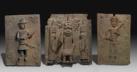
Relief plaque, lost-wax cast in brass. Wide plaque, rectangular in form with side flanges. Background surface decorated with river leaf patterns and stippling. Rosettes in relief in each corner. Two nail holes at top of plaque, two holes at bottom. Depicts standing European (Portuguese) figure in semi-sideways pose holding gun across body in right and left hands; crossguard sword in scabbard on left hip attached to belt. Figure wears domed and brimmed helmet with boss at top. Dressed in sleeveless buttoned doublet with neck ruff and decorative element on chect, with long-sleeved tunic below. Short pleated patterned 'skirt' and plain knee-length breeches.
Ethnic name (made by)
ethnic attribution
Edo
Date
16thC-17thC
Production place
production place
Made in: Benin City
Findspot
place collected
Found/Acquired: Benin City
Materials
material
brass
Technique
production technique
lost-wax cast
Dimensions
dimensions
Height: 47.00 cm~Width: 31.00 cm~Depth: 9.00 cm~Weight: 15.72 kg
Curator’s comments
provenance
The relief brass plaques that used to decorate the Oba's (king's) palace are among the most well-known of all the royal arts of Benin. Although frequently described as 'Benin Bronzes' most plaques are made of leaded brass in various compositions. It is widely accepted that they date to the 16th-17th centuries. In the years prior to the British royal influence in Benin was increasingly under threat from rival powers, both internal and external, with a focus on economic power and control of the important trading monopolies. However, the court and palace remained the political and spiritual centre of the Benin Kingdom. Earlier accounts written by Europeans visiting the city describe its size and scale. The palace complex was set up around atrium courtyards; some had galleries with wooden pillars supporting the roof. Brass plaques, probably made in matching pairs, were fixed to these pillars. The Benin brass plaques represent a distinct and unique corpus of work, unparalleled elsewhere on the continent. They are cast using the cire perdue (lost wax) technique and show significant variation in the depth of the relief. Some of the plaques portray historical events or commemorate successful wars, while others are a vivid depiction of Benin court life and ritual. Several groups of plaques show clear stylistic similarities. William B. Fagg suggested that these plaques represent the work of master brass casters. Fagg, William, 1973, 'Nigerian Images', London: Lund Humphries Gunsch, Kathryn, 2018, 'Benin plaques: a 16th century imperial monument', London: Routledge, Taylor and Francis Group ; Read & Dalton 1899: "Figure of a European armed with matchlock and sword. He wears a hat with a low plume, a sleeveless jerkin over a vest, with points upon the breast, and base like that in Af1898,0115.5. The short breeches are not so clearly represented. Round the neck is a high ruff. The sword has a guard differing from any of those previously figured. At each corner is a rosette in relief, as in Af1898,0115.5."
Bibliographic references
bibliography
Gunsch 2018: ~Read & Dalton 1899: pl XIII.6
Exhibition history
exhibition history
Exhibited: 1970-1973, London, Museum of Mankind, Divine Kingship in Africa 2003 Oct, Japan, Setagaya Art Museum, Art and Memory 2003 18 Oct-14 Dec, Tokyo Metropolitan Art Museum, Treasures of the World's Cultures 2004 17 Jan-28 Mar, Kobe City Museum, Treasures of the World's Cultures 2004 10 Apr-13 Jun, Fukuoka Art Museum, Treasures of the World's Cultures 2004 26 Jun-29 Aug, Niigata Bandaijima Art Museum, Treasures of the World's Cultures 2005 11 Apr-10 Jul, Seoul Arts Centre, Treasures of the World's Cultures 2005 25 Jul-8 Oct, Busan Museum, Treasures of the World's Cultures 2005 27 Oct-2006 31 Jan, Haengso Museum, Keimyung University, Daegu, Treasures of the World's Cultures 2006 18 Mar-4 Jun, Beijing, Capital Museum, Treasures of the World's Cultures 2019 15 May-9 Sep, Hong Kong Heritage Museum, 'A History of the World in 100 Objects' 2007 3 Feb-27 May, Taipei, National Palace Museum, Treasures of the World's Cultures 2007 14 Sep-2 Dec, Hong Kong Museum of Art, Treasures of the World's Cultures 2009 1 May-20 Sep, Victoria, Royal BC Museum, Treasures of the World's Cultures 2009 11 Dec-2010 10 May, Madrid, Canal de Isabel II, Treasures of the World’s Cultures 2012 April-July, Manarat Al Saadayat,Abu Dhabi, Treasures of the World's Cultures 2014 23 Apr-01 Aug, Manarat Al Saadiyat, Abu Dhabi, 'A History of the World in 100 Objects' 2014-2015 13 Dec-15 Mar, National Palace Museum, Taipei, 'A History of the World in 100 Objects' 2015 18 Apr–28 Jun, Tokyo Metropolitan Art Museum, Tokyo, 'A History of the World in 100 Objects' 2015 14 Jul–6 Sep, Kyushu National Museum, Dazaifu, 'A History of the World in 100 Objects' 2015-2016 20 Sep-11 Jan, Kobe City Museum, Kobe, 'A History of the World in 100 Objects' 2016 13 Feb-18 Jun, National Museum of Western Australia, Perth, 'A History of the World in 100 Objects' 2016-2017 08 Sep-29 Jan, National Museum of Australia, Canberra, 'A History of the World in 100 Objects' 2017 1 Mar-31 May, National Museum of China, Beijing, 'A History of the World in 100 Objects' 2017 28 Jun-08 Oct, Shanghai Museum, Shanghai, 'A History of the World in 100 Objects' 2018 19 Apr-22 Jul, Musée des Beaux-Arts, Valenciennes, 'A History of the World in 100 Objects' 2019 15 May-9 Sept, Hong Kong Heritage Museum, 'A History of the World in 100 Objects'
Condition
condition
Good; slight surface gouge to left of figure's face. Small section missing from bottom edge at right side with small hole above.
Subjects
iconography
european ~palace/mansion ~arms/armour
Associated events
event
Associated Event: British to Benin City - Feb 1897
Acquisition name (acquisition)
provenance
Secretary of State for Foreign Affairs
Acquisition date
accession date
1898
Acquisition notes (excavation)
provenance
This plaque was looted during the British to Benin City in 1897.
Sensitive Content

Digital Benin collates digital material from institutions, and some of this material is inherently colonial and contains words, terms and phrases that are inaccurate, derogatory and harmful towards African and African diasporic communities. Catalogue transcriptions, book titles, exhibition titles and museum titles may contain harmful terms. We recognise the potential for the material to cause physical and mental distress as well as evoke strong emotions. Owing to the scale of the collection’s data, a process to implement sensitive-content warnings in the displayed data is still incomplete. The material within the catalogue does not represent Digital Benin’s views. Digital Benin maintains a strong anti-colonial, anti-racist position and affirms its support for centring the humanity of historically marginalised and disenfranchised communities. Read more about the background of this statement here