ObjectNumber_Original
VO_98161
Institution
Weltmuseum Wien
English designations
Pendant Plaque
Categories
Ceremonial Regalia
Location
Heldenplatz, 1010 Wien, Austria
Loading...
Pendant Plaque
Pendant Plaque
Pendant Plaque

Iconographies

12 annotations
Oro
Headdress/crown with single projection

Figures wearing a headdress with a single protrusion from the crown of the head, known as the Oro, are found only among the Ọba and a select category of palace dignitaries whose ancestors originated in ancient Ile Ife ( ; Ọbazee 2025, p. 407). Only the Osa and Osuan, custodians of the Uwen and Ora deities, as well as members of the Emuru, who are responsible for the care of Iru vessels, may wear a headdress with the Oro. The identification of different figures is therefore interpreted based on the combination of the Oro with other items of regalia. Artists in the Igun-Ẹrọnmwọn and Igbesamwan depicted figures with the Oro on Ama-Ẹrọnmwọn (bronze relief plaques) and Aken'ni Elao (carved tusks), respectively. The Oro would either be made of coral beads as part of the crown or headdress, or be woven from itoto fibre ( ).

3 annotations
Oro
Oro
Oro
Colar Bead
Odigba
Coral beaded collar

Odigba (coral-beaded collar) is a rigid neck collar made of coral beads, worn as part of ceremonial attire only by senior princes who have been made Enigie (Inneh 2007, p. 107). Although Ibafe (2007, p. 43) argued that the Odigba was introduced during the Ogiso period (c. 900–c. 1170 AD) by Ogiso Ere, along with other symbolically important Emwin Arhe, such as the Ada (ceremonial sword) and the Ẹbẹn (ceremonial sword), this seems unlikely, as coral was only introduced in the late 15th century through trade with Portuguese merchants.

3 annotations
Odigba
Odigba
Odigba
Ẹkirẹ
Frog

Ẹkirẹ is the Edo term for frog ( ; Ọbazee 2025, p. 135). The Ẹkirẹ carries significant and often ambiguous symbolic importance, primarily linked to its liminal nature and association with spiritual and magical powers. As an amphibian that lives on the threshold between water and land, the Ẹkirẹ is seen as a messenger of Olokun. This connection reinforces the Ọba’s (king’s) ability to bridge the human and spiritual realms, a concept consistently present in Benin art.

While not as common as the mudfish, frogs appear on various Benin artworks, including Aken'ni Elao (carved tusks), pendant plaques, and Ẹrhẹ (royal stools). Their presence often relates to medicinal and occult practices. Frogs can be used in powerful curses, with a jumping frog signifying failure, and a frog, along with a coiled fish, used in rituals to release such curses. They are also associated with Osun, the deity of medicine, and scenes of snakes swallowing frogs can represent supernatural attacks or strong spiritual powers. For warriors, the Ẹkirẹ could even symbolise an aspect of their protective equipment and was used in palace rituals to encourage success in battle ( ).

2 annotations
Ẹkirẹ
Ẹkirẹ
Ewi
Mudfish

Depictions of Ewi (mudfish) are among the most frequent motifs in the Emwin Arhe (royal treasures). Mudfish hold an important place in Edo belief, both as representations of the god Olokun and as symbols of royalty (Plankensteiner 2007, p. 410), as well as of “prosperity, peace, well-being and fertility” (Ben-Amos 1976, p. 245). Mudfish are also particularly common animals for sacrifice, and mudfish-shaped Orhiẹvbẹ (kola-nut boxes) were used to make offerings or store kola nuts.

Yet, the appearance of Ewi across the Emwin Arhe is not consistent, and it has been argued that different species of mudfish were depicted by Edo artists, each with different qualities and capabilities. For example, the electric shock of Malapterurus electricus resembles the fierceness of the Ọba, while the liminal qualities of the Synodontis clarias mudfish, which lives both on land and in water, similarly reflect the Ọba’s rule over land and sea (Gallagher 1983, p. 93). With these different qualities in mind, the mudfish is an important symbol of Benin kingship and royalty.

Sometimes the Ọba was depicted by artists with mudfish rather than legs (see Ọba with Mudfish Legs).

1 annotation
Ewi
Ukpan obọ eva
Crossed Beaded Baldrics

The Ukpan obọ eva (coral-bead crossed baldrics) were worn as part of the ehaingbehia, the full ceremonial regalia, by only high-ranking members of the palace, including the Ọba himself, the Iy’Ọba, the Edaiken, and the Ezọmọ (Ben-Amos 1999, pp. 68, 141; Osadolor in Plankensteiner 2007, cat. no. 70, pp. 322–323).

1 annotation
Ukpan obọ eva
TBC_Royal Triad
Royal Triad

The Royal Triad is a motif composed of three figures, with a central figure supported on either side by two others. The motif has multiple meanings and interpretations. When understood on the human level, the central seated or standing figure is identified as the Ọba, flanked by two Enobare who each support one of his arms. This pose “encapsulates Edo ideals of kingship,” in which “even the most powerful of Benin's divinely ordained rulers cannot stand alone. He must maintain a careful balance between his authority over the Edo people and their acquiescence in his leadership” ( ). The identities of the supporting Enobare are interpreted variously. They have been identified as the Osa and Osuan, who support the Ọba in this manner during the Ugie Oro and Ododua festivals, although it is possible that the Edaiken (crown prince) and Ezọmọ performed these roles during the 18th century ( ).

In some examples, the central figure has mudfish in place of legs. These figures have sometimes been interpreted as representations of the deity Olokun ( ). Barbara Blackmun (1984, pp. 274–275) alternatively suggested that the triad may represent the high god Osanobua, his son and deity Olokun, and Olokun’s child, Ohen, who in turn represents the Ọba.

The number three is considered an “uncanny” number in Edo thought and “is never used lightly” ( ), being associated with the “threat of occult sanctions or forces” ( ).

The Royal Triad appears on almost all Aken'ni Elao (carved tusks), as well as on some Ẹgogo (gongs) and pendant plaques, and less frequently on Ama-Ẹrọnmwọn (bronze relief plaques). The motif is also referred to as the “supporting triad motif” or “linked supporting triad motif” ( ).

1 annotation
TBC_Royal Triad
Ivie okpagbaru/Ivie Ewuare
Royal/Ewuare Bead

This oval-shaped bead with faceted sides is known as the Ivie okpagbaru or Ivie Ewuare (the ‘royal bead’ or ‘Ewuare bead’). The association of Ọba Ewuare with this bead is based on a story in which Ewuare took beads from the deity Olokun, sanctifying his royal position and, in turn, receiving the title ‘Lord of the Land’, in contrast to Olokun’s title ‘Lord of the Sea’ (Omomo of Enisen in Blackmun 1990, p. 65). The Ivie okpagbaru/Ivie Ewuare is a distinctive motif that can be used to identify representations of the Ọba.

Due to the association of beads with Olokun, it is unsurprising that this bead has come to symbolise wealth when used to decorate Emwin Arhe (royal treasures) (Blackmun 1984, p. 59). Paula Ben-Amos (1999, p. 64) associated the bead with a different narrative and the name ‘One Bead Does Not Go around the Neck’. Ben-Amos suggests that the bead is in fact the one that was fought over by Ọba Ẹsigie and his brother Aruanran when they struggled for the right to the throne in the early 16th century.

1 annotation
Ivie okpagbaru/Ivie Ewuare

Provenance

4 events
Production
unknown to February 22, 1897 (day approximate)
The object was produced by Unknown member(s) of the Igun-Ẹrọnmwọn guild in Benin City.
Looted
February 22, 1897 (day approximate) to June 1899 (year approximate)
The object was looted by Unknown member of the British colonial military campaign on Benin - February 1897 from Benin Kingdom.
Unknown
1906
The object is known to have come into contact with Hans Meyer, later in Leipzig.
Unknown
1918
The object is known to have come into contact with Hans Meyer and the Weltmuseum Wien, in Leipzig and later Vienna.

Related archival documents

1 documents
See all
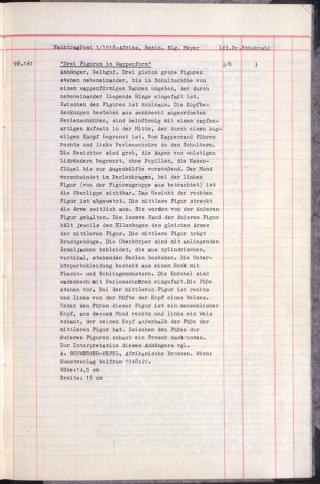
An archival document representing a Inventories of 1 page(s)
InventoryAccession Record
Weltmuseum Wien
Inventory book - objects
Date
January 1, 1918

Institution data

Weltmuseum Wien
The data was transferred directly by the institution.
Last updated: 2022-05-24
Languages: german, english
Institution fieldValue
ObjectNumber_Original
object id
VO_98161
NativeTitle
edo designation
TextEntry
description
Dieser Anhänger mit königreicherTriade ist Teil der historischen Sammlungen aus dem Königreich Benin im heutigen Nigeria. 1897 wurde das Königreich erobert und dessen Oba (König) Ovonramwen ins Exil verbannt. Die aus dem Königspalast geraubten Kunstschätz
Medium
material
Gelbguss
Medium_en
material
Brass
ObjectName
object type
Anhänger mit Königreicher Triade
ObjectName_en
object type
Pendant with Royal Triad
DateBegin
date made
1700
DateEnd
date made
1800
Dated
date made
18. Jahrhundert
Dated_en
date made
18th century
Period
date made
Term
production place
Afrika südlich der Sahara
Term2
production place
West-Afrika
Term3
production place
Nigeria
Term4
production place
Benin
Thesaurus
production place
Afrika südlich der Sahara/West-Afrika/Nigeria/Benin
Provenance
provenance
Dr. Hans Meyer (1858-1929), Leipzig
Role_person
provenance
Sammlung-Collection-Hans Meyer|
Culture
ethnic attribution
Edo, Benin Königreich
Culture_en
ethnic attribution
Edo, Benin Kingdom
CreditLine
department and institution
Weltmuseum Wien
Department
department and institution
MVK Objekte - Afrika südlich der Sahara
Zugangsdatum
accession date
1918
LocationString
display status
Raum Me.40
FileName
images
VO_98161_2.jpg|
PrimaryImage
images
VO_98161_2.jpg
Classification
||
DepartmentID
35
Department_cut
Afrika südlich der Sahara
DisplayOrder
|
Last_Modified
2021-12-06 08:15:34
LocationID
75091
ObjectID
428246
ObjectNumber
98161
PublicAccess
1
SortNumber
VO 98161
TextDate_en
|
TextEntryHTML
Dieser Anhänger mit königreicherTriade ist Teil der historischen Sammlungen aus dem Königreich Benin im heutigen Nigeria. 1897 wurde das Königreich erobert und dessen Oba (König) Ovonramwen ins Exil verbannt. Die aus dem Königspalast geraubten Kunstschätz
TextEntryHTML_en
This Pendant with Royal Triad is part of the historical collections from the Benin Kingdom, in present-day Nigeria. In 1897, the kingdom was conquered and Oba (king) Ovonramwen banned into exile. The loot from the royal palace was then sold through the ar
TextEntry_en
This Pendant with Royal Triad is part of the historical collections from the Benin Kingdom, in present-day Nigeria. In 1897, the kingdom was conquered and Oba (king) Ovonramwen banned into exile. The loot from the royal palace was then sold through the ar
cxrDisplayOrder
1|
Sensitive Content

Digital Benin collates digital material from institutions, and some of this material is inherently colonial and contains words, terms and phrases that are inaccurate, derogatory and harmful towards African and African diasporic communities. Catalogue transcriptions, book titles, exhibition titles and museum titles may contain harmful terms. We recognise the potential for the material to cause physical and mental distress as well as evoke strong emotions. Owing to the scale of the collection’s data, a process to implement sensitive-content warnings in the displayed data is still incomplete. The material within the catalogue does not represent Digital Benin’s views. Digital Benin maintains a strong anti-colonial, anti-racist position and affirms its support for centring the humanity of historically marginalised and disenfranchised communities. Read more about the background of this statement here