


OBJEKTE_ID
1797382
Edo designations
English designations
Relief Plaque
Categories
Palace Architecture & Ornamentation
Location
Johannispl. 5-11, 04103 Leipzig, Germany
Loading...

Iconographies

14 annotations
leopard teeth
Akọn Ẹkpen
Leopard Teeth Neck Ornament

Akọn Ẹkpẹn are necklaces or neck ornaments made of strung leopard’s teeth. They are worn by figures to signify their high rank and military prowess, as well as by their leaders, the Ezọmọ or Iyasẹ. They are often worn alongside quadrangular Ẹroro (bells) and Ohian Ẹkpẹn (leopard tunics).

The Akọn Ẹkpẹn is clearly and profoundly related to the symbolism of the Ẹkpẹn (leopard) and its association with the Ọba (king), who is metaphorically referred to as ‘ẹkpẹn ne owa’, the ‘leopard of the home’. On the other hand, the Ẹkpẹn is often referred to as the ‘king of the bush’, embodying ferocity, aggression, strength, and leadership—qualities attributed to the Ọba (Nevadomsky 1988). This intricate link between the leopard, the monarch, and his military leaders reinforces the complex hierarchy and spiritual authority central to Benin’s courtly art.

1 annotation
Akọn Ẹkpen
Colar Bead
Odigba
Coral beaded collar

Odigba (coral-beaded collar) is a rigid neck collar made of coral beads, worn as part of ceremonial attire only by senior princes who have been made Enigie (Inneh 2007, p. 107). Although Ibafe (2007, p. 43) argued that the Odigba was introduced during the Ogiso period (c. 900–c. 1170 AD) by Ogiso Ere, along with other symbolically important Emwin Arhe, such as the Ada (ceremonial sword) and the Ẹbẹn (ceremonial sword), this seems unlikely, as coral was only introduced in the late 15th century through trade with Portuguese merchants.

1 annotation
Odigba
hairstyles
Eto
hairstyles

Hairstyles are used to determine a person's status in the society, as chiefs, common folks, chief's wives and the wives of the Ọba all wear different hairstyles. We have Okuku, Ikpe~okhokho, Idu~akpata

2 annotations
Eto
Eto
Igan
Feather

Igan (feathers) are commonly depicted tucked into the headdresses and hats of chiefs represented on Emwin Arre (royal treasures). These feathers are from the Oɛɣohɔ (vulturine fish eagle) and symbolise respected old age and proper chieftaincy ( ).

1 annotation
Igan
Water fern
Ebe Amẹ
Water Fern

Ebe Amẹ refers to a wide variety of plants, particularly the leaves of the water fern or river leaf, found in riverine areas of southern Nigeria ( ). Artists from the Igun-Ẹrọnmwọn used these as a decorative motif in the background of most Ama-Ẹrọnmwọn (bronze relief plaques). The petals of the Ebe Amẹ, like the points of the ἀghàdàgháda (crossroads), represent the four cardinal directions: north, east, south, and west. The number four plays a foundational role in the Edo calendar, which is structured around four market days ( ).

1 annotation
Ebe Amẹ
tribal marks
Iwu
Facial and Body Markings

Iwu are facial and body markings (scarifications) that were historically worn by Edo men and women. However, since the 1960s, the practice has been nearly extinct (Aisien 2011). In the past, Iwu were used as a way of proving that one was an Edo citizen, and the ceremony of having Iwu completed was an important rite of passage for men and women. The Osiwu, who also practised circumcision and other surgical procedures, would carry out the procedure of adding Iwu. There are different types of Iwu: ‘blades’ worn on the torso (Iwu-eko), and those worn on the face, such as Ikharo (three or four markings above the eyebrows), Irho (two narrow ‘blades’ worn on each cheek), Ovbihue (nasal ‘blades’), Ovbi-agbanmwen (chin ‘blade’), and Igho-okpa/Ukpgho (three forehead ‘blades’) (Aisien 2011, p. 22).

The number of Iwu also varied depending on the identity of the person wearing them. For example, royal men would wear six ‘blades’ on their torso, whilst men who were not royal would wear seven ‘blades’. Meanwhile, the Ọba’s female children would wear fifteen ‘blades’, and all other women would wear sixteen (Aisien 2011).

2 annotations
Iwu
Iwu
Ẹroro
Bell

Ẹroro (bells) frequently appear as ornaments worn by figures depicted on the Emwin Arhe, particularly on Ama-Eronmwon (bronze relief plaques) and Aken’ni Elao (carved tusks). These Ẹroro are most commonly quadrangular in form or, less commonly, cylindrical with rounded tops. Quadrangular Ẹroro worn around the neck are often part of the attire that indicates that figures can be interpreted as warriors, alongside the Akọn Ẹkpẹn (leopard tooth neck ornament) and the Ohian Ẹkpẹn (leopard tunics).

1 annotation
Ẹroro
Uhunmwu-Ẹkuẹ
Pendant Mask

Uhunmwu-Ẹkuẹ (pendant masks) formed part of the ceremonial regalia worn by court dignitaries to indicate their rank or function and are frequently represented among the Emwin Arhe (royal treasures), particularly those made of brass, bronze, or ivory.

Different animals were depicted on Uhunmwu-Ẹkuẹ, particularly the heads of leopards and crocodiles. The most common type features the face or head of an Ọba. Other examples take the form of an elephant head incorporating the trunk-hand motif, a ram’s head, or, in a very small number of cases, the face of a Portuguese man. Different figures appear to have worn Uhunmwu-Ẹkuẹ with different imagery. For example, warrior chiefs are often depicted wearing leopard-head pendant masks, whereas crocodile-head Uhunmwu-Ẹkuẹ are generally shown being worn only by the Ọba and his Enọbare (Blackmun 2007, cat. no. 137, p. 365).

1 annotation
Uhunmwu-Ẹkuẹ
Ẹrhu
Headwear

Many different kinds of Ẹrhu (headwear) are worn by the various figures depicted in the imagery of Benin royal artefacts. Through comparisons with ceremonial regalia still worn by chiefs and members of the royal court, including the Ọba himself, some Ẹrhu have been used to identify the different figures depicted. For example, the conical hat worn by high-ranking town chiefs as part of the pangolin regalia, still worn at ceremonies, is also visible on figures on some Ama-Ẹrọnmwọn (bronze relief plaques) ( ). Other examples include the distinctive bell-shaped helmet associated with the Iyasẹ ( ). Figures who wear a shallow-brimmed hat and a cross have been identified as Ewua or Ohensa priests ( ).

Different kinds of helmets and headwear were worn by warriors, reflecting the many different ranks and roles in the army at any given time, as well as developing trends that were in turn represented on Emwin Arhe created at different points in time. Warrior figures wearing helmets covered in cowrie shells were carved on the Aken'ni Elao (carved tusks) (Blackmun 1984, p. 330), yet on the brass Ama, warriors are sometimes depicted wearing helmets made from crocodile hide or horsehair with a front plate (Osadolor in Plankensteiner 2007, cat. no. 238, p. 457). Helmets made from horsehair with a front plate are one of the more common types represented on the Ama-Ẹrọnmwọn, and the demand for black horse tails was noted by both Portuguese and British traders during the late 17th and 18th centuries (Osadolor in Plankensteiner 2007, cat. no. 238, p. 457). Other warriors depicted on Ama-Ẹrọnmwọn wear helmets with a rounded top, chinstrap, and sometimes also a feather tucked into the left side. These types of headwear are known as Ẹrhu Iyokuo.

Attire worn for battle also differed from that worn for ceremonial occasions, such as the pointed headwear worn in combination with an ornate leopard-head tunic by war chiefs. Depictions of figures wearing this attire on brass Ama-Ẹrọnmwọn (bronze relief plaques) have been interpreted as representing the war chiefs’ participation in the war-ritual Isiokuo festival (Osadolor in Plankensteiner 2007, cat. no. 238, p. 457).

Another distinctive form of headwear is that worn by figures identified as leopard hunters on the brass Ama-Ẹrọnmwọn (relief plaques). These large helmets cover almost all of the leopard hunters’ faces except for their noses, eyes, and upper lips, and are made of an unusual material that remains unidentifiable (Plankensteiner 2007, cat. nos. 68–69, p. 322).

European figures are also portrayed with distinctive hats, such as Portuguese three-cornered hats. These depictions reflect the artists’ keen observation and highlight the impact of European trade and military assistance (Ezra 1992).

1 annotation
Ẹrhu
Owẹn iba ẹdẹ ku
Rosette - 'The Sun Never Misses a Day'

This rosette design, usually found in the corners of Ama-Ẹrọnmwọn (bronze relief plaques), is one of two motifs representing the sun and one of a number of motifs in Edo art that are also connected with Olokun. The association between the sun and Olokun refers to the way in which the sun descends into the sea each day—hence the proverb ‘the sun never misses a day’—and the sea is where the deity Olokun lives ( ).

1 annotation
Owẹn iba ẹdẹ ku
Ẹkpoki
Cylindrical Boxes

Ẹkpoki are cylindrical boxes made by members of the Isekpokin (guild of leather workers) from leather and bark. In the late 19th century, some were also crafted from brass sheet with rich embossed ornamentation. Members of the Igun Ẹronmwon (guild of brass casters) might have created examples from cast brass, although only a single example of this kind is known today (inventory no. 212729). Ẹkpoki are used by the Ọba to present gifts to chiefs, while chiefs use leather Ẹkpoki to send kola nuts and other traditional items to one another (Inneh 2007, pp. 109–110). Ẹkpoki also feature in important rituals such as Iguẹ, during which the Ọba is ceremonially presented with an Ẹkpoki (Blackmun in Plankensteiner 2007, cat. no. 74, p. 328), as well as Ugie-Ewere, during which the Ọba is presented with an Ẹkpoki that symbolically contains a gift from the Ooni of Ife (Plankensteiner 2007, cat. no. 83, p. 336). This refers to an oral tradition that, at the coronation, the Ooni of Ife sent certain regalia. Gifts presented in Ẹkpoki could also have carried symbolic messages.

1 annotation
Ẹkpoki
TBC_Warrior figure
Warrior

The frequency with which Benin warriors are depicted in Emwin Arhe (royal treasures) reflects the importance of the army and military to the Kingdom, as well as the role of royal art as an archive in which artists from the palace guilds recorded important people, events, and institutions. The army was organised into a number of regiments, with soldiers grouped according to the weapons they used, including archers, swordsmen, crossbowmen, and spearmen ( ).

Warrior figures are frequently shown carrying weapons such as Asa (shields), Asoro (spears), warfare swords such as the Umozo or Ọhọ (executioners’ or warfare swords), Uhanbọ (bows), Ẹkpẹde (crossbows), and Ifẹnmwẹ (arrows), which were sometimes poisoned, as well as Osisi (firearms). Their dress also provides important indications of their military role. On both the Aken'ni Elao (carved tusks) and Ama-Ẹrọnmwọn (bronze relief plaques), warriors are depicted in a relatively standardised form, typically wearing an Ohian Ẹkpẹn (leopard tunic), Akọn Ẹkpen (leopard’s tooth neck ornament), an Ẹroro pendant around the neck, and the Uko ugbo-ohamwen (fortified chest band) ( ).

Differences are particularly apparent in the warriors’ headwear, both between individual figures and between representations on Aken'ni Elao and Ama-Ẹrọnmwọn. On the Ama - Eronmwon, the most common forms of headwear are crocodile-hide helmets and horsetail helmets with a front plate ( ). On the Aken'ni Elao, some warriors wear double-horned helmets ( ), while others wear simple rounded hats or helmets ( ). The most frequently represented warrior type on the tusks, however, wears a helmet with cowries sewn onto a front panel ( ).

1 annotation
TBC_Warrior figure

Provenance

9 events
Production
1504 (approximate) to 1550 (approximate)
The object was produced by Unknown member(s) of the Igun-Ẹrọnmwọn guild in Benin City.
Looted
February 22, 1897 (day approximate) to June 1899 (year approximate)
The object was looted by Unknown member of the British colonial military campaign on Benin - February 1897 from Benin Kingdom.
Unknown
February 22, 1897 (day approximate) to 1913
The object is known to have come into contact with William Downing Webster, later in London.
Purchase
February 22, 1897 (day approximate) to 1913
The object was purchased by Hans Meyer from William Downing Webster from London to Leipzig.
Loan
1900s to 1929
The object was loaned by Hans Meyer to the Staatliche Ethnographische Sammlungen Sachsen und Staatliche Kunstsammlungen Dresden in Leipzig.
Inheritance
1929
The object was inherited by Elisabeth Meyer from Hans Meyer in Leipzig.
Long-term loan
1929 to 2001
The object was placed on long-term loan from Elisabeth Meyer to the Staatliche Ethnographische Sammlungen Sachsen und Staatliche Kunstsammlungen Dresden in Leipzig.
Inheritance
1946
The object was inherited by Meyer community of heirs from Elisabeth Meyer in Leipzig.
Purchase
2001
The object was purchased by the Staatliche Ethnographische Sammlungen Sachsen und Staatliche Kunstsammlungen Dresden from Meyer community of heirs through Ernst von Siemens Kunststiftung, City of Leipzig, Free State of Saxony and Kulturstiftung der Länder in Leipzig.

Related archival documents

4 documents
See all
Museum Catalogue
Staatsbibliothek zu Berlin
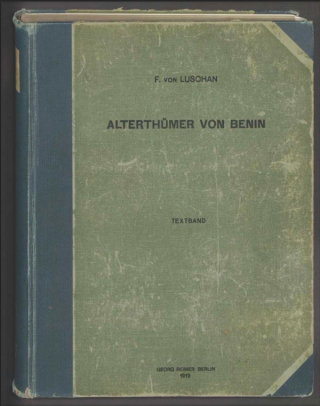
Die Altertümer von Benin
Date
January 1, 1919 at 12:00:00 AM
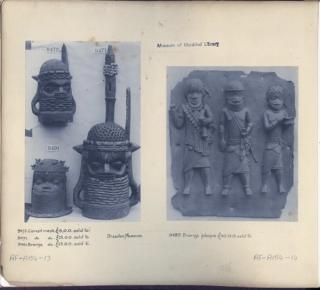
An archival document representing a Photograph Album of 2 page(s)
Photograph Album
British Museum
W. D. Webster photograph album
Date
January 1, 1898 to December 31, 1899
An archival document representing a Sales Catalogs of 46 page(s)
Sales Catalogue
Wellcome Collection
Catalogue of ethnological specimens : European and Eastern arms & armour, Prehistoric and other curiosities / W.D. Webster, Oxford House, Bicester, Oxon., England.
Date
January 1, 1900 to December 31, 1900

Institution data

Staatliche Ethnographische Sammlungen Sachsen und Staatliche Kunstsammlungen Dresden
The data was transferred directly by the institution.
Last updated: 2021-09-28
Language: german
Institution fieldValue
INV_NR
object id
MAf 34540
OBJEKTE_ID
object id
1797382
KURZTITEL
designation
Reliefplatte
Object-name-and-materials
designation
material
Reliefplatte: Würdenträger und 2 Begleiter Gelbguss
TITEL
designation
Reliefplatte: Würdenträger und Begleiter;Platte der Säulen- oder Wandverkleidung des Palastes in Benin "Würdenträger mit Begleitung"
INTERNETKOMMENTAR
description
notes
Die Reliefplatte ist Bestandteil des kulturellen und künstlerischen Erbe des vermutlich 800jährigen Königreiches von Benin. Das Königreich, welches auf dem Gebiet des heutigen südwestlichen Nigeria gelegen hat, wurde 1897 von den Briten erobert und die höfischen Kunstwerke gelangten als Kriegsbeute nach Europa. Bronzene Reliefplatten überzogen die Säulen des Palastes des Oba in Benin City. Die Tafeln zeigen Aspekte des höfischen Lebens und sind Zeugen der Geschichte des Königreiches. Das Bildprogramm zeigt drei unterschiedliche Figuren. Die linke Figur kann durch ihre Leopardenzahnkette und der Glocke an der Schwertschneide unter ihrem linken Arm als Krieger identifiziert werden. Die mittlere Figur hat ihre Hand am Schwertgriff positioniert, unter dem sich eine dreifache Schmuckquaste erkennen lässt. Die rechte und kleinste Figur trägt eine einreihige Perlenkette sowie eine ekpoki-Dose in seiner linken Hand.|(SB)
KATALOGTEXT
description
MATERIAL
material
Messing
MASSEBEMERKUNG
dimensions
42,5 x 36,5 x 9,5 cm|Höhe: 42,5 cm; Breite: 36,5 cm; Relieftiefe: 9,5 cm
MASSETABANGABE
dimensions
Gesamt
MASSETABBEMERKUNG
dimensions
MASSETABBREITE
dimensions
36,5
MASSETABDURCHMESSER
dimensions
MASSETABEINHEITLAENGE
dimensions
cm
MASSETABEINHEITLAENGE_IDS
dimensions
1
MASSETABHOEHE
dimensions
42,5
MASSETABTIEFE
dimensions
9,5
Dimensions_weight
weight
H: 42,5 cm W: 36,5 cm X: 9,5 cm
MASSETABEINHEITGEWICHT
weight
MASSETABEINHEITGEWICHT_ID
weight
MASSETABGEWICHT
weight
OBJEKTBEZ
object type
Plastik
KONVOLUT
provenance
object count
SES Benin-Objekte; SES Dossier Benin-Objekte, Überlieferung an die Kontaktstelle für Sammlungsgut aus kolonialen Kontexten
ORT_DATUM_BIS
date made
1699;
ORT_DATUM_KONKRET
date made
';'
ORT_DATUM_VON
date made
1501;
MATTECHBEMERKUNG
production technique
Gelbguß|Ms (Restaurierung, Import 2016)
TECHNIK
production technique
gegossen
ORTE
production place
Federal Republic of Nigeria;Benin City
ORTZEITBEMERKUNG
production place
Königreich Benin, vor 1897, wohl 16./17. Jh.
Ort_Zeit-Bemerkung
production place
Königreich Benin, vor 1897, wohl 16./17. Jh.
REGIONEN
production place
Benin
Collector/Previous-owner
prior source
Hans Meyer
ERWERBUNG
prior source
Ankauf 2001 von Erbengemeinschaft Meyer mittels Finanzierungsverbund (u. a. Kulturstiftung der Länder, Freistaat Sachsen, BKM, Ernst von Siemens-Stiftung und Stadt Leipzig)
PERSON
prior source
unbekannt;Webster, William Downing;Meyer, Hans
Acquisition-Details
provenance
Purchased by Finanzierungsverbund (Kulturstiftung der Länder, der Freistaat Sachsen, usw.)
EIGENTUEMER
provenance
PROVENIENZ
provenance
Händler: W. D. Webster (bis ?); Sammler: Hans Meyer (bis 1929); Elisabeth Meyer (bis 1946); Erbengemeinschaft Meyer (bis 2001)
PROVENIENZSTATUS
provenance
EREIGNISSE
event
;;
ETHNIEN
ethnic attribution
Institution
department and institution
Staatliche Ethnographische Sammlungen Sachsen - GRASSI Museum für Völkerkunde Leipzig
MUSEUM
department and institution
MVL
Institutional-acquisition-date
accession date
2001
Comments
notes
Hans Heinrich Joseph Meyer, 1858-1929, German Explorer, Editor, Africanist, professor of colonial history in Leipzig
PRAESENZ
display status
ausgestellt
BIBLIOGRAPHIE
bibliography
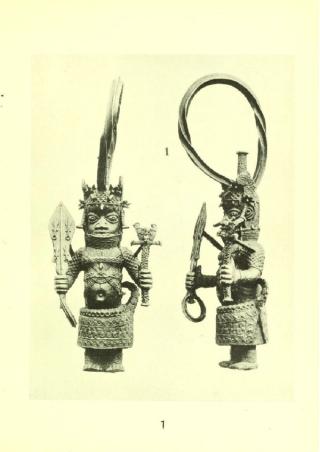
'- Ben-Amos, 1995, S. 108; |- Blackmun, 1983b, S. 86 u. Abb. S. 85; |- Ezra,1992, S. 231, vgl. Abb. S. 139 u. Fig. 48, S. 179; ebd. S. 126-127; |- von Luschan, 1919, VIII, S. 101, Abb. 182; |- Patrimonia 220, 2000, S. 108f.
ERWAEHNTIN
bibliography
'- Ausstellungsverzeichnis Peter Göbel 1994-2000, Nr. 21; |- Katalog Kunst aus Benin 1994, S. 74.
LITERATUR
bibliography
Gunsch, K.W.: The Benin Plaques: A Singular Monument. in: Art. N° 88 Summer 2018. S. 98-113
LIT_LITERATUR
bibliography
Göbel 2002 [Kunst aus Benin - Sa...];Meyer 1994;Luschan 1919;Gunsch 2018;Wysocki Gunsch 2018
BILDUNTERSCHRIFT
images
ALTINVENTARE
lfd. Nr. Leihliste: 5; Hans Meyer (s. L 1929/2)
AUTHENTIZITAETSZUSATZ
;;
AUTHZUSAETZE_IDS
;;
Additional-IDs
9489 (Webster Nr.); Benin 8 (H. Meyer number)
Dokumentname
MAf 34540
EREIGNISSE_IDS
;;
ETHNIEN_IDS
ETH_AUTHZUSAETZE
ETH_AUTHZUSAETZE_IDS
ETH_EREIGNISSE
ETH_EREIGNIS_IDS
FERTIG
1
FLAG
EXP
FOTOFELD
Neg.Af.Obj. 569 (im Rahmen Hans Meyer)
FUNKTION
Hersteller;Händler;Sammler
GEAENDERT_AM
GLEICHRANGIG
GND_ID_OBEZ
22955
GND_ID_SCHLAGWORT
9470;116012;42159;20280;22955;24148
GRUNDDATEN
1
INTERNETFREIGABE
1
INVENTURDATUM
11.10.05;19.03.18
INVNR_MERKMALE_IDS
577;581;581;577;577
KONVOLUTE_IDS
959;1409
KOORDINATEN
(10 8);(6,33504 5,62749)
LEIHVERKEHR
LIT_ABBILDUNG
Tafel XXIII;;182;;Fig. 6.67 2A
LIT_BAND_SEITE
Bd.220/S.109;Seite 74;Seite 101;S. 98-113;S. 178
LIT_BEMERKUNG
schwarz-weiss;schwarz-weiss;schwarz-weiss;;s/w
LIT_LITERATUR_IDS
184;681;703;2783;3121
LIT_NUMMERE
;;;;
LIT_STA_INETFREIGABE
1;1;1;1;1
MAND_ID
1
MATERIALIEN_IDS
1074
MERKMAL
Aktenstück;Originalnummer;Originalnummer;Aktenstück;Aktenstück
MUSEEN_ID
34
ORTE_IDS
2328926;2347283
ORT_AUTHZUSAETZE
;
ORT_AUTHZUSAETZE_IDS
;
ORT_BEZUG
;
ORT_EREIGNISSE
Herstellung;Sammelereignis
ORT_EREIGNISSE_IDS
12;17
PND_BEZUG
;;
PND_FUNKTIONEN_IDS
-2;645;642
PND_INETFREIGABE
1;1;1
PND_PERSONEN_IDS
12797488;12821279;11145307
PRAESENZEN_WERT_ID
-38
PROVSTATUS_WERT_ID
REGIONEN_IDS
612
REG_EREIGNISSE
Sammelereignis
REG_EREIGNIS_IDS
17
SAMMLUNG
Afrika
SAMMLUNGEN_ID
534
SCHLAGWORT
Architektur;Hofstaat;Kunst;Mann;Plastik;Relief
TECHNIKEN_IDS
75
UNTERGEORDNET
VORLAGEN
WEITERE_NUMMERN
2001/14;9489 (Webster) ;Benin 8 H. Meyer;L 1929/2;1989/21
WISSENSCHAFT
1
XRAY
###
Sensitive Content

Digital Benin collates digital material from institutions, and some of this material is inherently colonial and contains words, terms and phrases that are inaccurate, derogatory and harmful towards African and African diasporic communities. Catalogue transcriptions, book titles, exhibition titles and museum titles may contain harmful terms. We recognise the potential for the material to cause physical and mental distress as well as evoke strong emotions. Owing to the scale of the collection’s data, a process to implement sensitive-content warnings in the displayed data is still incomplete. The material within the catalogue does not represent Digital Benin’s views. Digital Benin maintains a strong anti-colonial, anti-racist position and affirms its support for centring the humanity of historically marginalised and disenfranchised communities. Read more about the background of this statement here