Reg No.
RAF 621
Edo designations
English designations
Fragment
Altar Tusk
Categories
Altar & Shrine Objects
Location
Gablerstrasse 15, 8002 Zürich, Switzerland
Loading...
Fragment
Fragment

Iconographies

2 annotations
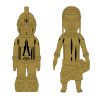
tribal marks
Iwu
Facial and Body Markings

Iwu are facial and body markings (scarifications) that were historically worn by Edo men and women. However, since the 1960s, the practice has been nearly extinct (Aisien 2011). In the past, Iwu were used as a way of proving that one was an Edo citizen, and the ceremony of having Iwu completed was an important rite of passage for men and women. The Osiwu, who also practised circumcision and other surgical procedures, would carry out the procedure of adding Iwu. There are different types of Iwu: ‘blades’ worn on the torso (Iwu-eko), and those worn on the face, such as Ikharo (three or four markings above the eyebrows), Irho (two narrow ‘blades’ worn on each cheek), Ovbihue (nasal ‘blades’), Ovbi-agbanmwen (chin ‘blade’), and Igho-okpa/Ukpgho (three forehead ‘blades’) (Aisien 2011, p. 22).

The number of Iwu also varied depending on the identity of the person wearing them. For example, royal men would wear six ‘blades’ on their torso, whilst men who were not royal would wear seven ‘blades’. Meanwhile, the Ọba’s female children would wear fifteen ‘blades’, and all other women would wear sixteen (Aisien 2011).

1 annotation
Iwu
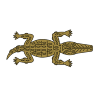
alligator
Ẹghughu
Crocodile

In the riverine area surrounding Benin City, there are two types of crocodile. The Ẹghughu, known in English as the dwarf or bush crocodile, is believed to be more docile ( ; Ọbazee 2025, p. 133). The second type is the Àgbákà, the aggressive Nile crocodile ( ; Ọbazee 2025, p. 11).

Crocodiles are one of the important animals represented in the historical Emwin Arhe, and they are known as Olokun’s guards or the “policemen” of the waters. The powerful and ferocious qualities of these animals might explain why warrior figures are often depicted wearing Uhunmwu-Ẹkuẹ (pendant masks) in the shape of crocodile heads on Ama-Ẹrọnmwọn (bronze relief plaques) ( ). Olokun devotees use crocodiles as sacrificial animals in offerings during the worship of Olokun.

1 annotation
Ẹghughu

Provenance

7 events
Production
1750 (year uncertain/approximate) to February 22, 1897 (day approximate)
The object was produced by Unknown member(s) of the Igbesamwan guild in Benin City.
Looted
February 22, 1897 (day approximate) to June 1899 (year approximate)
The object was looted by February 1897 Unknown member of the British colonial military campaign on Benin from Benin Kingdom.
Unknown
1910s to 1931
The object is known to have come into contact with Han Coray, later in Agnuzzo.
Transfer
1931
The object was transferred from Han Coray to Zürich Schweizerische Volksbank from Agnuzzo to Switzerland.
Transfer
1940
The object was transferred from Zürich Schweizerische Volksbank to Völkerkundemuseum der Universität Zürich from Switzerland to Zurich.
Transfer
1940
The object was transferred to Kunstgewerbemuseum in Zurich.
Transfer
1961
The object was transferred from Kunstgewerbemuseum to the Museum Rietberg Zürich in Zurich.

Related archival documents

4 documents
See all
Date

Institution data

Museum Rietberg Zürich
The data was transferred directly through the Swiss Benin Initiative.
Last updated: 2022-07-04
Language: english
Institution fieldValue
Reg No.
object id
RAF 621
Object name and materials
designation
Carved elephant tusk fragment (18th century), ivory
Material
material
ivory
Dimension/s
dimensions
H. 21.5 cm W. 15.5 cm D. 17.5 cm
Provisional dating
date made
18th century
Creditline
prior source
Transfer from: the Kunstgewerbemuseum Zürich
Provenances
provenance
18th century, possibly commissioned from the the Royal Ivory-sculptors Guild (Igbesanmwan) by the Royal Palace of Benin; possibly by descent to Oba Ovonramwen (Ovonramwen Nogbaisi, b. about 1857 - d. about 1914; r. 1888 - 1897); 1897, probably looted from the Royal Palace during the British military occupation of Benin; [...]; until 1931 Han Coray (collector, Agnuzzo) (Reg. No EK 4); 1931-1940, Schweizerische Volksbank; 1940, Völkerkundemuseum der Universität Zürich; 1940 -1961 Kunstgewerbemuseum Zürich; 1961, transfered to the Museum Rietberg Zürichbefore
Institution
department and institution
MRZ Museum Rietberg Zürich
Institution acquisition date
accession date
1961
Additional IDs
Sensitive Content

Digital Benin collates digital material from institutions, and some of this material is inherently colonial and contains words, terms and phrases that are inaccurate, derogatory and harmful towards African and African diasporic communities. Catalogue transcriptions, book titles, exhibition titles and museum titles may contain harmful terms. We recognise the potential for the material to cause physical and mental distress as well as evoke strong emotions. Owing to the scale of the collection’s data, a process to implement sensitive-content warnings in the displayed data is still incomplete. The material within the catalogue does not represent Digital Benin’s views. Digital Benin maintains a strong anti-colonial, anti-racist position and affirms its support for centring the humanity of historically marginalised and disenfranchised communities. Read more about the background of this statement here