

Reg No.
5280
Edo designations
English designations
Stool
Categories
Ceremonial Objects
Location
1 Adesogbe (Plymouth) Road, P.M.B. 1115, Benin City , Edo State
Loading...
Stool

Iconographies

4 annotations
Uzo
Antelope

These motifs are sometimes interpreted as Uzo (antelopes) but also as Emila (cows). Both animals share certain characteristics, being regarded as physically beautiful and peaceful creatures. Some Orhiẹvbẹ (kola-nut bowls) take the form of an antelope head with its horns grasped by a pair of hands, a gesture that symbolises the right of humans to sacrifice antelopes and cows with impunity (Ben-Amos Girschick 2007, cat. no. 88, pp. 339, 341).

Uzo primarily symbolise beauty, docility, and their status as permissible sacrificial animals, reinforcing themes of human control over nature and the rituals that underpin social and spiritual order.

1 annotation
Uzo
snake
Ẹyẹn
Snake

Ẹyẹn (snakes) are among the most common animals depicted by Edo artists on the Emwin Arhe (royal treasures). The varied depictions of these reptiles suggest different snake species, including the Ikpin (python), Arhunmoto (puff adder), and Olose (red-black striped snake); therefore, here we use the generic term for snake: Ẹyẹn.

The identification of snake motifs and depictions as Ikpin, as well as the importance accorded to this species, is a subject of scholarly debate. Paula Ben-Amos (1976, p. 247) argued that the Edo admired the “stature, colouration and crushing power” of the python, which was in turn associated with Olokun. She went on to identify the brass figures of snakes that formerly adorned the roof of the palace, as well as several other snakes, as pythons. Joseph Nevadomsky (1988, p. 77) argued instead that the importance of the Ikpin had been overstated.

Some of these snake representations may in fact be the Arhunmwoto (puff adder). The first to suggest this was the German curator Felix von Luschan (1919) in his early research into the Benin royal treasures. Nevadomsky (1988, pp. 79–80) suggested that the large head, narrow neck, and rough scales are indicative of either the puff adder, a symbol of “material wealth, tribute, and gifts,” or the Gaboon viper.

Another kind of snake that may be depicted is the Olose (red-black striped snake). It has the praise name “king of the snakes” in Edo. Olose is also closely connected to the deity Olokun, both because of its attractiveness and because it inhabits wet environments such as forest streams, which in turn flow into rivers and the sea, where Olokun lives (Nevadomsky 1988, pp. 76–77). Although the exact meanings of these different snakes vary, they share the characteristic of being spiritually powerful creatures.

1 annotation
Ẹyẹn
Ubanu'hi / Obanu'hi
Ubanu'hi / Obanu'hi
Inifinity Symbol

The Ubanu'hi (infinity symbol) is a kind of guilloche or interlaced strapwork motif that can be angular or rounded. It was used by Edo artists in the decoration of many Emwin Arhe (royal treasures) and is ubiquitous in Benin royal arts. Ubanu'hi is a shortened form of “uba no Ọba ya de agbon ke ehimwin yi”, which means “the rope with which the Ọba ties the heaven and earth together” (pers. comm. Chief John Igbineweka Inneh n’Igbesawman, 2022). Similarly, Paula Ben-Amos Girshick (in Plankensteiner 2007, pp. 339, 341) described this as “Ọba n’iri agbon”, or the “rope of the world” pattern.

According to Ọbabanmu Ineh (in Blackmun 1984, p. 51), the use of this motif indicates that objects were carved by members of the Igbesanmwan. However, the motif is found on all types of Emwin Arhe (royal treasures), not only those made of ivory or wood. On the flanges of the Ama (relief plaques) alone, Kathryn Gunsch (2018, pp. 75–77) identified three different versions of the Ubanu'hi and, through her analysis of over 850 plaques, found that these different Ubanu'hi forms align with other characteristics, such as dimensions, the prevalence of ornamental motifs, and stylistic qualities. Together, these provide evidence, she argues, of different production groups among the plaque makers .

Kate Ezra (1992, pp. 209, 264) went on to argue that the use of these motifs indicates that certain objects were used in a “royal context” and were associated with “royal patronage”.

1 annotation
Ubanu'hi / Obanu'hi
Ẹkirẹ
Frog

Ẹkirẹ is the Edo term for frog ( ; Ọbazee 2025, p. 135). The Ẹkirẹ carries significant and often ambiguous symbolic importance, primarily linked to its liminal nature and association with spiritual and magical powers. As an amphibian that lives on the threshold between water and land, the Ẹkirẹ is seen as a messenger of Olokun. This connection reinforces the Ọba’s (king’s) ability to bridge the human and spiritual realms, a concept consistently present in Benin art.

While not as common as the mudfish, frogs appear on various Benin artworks, including Aken'ni Elao (carved tusks), pendant plaques, and Ẹrhẹ (royal stools). Their presence often relates to medicinal and occult practices. Frogs can be used in powerful curses, with a jumping frog signifying failure, and a frog, along with a coiled fish, used in rituals to release such curses. They are also associated with Osun, the deity of medicine, and scenes of snakes swallowing frogs can represent supernatural attacks or strong spiritual powers. For warriors, the Ẹkirẹ could even symbolise an aspect of their protective equipment and was used in palace rituals to encourage success in battle ( ).

1 annotation
Ẹkirẹ

Provenance

6 events
Production
unknown to February 22, 1897 (day approximate)
The object was produced by Unknown member(s) of the Igbesamwan guild in Benin City.
Looted
February 22, 1897 (day approximate) to June 1899 (year approximate)
The object was looted by February 1897 Unknown member of the British colonial military campaign on Benin from Benin Kingdom.
Auction
January 1901
The object was auctioned to William Downing Webster through Stevens Auction Rooms in London.
Auction
June 30, 1902
The object was auctioned to Theodor 'Theo' Rautenstrauch by William Downing Webster through Stevens Auction Rooms in London.
Donation
November 21, 1902
The object was donated by Theodor 'Theo' Rautenstrauch to the Rautenstrauch-Joest-Museum in Cologne.
Restitution
December 8, 2022
The object was restituted by the Rautenstrauch-Joest-Museum to the Omo n'Oba n'Edo Uku Akpolokpolo, Ọba of Benin & National Commission for Museums and Monuments, Nigeria from Cologne to Nigeria.

Related archival documents

2 documents
See all
Date
Date

Institution data

Rautenstrauch-Joest-Museum
The data was transferred directly by the institution.
Last updated: 2022-07-27
Language: english
Institution fieldValue
Additional Ids
object id
190219
Additional Ids / bundle
object id
RJM 1902/19
Other numbers
object id
10817 (old inventory number)
Reg No.
object id
5280
Reg. No / Inventory number
object id
RJM 5280
Object name
designation
object type
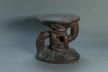
altar stool
Object name / Title
designation
Altar Stool (erhe)
materials
material
wood
Dimension/s
dimensions
H.40cm W.43.60cm X. 43.40cm
previous owner/collector
prior source
Theodor Rautenstrauch, son of Adele and Eugen Rautenstrauch, Member of Deutsche Kolonialgesellschaft - Dep. Köln Collection Wilhelm Joest 1912
provenance
provenance
30.06.1902 to 21.11.1902, Theodor Rautenstrauch (1873-1907) (auction); from 21.11.1902, Rautenstrauch-Joest Museum (donation); 1902 - 30.06.1902, J.C. Stevens, London (place), Stevens' Auction Rooms; auction probably in January 1901, W. D. Webster, London, Bicester (commission)
Institution
department and institution
Rautenstrauch-Joest Museum - Cultures of the World, Cologne
Institution acquisition date
accession date
11/21/02
Acquisition details
accession method
donation
comments
notes
Theodor Rautenstrauch got the objects at an auction of Mr. J.C. Stevens on 03.06.1902 in London. The auction named "Benin brass" and embraced a collection of the British Punitive from 1897.
Copyright
license
© Museumsgesellschaft RJM Köln, Foto Uli Grohs
notes concerning "other numbers"
inventory number W.D. Webster Webster catalogue 28/1901, figure 33
Sensitive Content

Digital Benin collates digital material from institutions, and some of this material is inherently colonial and contains words, terms and phrases that are inaccurate, derogatory and harmful towards African and African diasporic communities. Catalogue transcriptions, book titles, exhibition titles and museum titles may contain harmful terms. We recognise the potential for the material to cause physical and mental distress as well as evoke strong emotions. Owing to the scale of the collection’s data, a process to implement sensitive-content warnings in the displayed data is still incomplete. The material within the catalogue does not represent Digital Benin’s views. Digital Benin maintains a strong anti-colonial, anti-racist position and affirms its support for centring the humanity of historically marginalised and disenfranchised communities. Read more about the background of this statement here