

Inventory number
LG1959.23.5
Edo designations
English designations
U-Shaped Plaque
Categories
Palace Architecture & Ornamentation
Location
1 Adesogbe (Plymouth) Road, P.M.B. 1115, Benin City , Edo State
Loading...
Pendant Plaque
Pendant Plaque
37_LG1959235
Pendant Plaque
Pendant Plaque
Pendant Plaque

Iconographies

9 annotations
Colar Bead
Odigba
Coral beaded collar

Odigba (coral-beaded collar) is a rigid neck collar made of coral beads, worn as part of ceremonial attire only by senior princes who have been made Enigie (Inneh 2007, p. 107). Although Ibafe (2007, p. 43) argued that the Odigba was introduced during the Ogiso period (c. 900–c. 1170 AD) by Ogiso Ere, along with other symbolically important Emwin Arhe, such as the Ada (ceremonial sword) and the Ẹbẹn (ceremonial sword), this seems unlikely, as coral was only introduced in the late 15th century through trade with Portuguese merchants.

1 annotation
Odigba
Ẹkirẹ
Frog

Ẹkirẹ is the Edo term for frog ( ; Ọbazee 2025, p. 135). The Ẹkirẹ carries significant and often ambiguous symbolic importance, primarily linked to its liminal nature and association with spiritual and magical powers. As an amphibian that lives on the threshold between water and land, the Ẹkirẹ is seen as a messenger of Olokun. This connection reinforces the Ọba’s (king’s) ability to bridge the human and spiritual realms, a concept consistently present in Benin art.

While not as common as the mudfish, frogs appear on various Benin artworks, including Aken'ni Elao (carved tusks), pendant plaques, and Ẹrhẹ (royal stools). Their presence often relates to medicinal and occult practices. Frogs can be used in powerful curses, with a jumping frog signifying failure, and a frog, along with a coiled fish, used in rituals to release such curses. They are also associated with Osun, the deity of medicine, and scenes of snakes swallowing frogs can represent supernatural attacks or strong spiritual powers. For warriors, the Ẹkirẹ could even symbolise an aspect of their protective equipment and was used in palace rituals to encourage success in battle ( ).

1 annotation
Ẹkirẹ
Ivie okpagbaru/Ivie Ewuare
Royal/Ewuare Bead

This oval-shaped bead with faceted sides is known as the Ivie okpagbaru or Ivie Ewuare (the ‘royal bead’ or ‘Ewuare bead’). The association of Ọba Ewuare with this bead is based on a story in which Ewuare took beads from the deity Olokun, sanctifying his royal position and, in turn, receiving the title ‘Lord of the Land’, in contrast to Olokun’s title ‘Lord of the Sea’ (Omomo of Enisen in Blackmun 1990, p. 65). The Ivie okpagbaru/Ivie Ewuare is a distinctive motif that can be used to identify representations of the Ọba.

Due to the association of beads with Olokun, it is unsurprising that this bead has come to symbolise wealth when used to decorate Emwin Arhe (royal treasures) (Blackmun 1984, p. 59). Paula Ben-Amos (1999, p. 64) associated the bead with a different narrative and the name ‘One Bead Does Not Go around the Neck’. Ben-Amos suggests that the bead is in fact the one that was fought over by Ọba Ẹsigie and his brother Aruanran when they struggled for the right to the throne in the early 16th century.

1 annotation
Ivie okpagbaru/Ivie Ewuare
Ẹrhu
Headwear

Many different kinds of Ẹrhu (headwear) are worn by the various figures depicted in the imagery of Benin royal artefacts. Through comparisons with ceremonial regalia still worn by chiefs and members of the royal court, including the Ọba himself, some Ẹrhu have been used to identify the different figures depicted. For example, the conical hat worn by high-ranking town chiefs as part of the pangolin regalia, still worn at ceremonies, is also visible on figures on some Ama-Ẹrọnmwọn (bronze relief plaques) ( ). Other examples include the distinctive bell-shaped helmet associated with the Iyasẹ ( ). Figures who wear a shallow-brimmed hat and a cross have been identified as Ewua or Ohensa priests ( ).

Different kinds of helmets and headwear were worn by warriors, reflecting the many different ranks and roles in the army at any given time, as well as developing trends that were in turn represented on Emwin Arhe created at different points in time. Warrior figures wearing helmets covered in cowrie shells were carved on the Aken'ni Elao (carved tusks) (Blackmun 1984, p. 330), yet on the brass Ama, warriors are sometimes depicted wearing helmets made from crocodile hide or horsehair with a front plate (Osadolor in Plankensteiner 2007, cat. no. 238, p. 457). Helmets made from horsehair with a front plate are one of the more common types represented on the Ama-Ẹrọnmwọn, and the demand for black horse tails was noted by both Portuguese and British traders during the late 17th and 18th centuries (Osadolor in Plankensteiner 2007, cat. no. 238, p. 457). Other warriors depicted on Ama-Ẹrọnmwọn wear helmets with a rounded top, chinstrap, and sometimes also a feather tucked into the left side. These types of headwear are known as Ẹrhu Iyokuo.

Attire worn for battle also differed from that worn for ceremonial occasions, such as the pointed headwear worn in combination with an ornate leopard-head tunic by war chiefs. Depictions of figures wearing this attire on brass Ama-Ẹrọnmwọn (bronze relief plaques) have been interpreted as representing the war chiefs’ participation in the war-ritual Isiokuo festival (Osadolor in Plankensteiner 2007, cat. no. 238, p. 457).

Another distinctive form of headwear is that worn by figures identified as leopard hunters on the brass Ama-Ẹrọnmwọn (relief plaques). These large helmets cover almost all of the leopard hunters’ faces except for their noses, eyes, and upper lips, and are made of an unusual material that remains unidentifiable (Plankensteiner 2007, cat. nos. 68–69, p. 322).

European figures are also portrayed with distinctive hats, such as Portuguese three-cornered hats. These depictions reflect the artists’ keen observation and highlight the impact of European trade and military assistance (Ezra 1992).

1 annotation
Ẹrhu
TBC_Royal Triad
Royal Triad

The Royal Triad is a motif composed of three figures, with a central figure supported on either side by two others. The motif has multiple meanings and interpretations. When understood on the human level, the central seated or standing figure is identified as the Ọba, flanked by two Enobare who each support one of his arms. This pose “encapsulates Edo ideals of kingship,” in which “even the most powerful of Benin's divinely ordained rulers cannot stand alone. He must maintain a careful balance between his authority over the Edo people and their acquiescence in his leadership” ( ). The identities of the supporting Enobare are interpreted variously. They have been identified as the Osa and Osuan, who support the Ọba in this manner during the Ugie Oro and Ododua festivals, although it is possible that the Edaiken (crown prince) and Ezọmọ performed these roles during the 18th century ( ).

In some examples, the central figure has mudfish in place of legs. These figures have sometimes been interpreted as representations of the deity Olokun ( ). Barbara Blackmun (1984, pp. 274–275) alternatively suggested that the triad may represent the high god Osanobua, his son and deity Olokun, and Olokun’s child, Ohen, who in turn represents the Ọba.

The number three is considered an “uncanny” number in Edo thought and “is never used lightly” ( ), being associated with the “threat of occult sanctions or forces” ( ).

The Royal Triad appears on almost all Aken'ni Elao (carved tusks), as well as on some Ẹgogo (gongs) and pendant plaques, and less frequently on Ama-Ẹrọnmwọn (bronze relief plaques). The motif is also referred to as the “supporting triad motif” or “linked supporting triad motif” ( ).

1 annotation
TBC_Royal Triad
TBC ov-ene obo
Trunk hand

The trunk hand motif, comprising an elephant’s trunk ending in a fist, is believed to have complex and varied symbolic meanings. During the 15th and 16th centuries, the era of the warrior kings, the motif appeared only occasionally. During the 18th century, it was revived to honour the richest of all Ọbas, Ọba Akenzua I. This was particularly the case on the Aken'ni Elao (carved tusks), and the trunk hand motif commonly appears on these ivories from the 18th century and throughout the 19th and into the 20th centuries ( ). In her PhD thesis, Barbara Blackmun ( ) identified eight different kinds of motifs of this type on the Aken’ni Elao alone, indicating that the form itself is variable. In addition to the ivory Aken’ni Elao, the motif also commonly appears on the flanges of Uhunmwu-Elao (commemorative heads), the bases of Urhotọ (altar tableaux), and some ornately decorated bronze Ukhurhẹ (ancestral staffs).

The elephant trunk hand has been interpreted as a symbol of physical power ( ) and strength ( ), and as the “ultimate Hand of Hands” ( ). A past Ihama n’Igun-Ẹrọnmwọn ( ) interpreted the motif as a symbol of “taking life”. On some Emwin Arhe (royal treasures) where the trunk hand motif is present, depictions of human sacrifices are also present, representing the ultimate power held by the divine Ọbas. The potent nature of the trunk hand motif is further emphasised by Barbara Blackmun through the combination of “the head of one of the most powerful animals with a hand that grasps with enormous strength”; together, these signify “the acquisition of great wealth for the kingdom” ( ).

1 annotation
TBC ov-ene obo
Oro
Headdress/crown with single projection

Figures wearing a headdress with a single protrusion from the crown of the head, known as the Oro, are found only among the Ọba and a select category of palace dignitaries whose ancestors originated in ancient Ile Ife ( ; Ọbazee 2025, p. 407). Only the Osa and Osuan, custodians of the Uwen and Ora deities, as well as members of the Emuru, who are responsible for the care of Iru vessels, may wear a headdress with the Oro. The identification of different figures is therefore interpreted based on the combination of the Oro with other items of regalia. Artists in the Igun-Ẹrọnmwọn and Igbesamwan depicted figures with the Oro on Ama-Ẹrọnmwọn (bronze relief plaques) and Aken'ni Elao (carved tusks), respectively. The Oro would either be made of coral beads as part of the crown or headdress, or be woven from itoto fibre ( ).

1 annotation
Oro
Ubanu'hi / Obanu'hi
Ubanu'hi / Obanu'hi
Inifinity Symbol

The Ubanu'hi (infinity symbol) is a kind of guilloche or interlaced strapwork motif that can be angular or rounded. It was used by Edo artists in the decoration of many Emwin Arhe (royal treasures) and is ubiquitous in Benin royal arts. Ubanu'hi is a shortened form of “uba no Ọba ya de agbon ke ehimwin yi”, which means “the rope with which the Ọba ties the heaven and earth together” (pers. comm. Chief John Igbineweka Inneh n’Igbesawman, 2022). Similarly, Paula Ben-Amos Girshick (in Plankensteiner 2007, pp. 339, 341) described this as “Ọba n’iri agbon”, or the “rope of the world” pattern.

According to Ọbabanmu Ineh (in Blackmun 1984, p. 51), the use of this motif indicates that objects were carved by members of the Igbesanmwan. However, the motif is found on all types of Emwin Arhe (royal treasures), not only those made of ivory or wood. On the flanges of the Ama (relief plaques) alone, Kathryn Gunsch (2018, pp. 75–77) identified three different versions of the Ubanu'hi and, through her analysis of over 850 plaques, found that these different Ubanu'hi forms align with other characteristics, such as dimensions, the prevalence of ornamental motifs, and stylistic qualities. Together, these provide evidence, she argues, of different production groups among the plaque makers .

Kate Ezra (1992, pp. 209, 264) went on to argue that the use of these motifs indicates that certain objects were used in a “royal context” and were associated with “royal patronage”.

1 annotation
Ubanu'hi / Obanu'hi
Uhunmwu-Ẹkuẹ
Pendant Mask

Uhunmwu-Ẹkuẹ (pendant masks) formed part of the ceremonial regalia worn by court dignitaries to indicate their rank or function and are frequently represented among the Emwin Arhe (royal treasures), particularly those made of brass, bronze, or ivory.

Different animals were depicted on Uhunmwu-Ẹkuẹ, particularly the heads of leopards and crocodiles. The most common type features the face or head of an Ọba. Other examples take the form of an elephant head incorporating the trunk-hand motif, a ram’s head, or, in a very small number of cases, the face of a Portuguese man. Different figures appear to have worn Uhunmwu-Ẹkuẹ with different imagery. For example, warrior chiefs are often depicted wearing leopard-head pendant masks, whereas crocodile-head Uhunmwu-Ẹkuẹ are generally shown being worn only by the Ọba and his Enọbare (Blackmun 2007, cat. no. 137, p. 365).

1 annotation
Uhunmwu-Ẹkuẹ

Provenance

4 events
Production
unknown to February 22, 1897 (day approximate)
The object was produced by Unknown member(s) of the Igun-Ẹrọnmwọn guild in Benin City.
Looted
February 22, 1897 (day approximate) to June 1899 (year approximate)
The object was looted by February 1897 Unknown member of the British colonial military campaign on Benin from Benin Kingdom.
Unknown
1920s to 1939
The object is known to have come into contact with Irene Marguerite Beasley and Harry Geoffrey Beasley, later in Chislehurst.
Purchase
1959
The object was purchased by the Omo n'Oba n'Edo Uku Akpolokpolo, Ọba of Benin & National Commission for Museums and Monuments, Nigeria from Irene Marguerite Beasley from Brighton to Lagos.

Institution data

Omo n'Oba n'Edo Uku Akpolokpolo, Ọba of Benin & National Commission for Museums and Monuments, Nigeria
The data was transferred directly by the institution and digitized by Digital Benin in collaboration with the NCMM
Last updated: 2023-11-30
Languages: english, bini; edo
Institution fieldValue
Inventory number
object id
LG1959.23.5
URL
weblink
https://digitalbenin.org/catalogue/37_LG1959235
Object Description
description
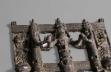
Pendant plaques, like pendant masks, can be cast in brass or carved in ivory, and were worn as part of ceremonial regalia by members of the royal palace societies. Pendant plaques are typically U-shaped, with a suspension loop or loops at the top. Crotal bells would have been attached to the small round eyelets that decorate the bottom half. Many different motifs are shown; some common ones include images of horses and riders and Portuguese men, or just their heads, hinting at the close ties between Benin Kingdom and Portugal during the sixteenth and seventeenth centuries. Additionally, the Ọba is supported on either side by kneeling attendants in a triad or trinity form, a position often seen as part of festivals and ceremonies in Benin City today (Plankensteiner, 2007, p.369[17]).
Diameter
dimensions
Dimension L (cm)
dimensions
38.0
Dimension W (cm)
dimensions
38.0
Dimension H (cm)
dimensions
7.5
Brief Object Description
designation
Material
material
brass
Object Count
object count
1
Date Made
date made
Associated Guild
producer
Igun Ẹrọnmwọn
Production Technique
production technique
Casting
Production Place
production place
Benin City
Inscriptions
inscriptions
Note
Inventory Book Description
Semi-circular bronze plaque with central figure which may represent the lame OBA OHEN or possibly, OLOKUN, and two other figures. Benin. Purchased by the Nigerian museum through Mrs. I. M. Beazley, Brighton.
fileNames
LG1959235_5.jpg, LG1959235_6.jpg, LG1959235_3.jpg, LG1959235_2.jpg, LG1959235_1.jpg, LG1959235_4.jpg
Sensitive Content

Digital Benin collates digital material from institutions, and some of this material is inherently colonial and contains words, terms and phrases that are inaccurate, derogatory and harmful towards African and African diasporic communities. Catalogue transcriptions, book titles, exhibition titles and museum titles may contain harmful terms. We recognise the potential for the material to cause physical and mental distress as well as evoke strong emotions. Owing to the scale of the collection’s data, a process to implement sensitive-content warnings in the displayed data is still incomplete. The material within the catalogue does not represent Digital Benin’s views. Digital Benin maintains a strong anti-colonial, anti-racist position and affirms its support for centring the humanity of historically marginalised and disenfranchised communities. Read more about the background of this statement here