
Inventory number
LG1954.15.5
Edo designations
English designations
Pot
Categories
Ceremonial Objects
Containers
Location
1 Adesogbe (Plymouth) Road, P.M.B. 1115, Benin City , Edo State
Loading...
Pot
Pot
Pot
Pot
Pot

Iconographies

4 annotations
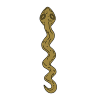
snake
Ẹyẹn
Snake

Ẹyẹn (snakes) are among the most common animals depicted by Edo artists on the Emwin Arhe (royal treasures). The varied depictions of these reptiles suggest different snake species, including the Ikpin (python), Arhunmoto (puff adder), and Olose (red-black striped snake); therefore, here we use the generic term for snake: Ẹyẹn.

The identification of snake motifs and depictions as Ikpin, as well as the importance accorded to this species, is a subject of scholarly debate. Paula Ben-Amos (1976, p. 247) argued that the Edo admired the “stature, colouration and crushing power” of the python, which was in turn associated with Olokun. She went on to identify the brass figures of snakes that formerly adorned the roof of the palace, as well as several other snakes, as pythons. Joseph Nevadomsky (1988, p. 77) argued instead that the importance of the Ikpin had been overstated.

Some of these snake representations may in fact be the Arhunmwoto (puff adder). The first to suggest this was the German curator Felix von Luschan (1919) in his early research into the Benin royal treasures. Nevadomsky (1988, pp. 79–80) suggested that the large head, narrow neck, and rough scales are indicative of either the puff adder, a symbol of “material wealth, tribute, and gifts,” or the Gaboon viper.

Another kind of snake that may be depicted is the Olose (red-black striped snake). It has the praise name “king of the snakes” in Edo. Olose is also closely connected to the deity Olokun, both because of its attractiveness and because it inhabits wet environments such as forest streams, which in turn flow into rivers and the sea, where Olokun lives (Nevadomsky 1988, pp. 76–77). Although the exact meanings of these different snakes vary, they share the characteristic of being spiritually powerful creatures.

1 annotation
Ẹyẹn
Ubanu'hi / Obanu'hi
Ubanu'hi / Obanu'hi
Inifinity Symbol

The Ubanu'hi (infinity symbol) is a kind of guilloche or interlaced strapwork motif that can be angular or rounded. It was used by Edo artists in the decoration of many Emwin Arhe (royal treasures) and is ubiquitous in Benin royal arts. Ubanu'hi is a shortened form of “uba no Ọba ya de agbon ke ehimwin yi”, which means “the rope with which the Ọba ties the heaven and earth together” (pers. comm. Chief John Igbineweka Inneh n’Igbesawman, 2022). Similarly, Paula Ben-Amos Girshick (in Plankensteiner 2007, pp. 339, 341) described this as “Ọba n’iri agbon”, or the “rope of the world” pattern.

According to Ọbabanmu Ineh (in Blackmun 1984, p. 51), the use of this motif indicates that objects were carved by members of the Igbesanmwan. However, the motif is found on all types of Emwin Arhe (royal treasures), not only those made of ivory or wood. On the flanges of the Ama (relief plaques) alone, Kathryn Gunsch (2018, pp. 75–77) identified three different versions of the Ubanu'hi and, through her analysis of over 850 plaques, found that these different Ubanu'hi forms align with other characteristics, such as dimensions, the prevalence of ornamental motifs, and stylistic qualities. Together, these provide evidence, she argues, of different production groups among the plaque makers .

Kate Ezra (1992, pp. 209, 264) went on to argue that the use of these motifs indicates that certain objects were used in a “royal context” and were associated with “royal patronage”.

1 annotation
Ubanu'hi / Obanu'hi
Elukeluke / Etuoo
Tortoise

The Elukeluke/Etuoo (tortoise) holds diverse symbolic meanings and associations, including with Ogun (god of war), pride, and trickery ( ). The tortoise is one of the rarest animals depicted on the Emwin Arhe (royal treasures); however, it was used by some carvers of the Igbesamwan to decorate the Aken'ni Elao (carved tusks) and some ivory Ẹgogo (gongs). According to Hans Melzian ( ), the Elukeluke has two praise names: “the thing that swaggers proudly” and “the thing that walks like a cripple.” Both praise names, although contradictory, evoke descriptions of Ọba Ohẹn, who was paralysed from the waist down and attempted to deceive the royal court about this fact.

The Elukeluke appears in stories as an “ambitious and cunning” animal ( ) and is often seen as a cautionary figure in Edo oral tradition. Priestess Azaigueni Aghahowa ( ) described the Elukeluke as a “great liar” who, in the form of a human, had attempted to deceive an Ọba. On discovering the deceit, “the Ọba cursed his house, which fell upon the tortoise's back and crushed it, becoming a part of him. From that time forward his deceitful character has been publicly acknowledged, because ‘he hides his body’.”

1 annotation
Elukeluke / Etuoo
Ukpọn
Wrapper

Ukpọn is the Edo term for cloth (Aigbe 1985, p. 55; Ọbazee 2025, p. 542) and is used here to refer to the wrappers or kilts worn by many of the figures depicted on the Emwin Arre (royal treasures). The cloth worn around the waist may be plain, but it is more commonly richly decorated with motifs associated with the monarchy, power, and wealth, such as the Ọba'nui (infinity symbol) and Uhunme Ikpotoki (Portuguese heads).

The Benin Kingdom was renowned for its textile production, both for local use and for trade ( ). Within the royal court, members of the Owina n’Ido produced ukhuen cloth for the Ọba and other members of the court, who wore it as wrappers during festivals and ceremonies ( ).

Alongside locally produced textiles, imported cloth was also an important commodity in the Benin Kingdom’s trade networks. Textiles were exchanged with neighbouring production centres, particularly Ijebu ( ), while European traders brought silks, woollens, linens, and cotton from Europe and Asia from the 15th century onwards ( ).

1 annotation
Ukpọn

Provenance

5 events
Production
unknown to February 22, 1897 (day approximate)
The object was produced by Unknown member(s) of the Igun-Ẹrọnmwọn guild in Benin City.
Looted
February 22, 1897 (day approximate) to June 1899 (year approximate)
The object was looted by Robert B. Allman from Benin Kingdom.
Inheritance
1917
The object was inherited by Elizabeth M. Dorothy (born Allman) Hemingway from Robert B. Allman.
Auction
April 26, 1954
The object was auctioned to Aäron Vecht by Elizabeth M. Dorothy (born Allman) Hemingway through Sotheby's in London.
Purchase
April 26, 1954
The object was purchased by the Omo n'Oba n'Edo Uku Akpolokpolo, Ọba of Benin & National Commission for Museums and Monuments, Nigeria from Aäron Vecht through Bernard Evelyn Buller Fagg and Colonial Government of Nigeria from London to Lagos.

Institution data

Omo n'Oba n'Edo Uku Akpolokpolo, Ọba of Benin & National Commission for Museums and Monuments, Nigeria
The data was transferred directly by the institution and digitized by Digital Benin in collaboration with the NCMM
Last updated: 2023-11-30
Languages: english, bini; edo
Institution fieldValue
Inventory number
object id
LG1954.15.5
URL
weblink
https://digitalbenin.org/catalogue/37_LG1954155
Object Description
description
Akhẹ-Osun (Osun pot) is a specific term for the pot used for storing medicinal plants at the Osun Shrine. Akhẹ-Osun can be distinguished by the high-relief decorative motifs around the rim of these pots, which are often figurative. The motifs depend on the deity at whose shrine the Akhẹ-Osun was used for medicine. We have Akhẹ-Osun Ake, Akhẹ-Osun Ebomisi, Akhẹ-Osun Olokun, Akhẹ-Osun Oghidian and many other deities. Akhẹ-Osun, Akhẹ-Amẹ and Akhẹ are all grouped under the English designation ‘pots’.
Diameter
dimensions
22.0
Dimension L (cm)
dimensions
23.1
Dimension W (cm)
dimensions
Dimension H (cm)
dimensions
Brief Object Description
designation
Material
material
Object Count
object count
1
Date Made
date made
Associated Guild
producer
Igun Ẹrọnmwọn
Production Technique
production technique
Casting
Production Place
production place
Benin City
Inscriptions
inscriptions
Note
Inventory Book Description
Bronze vase from Benin. No. 107 in the sale catalogue where it is described as follows: " A RARE BENIN BRONZE VASE the ovoid body with flared neck, and double handles formed of catfish each with a man in its mouth and divided by human figures playing musical instruments, their heads touching the rim and modelled in the round to the waist, the draped skirts and crossed legs in relief, flanked by a tortoise and a snail on a field of interlaced strapwork, guilloche decoration and geometric motifs in eight zones, 9 1/4 ins., perhaps unique." This was bought after the sale by negotiation with the buyer at the sale, Mr. A. Vecht of Amsterdam, Holland. Purchased by the Nigerian Government at the Sale by Messrs. Sotheby & Co. Bond Street, London on April 26th 1954: M. B. E. B. Fagg, assistant surveyor of antiquities, acted for the Nigerian Government at the sale and in subsequent negotiations : P.V. 5/14/54-55 and 5/15/54-55. The property of Mrs. Dorothy Hemingway. (From the collection of Dr. R. Allman, Principal Medical Officer of Southern Nigeria during the Benin Punitive of 1897).
fileNames
LG1954155_4.jpg, LG1954155_5.jpg, LG1954155_1.jpg, LG1954155_2.jpg, LG1954155_3.jpg
Sensitive Content

Digital Benin collates digital material from institutions, and some of this material is inherently colonial and contains words, terms and phrases that are inaccurate, derogatory and harmful towards African and African diasporic communities. Catalogue transcriptions, book titles, exhibition titles and museum titles may contain harmful terms. We recognise the potential for the material to cause physical and mental distress as well as evoke strong emotions. Owing to the scale of the collection’s data, a process to implement sensitive-content warnings in the displayed data is still incomplete. The material within the catalogue does not represent Digital Benin’s views. Digital Benin maintains a strong anti-colonial, anti-racist position and affirms its support for centring the humanity of historically marginalised and disenfranchised communities. Read more about the background of this statement here