
Identifikationsnummer
C 4049
Edo designations
English designations
Fragment
Altar Tableau
Figure Group
Categories
Altar & Shrine Objects
Figures
Location
1 Adesogbe (Plymouth) Road, P.M.B. 1115, Benin City , Edo State
Loading...
Fragment
Fragment
Fragment
Fragment
Fragment
Fragment
Fragment

Iconographies

5 annotations
Uhanbọ & Ifẹnmwẹ
Bow & Arrow

Uhanbọ (bows) and Ifẹnmwẹ (arrows) were produced by members of the Iwifenmwen (guild of archers and manufacturers of poisoned arrows). Arrows, particularly poisoned arrows, were used in warfare. When depicted on Emwin Arhe (royal treasures), Uhanbọ and Ifẹnmwẹ are believed to represent Ake, the deity of archery. According to Aisien (in Plankensteiner 2007, cat. no. 218, p. 438), Ake was an expert marksman who lived during the reign of Ọba Ẹwuare (c. 1440–1473 AD) and is credited with inventing the poisoned arrow used in hunting and warfare.

1 annotation
Uhanbọ & Ifẹnmwẹ
Asa
Shield

Asa (shields) are a crucial attribute of warriors and warrior chiefs, forming part of their ceremonial and battle attire as represented on the Emwin Arhe (royal treasures). Asa were usually made from elephant or crocodile skin and used by warriors for protection during hand-to-hand combat (Osadolor 2001, p. 102). Interestingly, the form of Asa depicted on historic royal artefacts differs from those found in museum collections today, reflecting changes in shield shapes and designs over time.

1 annotation
Asa
Ẹrhu
Headwear

Many different kinds of Ẹrhu (headwear) are worn by the various figures depicted in the imagery of Benin royal artefacts. Through comparisons with ceremonial regalia still worn by chiefs and members of the royal court, including the Ọba himself, some Ẹrhu have been used to identify the different figures depicted. For example, the conical hat worn by high-ranking town chiefs as part of the pangolin regalia, still worn at ceremonies, is also visible on figures on some Ama-Ẹrọnmwọn (bronze relief plaques) ( ). Other examples include the distinctive bell-shaped helmet associated with the Iyasẹ ( ). Figures who wear a shallow-brimmed hat and a cross have been identified as Ewua or Ohensa priests ( ).

Different kinds of helmets and headwear were worn by warriors, reflecting the many different ranks and roles in the army at any given time, as well as developing trends that were in turn represented on Emwin Arhe created at different points in time. Warrior figures wearing helmets covered in cowrie shells were carved on the Aken'ni Elao (carved tusks) (Blackmun 1984, p. 330), yet on the brass Ama, warriors are sometimes depicted wearing helmets made from crocodile hide or horsehair with a front plate (Osadolor in Plankensteiner 2007, cat. no. 238, p. 457). Helmets made from horsehair with a front plate are one of the more common types represented on the Ama-Ẹrọnmwọn, and the demand for black horse tails was noted by both Portuguese and British traders during the late 17th and 18th centuries (Osadolor in Plankensteiner 2007, cat. no. 238, p. 457). Other warriors depicted on Ama-Ẹrọnmwọn wear helmets with a rounded top, chinstrap, and sometimes also a feather tucked into the left side. These types of headwear are known as Ẹrhu Iyokuo.

Attire worn for battle also differed from that worn for ceremonial occasions, such as the pointed headwear worn in combination with an ornate leopard-head tunic by war chiefs. Depictions of figures wearing this attire on brass Ama-Ẹrọnmwọn (bronze relief plaques) have been interpreted as representing the war chiefs’ participation in the war-ritual Isiokuo festival (Osadolor in Plankensteiner 2007, cat. no. 238, p. 457).

Another distinctive form of headwear is that worn by figures identified as leopard hunters on the brass Ama-Ẹrọnmwọn (relief plaques). These large helmets cover almost all of the leopard hunters’ faces except for their noses, eyes, and upper lips, and are made of an unusual material that remains unidentifiable (Plankensteiner 2007, cat. nos. 68–69, p. 322).

European figures are also portrayed with distinctive hats, such as Portuguese three-cornered hats. These depictions reflect the artists’ keen observation and highlight the impact of European trade and military assistance (Ezra 1992).

1 annotation
Ẹrhu
Ẹroro
Bell

Ẹroro (bells) frequently appear as ornaments worn by figures depicted on the Emwin Arhe, particularly on Ama-Eronmwon (bronze relief plaques) and Aken’ni Elao (carved tusks). These Ẹroro are most commonly quadrangular in form or, less commonly, cylindrical with rounded tops. Quadrangular Ẹroro worn around the neck are often part of the attire that indicates that figures can be interpreted as warriors, alongside the Akọn Ẹkpẹn (leopard tooth neck ornament) and the Ohian Ẹkpẹn (leopard tunics).

1 annotation
Ẹroro
Ibierugha and TBC
Attendant

Figures of young men and women, often depicted nude except for waist beads, occur frequently throughout the visual language of Emwin Arhe (royal artefacts), particularly on Ama-Ẹrọnmwọn (bronze relief plaques), Urhotọ (altar tableaux), and Aken'ni Elao (carved tusks). These figures are typically shown attending or supporting high-status individuals such as the Ọba, Iy’Ọba, or warrior chiefs. Their smaller scale visually reinforces their subordinate status.

Attendants may carry symbols of state, such as the Ada and Ẹbẹn (ceremonial swords), on behalf of the Ọba; Ẹzuzu (fans), used to cool the Ọba and Iy’Ọba and to waft away evil spirits; or Asa (shields), held over the heads of higher-status figures to protect them from malevolent forces (Kaplan 2007, p. 149). Other attendants are shown carrying offerings, sometimes contained in specialised vessels such as Ẹkpoki (cylindrical boxes) or Orhiẹvbẹ (kola-nut bowls).

Ibierugha (male attendant figures) are distinguished by a characteristic crest-like hairstyle with a braided lock of hair falling over the left ear (Völger 2007, cat. no. 9, p. 279). The Ọba was typically attended by young men, while the Iy’Ọba was attended by young women. Attendants of both genders were usually provided with clothing by the Ọba or Iy’Ọba once they reached maturity, at which point the royal household would also arrange suitable marriage partners for them (Ezra 1992, p. 81).

1 annotation
Ibierugha and TBC

Provenance

6 events
Production
unknown to February 22, 1897 (day approximate)
The object was produced in Edo State.
Looted
February 22, 1897 (day approximate) to June 1899 (year approximate)
The object was looted by February 1897 Unknown member of the British colonial military campaign on Benin from Benin Kingdom.
Unknown
1904 (approximate)
The object is known to have come into contact with Bernhard Adolf Heemke, in Benin City.
Transfer
1904 (approximate)
The object was transferred from Bernhard Adolf Heemke through Bey & Co. from Benin City to Hamburg.
Purchase
1904
The object was purchased by the MARKK Museum am Rothenbaum Kulturen und Künste der Welt from Bernhard Adolf Heemke in Hamburg.
Restitution
December 16, 2022
The object was restituted by the MARKK Museum am Rothenbaum Kulturen und Künste der Welt to the Omo n'Oba n'Edo Uku Akpolokpolo, Ọba of Benin & National Commission for Museums and Monuments, Nigeria through Carsten Brosda, S.E. Yusuf Maitama Tuggar, Abba Isa Tijani and Barbara Plankensteiner from Hamburg to Nigeria.

Related archival documents

1 documents
See all
Date

Institution data

MARKK Museum am Rothenbaum Kulturen und Künste der Welt
The data was transferred directly by the institution.
Last updated: 2022-06-10
Languages: german, english
Institution fieldValue
Identifikationsnummer
object id
C 4049
Titel
designation
Kriegergruppe (Fragment) aus Bronze
Materialien
material
ANORGANISCH/Metall/Gelbguß
Heutiges Staatsgebiet des Herstellungsortes
production place
Afrika/Westafrika/Nigeria/Benin-Reich
Provenienz/Name
prior source
provenance
Heemke
Provenienz Objektitinerar Akteure Orte Daten
provenance
Adolf Heemke
Provenienz/Affiliation
provenance
H. Bey & Co., Bey & Zimmer
Provenienz/Country
provenance
Germany
Provenienz/Date of Birth
provenance
8.10.1874
Provenienz/Date of Death
provenance
unknown
Provenienz/First Name
provenance
Adolf
Provenienz/No
provenance
15
Provenienz/Place of Birth
provenance
Geestemüde/Bremerhaven
Provenienz/Place of Death
provenance
unknown
Provenienz/Profession
provenance
Merchant
Provenienz/Role-Function/0
provenance
Consignor
Provenienz/Role-Function/1
provenance
Provenienz/Sex
provenance
male
Provenienz/Short Biography
provenance
Adolf Heemke (1874-?)was an overseas merchant and active as an agent for the trading company Bey & Zimmer in Nigeria. Today, works of art Heemke brought from Benin to Europe are still in collections in Stuttgart and Freiburg. In 1904, he sold ten Benin objects to the MARKK.
Provenienz/Street
provenance
Große Bäckerstraße 24
Provenienz/Town
provenance
Hamburg
Hersteller kulturhist. Herkunftsgesellschaft
ethnic attribution
--/Edo
Heutiger Aufbewahrungsort Sammlung
department and institution
Museum am Rothenbaum. Kulturen und Künste der Welt (MARKK)
Akquisitionsdatum
accession date
1904
Alte Inventarnummer
Inventurdatum
23.07.2009
Label Text (deu)
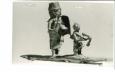
Fragment eines Altarstückes mit Kriegern Unbekannte Bronzegießerwerkstatt, Königreich Benin (?), Nigeria, 15./16. Jh. (?) / Gelbguss / Ankauf von Adolf Heemke, 1904, Inv. Nr. C 4049 Die beiden Figuren waren vermutlich Teil eines mehrfigürlichen Bronze-Altarensembles. Im Stil unterscheidet sich das Stück vom üblichen höfischen Stil der Bronzegießergilde. Es könnte sich hier um einen älteren vordynastischen Stil handeln und aus einer Werkstatt der benachbarten Ijebu-Yoruba oder der Küstenregion herstammen. Dargestellt ist ein hochrangiger Heerführer mit einem Begleiter, dessen niederer Rang durch die geringere Größe ersichtlich ist.
Label Text (eng)
Altar Piece (Fragment): Group of Warriors Unidentified bronze casting workshop, Benin Kingdom (?), Nigeria, 15th/16th century (?) / Brass / Acquired from Adolf Heemke, 1904, Inv. no. C 4049 The two figures are probably a fragment of a multi-figure bronze altar ensemble. In style, the piece differs from the usual courtly style of the bronze casters guild. It might pertain to an older pre-dynastic style, originate from a workshop of the neighbouring Ijebu-Yoruba or from the coastal region. Depicted is a high-ranking army commander with an attendant, whose lower rank is evident in his smaller size.
Maße
Breite: 8,50 cm; Höhe: 15,00 cm; Tiefe: 24,00 cm
Sensitive Content

Digital Benin collates digital material from institutions, and some of this material is inherently colonial and contains words, terms and phrases that are inaccurate, derogatory and harmful towards African and African diasporic communities. Catalogue transcriptions, book titles, exhibition titles and museum titles may contain harmful terms. We recognise the potential for the material to cause physical and mental distress as well as evoke strong emotions. Owing to the scale of the collection’s data, a process to implement sensitive-content warnings in the displayed data is still incomplete. The material within the catalogue does not represent Digital Benin’s views. Digital Benin maintains a strong anti-colonial, anti-racist position and affirms its support for centring the humanity of historically marginalised and disenfranchised communities. Read more about the background of this statement here