



Accession Number: (Registration Details)/Accession Details/Accession Number/Accession No.: (Accession Details)
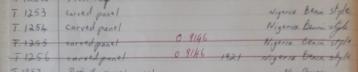
0.9146/1 (T.1255)
Institution
Manchester Museum
Edo designations
English designations
Carved Wooden Panel
Location
Oxford Rd, Manchester M13 9PL, UK
Loading...
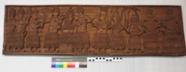
Carved Wooden Panel
Carved Wooden Panel
Carved Wooden Panel

Iconographies

10 annotations
Ẹbẹn
Ceremonial Sword

Ẹbẹn are a type of ceremonial sword of significant importance in the Benin Kingdom. During ceremonies, titled chiefs would hold them or toss them during dances, thereby paying homage to the Ọba at these public events, particularly when a chief receives a certain status. It is forbidden for Ẹbẹn to touch the ground, so the chief must take extra precautions to avoid dropping the Ẹbẹn during the dance. Therefore, the Okae-Odionmwan (head of executioners) dances with the Umozo (warfare or executioner’s sword) behind the dancing chief.

There are two central ceremonial swords used in the royal court of the Benin Kingdom, one of which is the Ẹbẹn, along with the Ada (ceremonial swords). They are distinguished by their blades: the Ẹbẹn blade reflects the shape of a leaf or an oar. Sometimes, it is decorated with openwork designs and/or brass inlays, most commonly shaped as small Ẹbẹn and Ẹkpẹn (leopards). The handle of the Ẹbẹn also has an unusual ring-shaped form, which further differentiates it from the Ada.

1 annotation
Ẹbẹn
tribal marks
Iwu
Facial and Body Markings

Iwu are facial and body markings (scarifications) that were historically worn by Edo men and women. However, since the 1960s, the practice has been nearly extinct (Aisien 2011). In the past, Iwu were used as a way of proving that one was an Edo citizen, and the ceremony of having Iwu completed was an important rite of passage for men and women. The Osiwu, who also practised circumcision and other surgical procedures, would carry out the procedure of adding Iwu. There are different types of Iwu: ‘blades’ worn on the torso (Iwu-eko), and those worn on the face, such as Ikharo (three or four markings above the eyebrows), Irho (two narrow ‘blades’ worn on each cheek), Ovbihue (nasal ‘blades’), Ovbi-agbanmwen (chin ‘blade’), and Igho-okpa/Ukpgho (three forehead ‘blades’) (Aisien 2011, p. 22).

The number of Iwu also varied depending on the identity of the person wearing them. For example, royal men would wear six ‘blades’ on their torso, whilst men who were not royal would wear seven ‘blades’. Meanwhile, the Ọba’s female children would wear fifteen ‘blades’, and all other women would wear sixteen (Aisien 2011).

1 annotation
Iwu
Traditional Drum
Ema
Traditional drum

Ema Ẹdo (Emedo) is the ‘drum of the Benin people’, made from either cowhide or leopard skin (ohian ema) and a cylindrical wooden body (erhan ema). These drums are beaten with Ukeke (strikers), the hands, or a combination of both during festivals and ceremonies ( ; ).

1 annotation
Ema
hairstyles
Eto
hairstyles

Hairstyles are used to determine a person's status in the society, as chiefs, common folks, chief's wives and the wives of the Ọba all wear different hairstyles. We have Okuku, Ikpe~okhokho, Idu~akpata

1 annotation
Eto
Fan
Ẹzuzu
Hand fan

Ẹzuzu (round hand fans) are usually carried by attendants to the Ọba or Iy’Ọba. On the Ama-Ẹrọnmwọn (bronze relief plaques), male attendants to the Ọba carry fans, whereas on Urhotọ (altar tableaux), female attendants carrying fans are depicted flanking the Iy’Ọba. Ẹzuzu connote the status of both the person being fanned and the holder, who is usually an attendant fanning the superior Ọba or Iy’Ọba. Usually, male attendants—members of the Emada—would be represented with the Ọba, while young women would attend to the Iy’Ọba. Ẹzuzu have an important function in cooling; however, the wafting of the fans can also calm spiritual energy, thus making the fan a symbol of peace ( ).

A further symbolic use for the Ẹzuzu includes blowing medicine across the surface of a fan and using mirrored fans by ritual specialists to make predictions about the future ( ). The symbolic importance of fans in Edo belief is reflected in their use as one of a small group of inanimate objects that are the focal subjects of some Ama-Ẹrọnmwọn.

1 annotation
Ẹzuzu
Ada
Ceremonial sword

The Ada is a symbol of authority usually borne in the presence of the Ọba by a designated holder, the Omada, which translates as ‘Ada bearer’. The Ọba has almost exclusive rights to the use of the Ada, except when he permits titled chiefs, such as the Oliha, to possess one. During the Ogiso period, predating the current Ọba dynasty, the Ada is said to have been a symbol of ancestral power, with the ability to control the future (Ben-Amos 1995, p. 25). The Ada is ranked higher than the Ẹbẹn, another symbolically important ceremonial sword.

1 annotation
Ada
Ewu ivie
Coral Beaded Shirt

The Ewu ivie (coral bead shirt) is made of strings of coral beads. This heavy shirt was part of the ceremonial regalia worn only by a small number of high-ranking members of the palace: the Ọba, the Edaiken, the Iy’Ọba, and the Ezọmọ (Girshick Ben-Amos 1999, p. 68). The Ewu ivie would be worn along with the Odigba (coral bead collar).

1 annotation
Ewu ivie
Ọba
King

The Ọba is the monarch of the Edo people and Kingdom. The current reigning monarch, Ọba Ẹwuare II, is the fortieth Ọba of the current dynasty, which is traditionally understood to have begun around 1170 AD ( ). Over the centuries, the role and conception of the monarch have shifted, and the Emwin Arre (royal treasures) and the visual language they carry provide important evidence for understanding these developments. Although Emwin Arhe served a variety of functions within court life and ritual, “their primary purpose was to glorify the godlike king and the history of the powerful empire” (Plankensteiner 2007, p. 25). Representations of the Ọba are therefore ubiquitous across Benin court arts and frequently occupy a central position within their visual language.

Representations of the Ọba can be recognised through a combination of characteristics, including his size, as he is usually depicted larger than other figures, and his position within compositions, where he may appear in front of or be supported by other figures, as in the Royal Triad motif. The Ọba is also distinguished by particular items of regalia, including the Oro projection from his crown, the distinctive beaded swag extending from his right hip, the Ewu ivie (coral-beaded shirt), and Ukpan obọ eva (crossed coral-beaded baldrics).

Since the early 20th century, scholars have sought to identify individual Ọbas represented on Emwin Arhe by analysing the regalia and other attributes of figures identified as monarchs, as well as the combinations of motifs and figures appearing on particular objects. Oral traditions and historical accounts, alongside European archival sources, have also played an important role in determining the identities of specific Ọbas (e.g., , ; ). Just as the institution of the monarchy developed and changed over time, so too did the ways in which Ọbas were represented by artists working within the royal guilds, including the Igun-Ẹrọnmwọn and Igbesamwan.

1 annotation
Ọba
Beaded Crown
Ẹde
Beaded Crown

Although many other members of the Benin royal court wore a variety of hats and forms of headwear, only the Ọba may wear the Ẹde (beaded crown). The Ọba must never be seen bare-headed, and successive Ọbas introduced different styles and types of crowns ( ).

Across different media and objects, Ọbas are depicted wearing various types of crowns, all elaborately crafted from coral beads. Some feature tall projections rising from the crown, known as Oro, while others have curved projections extending from either side of the head, known as the winged cap. The latter was introduced only in the 19th century, most likely by Ọba Osẹmwẹndẹ ( ). Depictions of Ọba Esigie on Ama-Ẹrọnmwọn (bronze relief plaques) show him wearing an elaborate crown decorated with large jasper or coral beads ( ).

1 annotation
Ẹde
Colar Bead
Odigba
Coral beaded collar

Odigba (coral-beaded collar) is a rigid neck collar made of coral beads, worn as part of ceremonial attire only by senior princes who have been made Enigie (Inneh 2007, p. 107). Although Ibafe (2007, p. 43) argued that the Odigba was introduced during the Ogiso period (c. 900–c. 1170 AD) by Ogiso Ere, along with other symbolically important Emwin Arhe, such as the Ada (ceremonial sword) and the Ẹbẹn (ceremonial sword), this seems unlikely, as coral was only introduced in the late 15th century through trade with Portuguese merchants.

1 annotation
Odigba

Provenance

3 events
Production
August 1921 (year approximate)
The object was produced by Opame in Benin City.
Unknown
unknown to 1958
The object is known to have come into contact with J. Sutcliffe, later in United Kingdom.
Donation
1958
The object was donated by J. Sutcliffe to the Manchester Museum from United Kingdom to Manchester.

Institution data

Manchester Museum
The data was transferred directly by the institution.
Last updated: 2022-06-24
Language: english
Institution fieldValue
Accession Number: (Registration Details)/Accession Details/Accession Number/Accession No.: (Accession Details)
object id
0.9146/1 (T.1255)
Physical Description
designation
description
A carved panel cut from a single plank of soft brown wood. One face is carved in Benin style with a seated king receiving a severed head. Attendants at the left of the picture, 2 drummers on the right. Below is carved: OKPAME -- GOODCARVR
Object Name/Object Name: (Classification)
object type
Panel Carving
Place: (Production Details)
production place
Africa, Nigeria, Benin
Accession Lot: (Collection Details)/Accession Lot: (Accession Details)
prior source
[0.9146- 0.9147] Sutcliffe, Miss J (1956-58)
Origin
provenance
Nigeria, Benin. Donated by J Sutcliffe to Manchester Museum in 1958.
Current Location/Current Location: (Current Location)
display status
Manchester Museum - Coupland 1 - Basement - B.55 - Ethnology Store - Large Africa Cupboard G - Shelf 2
Copyright
license
© The Manchester Museum, The University of Manchester Images (.tiff): © The Manchester Museum, The University of Manchester, photography by Michael Pollard
Correspondence Transcripts
Salford Museum Benin Collection Correspondence Transcripts Salford Museum Carvings - 1903’ 247-248 Bedwell Farm, Stevenage, Herts 14.IX.03 Dear Sir, I [beg] to enclose two illustrations showing ethnological specimens of acrved wood, from Benin City, West Africa, taken at the fall of the City in February 1897 by the British Punitive , under the command of Admiral Rawson. The illustrations are from Mr Websters Catalogue and he sold the pieces originally for the price of £20 + £4.10.0. I am asking £10.10.0 for the two and if you think they would be suitable for your museum I shall be very pleased to send them on approval. I have also a small axe, with turtle shell blade, from the Matty Islands - price 17/6 - these I believe are very rare. I enclose a stamped addressed envelope for return of the illustration. Yours faithfully B G L Killerby Bedwell Farm, Stevenage, Herts 22.IX.03 Dear Sir, I have sent off by passenger train G.N.R. Carriage paid in the Benin stool etc and trust they will reach you safely. If you should not decide to keep the articles you will oblige by returning them by rail - Suttons, I find knock the thing about so much. Yours faithfully B G L Killerby Bedwell Farm, Stevenage, Herts 20.X.03 Dear Sir I thank you for your letter of yesterday’s date and beg to say I will accept your offer of £6.6.0 for the two specimens of Benin Carvings. I am Dear Sir Yours faithfully B G L Killerby Bedwell Farm, Stevenage, Herts 16.X.03 My Dear Sir I thank you very much for your letter of the 14th - inset - and for putting my two specimens of Carved wood from Benin before your committee. I am afraid the gentlemen of the committee do not quite understand the rarity and value of the specimens or they would have made a better offer. The table was originally sold for £20 and the other specimen for £14.10.0 as you will see by the cuttings I sent you from Mr Websters Catalogue (https://wellcomecollection.org/works/rqmurwzt). At the death of General Pitt-Rivers (the greatest authority and collector of benin work) the two articles were sold - with a collection of others - at Staren’s Auction Rooms in London. The table was knocked down and considered very cheap at £6.0.0 and the panel I bought at the same sale for £7.12.6. Although I am anxious to sell the pieces I do not care to part with them at £2.7.6 less than they cost. Do you think the Committee would increase their offer if the smaller were place before them at the next meeting. I thought they would have been delighted to have added the objects to the museum at £10.10.0 - and to knocke the price down half seems _________! I am my dear Sir Yours Faithfully B G L Killerby ___________ Bertie Mullen Esq Stephen Welsh 19 August 2021
Sensitive Content

Digital Benin collates digital material from institutions, and some of this material is inherently colonial and contains words, terms and phrases that are inaccurate, derogatory and harmful towards African and African diasporic communities. Catalogue transcriptions, book titles, exhibition titles and museum titles may contain harmful terms. We recognise the potential for the material to cause physical and mental distress as well as evoke strong emotions. Owing to the scale of the collection’s data, a process to implement sensitive-content warnings in the displayed data is still incomplete. The material within the catalogue does not represent Digital Benin’s views. Digital Benin maintains a strong anti-colonial, anti-racist position and affirms its support for centring the humanity of historically marginalised and disenfranchised communities. Read more about the background of this statement here