
Iconographies

Provenance
Institution data
| Institution field | Value |
|---|---|
Inventory no. [ObjInventarNrS] object id | 12181 |
Object designation [ObjTitelOriginalS] designation object type | Ceremonial sword |
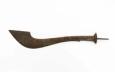
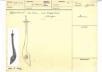
Description [ObjReserve02M] description | 12181. Curved blade, iron, covered with copper sheet, engraved circle with knot ornament. Same ornament on both sides. Handle incomplete, copper overlay broken. Damaged overall. Restoration: Heinrich Scheich "Art forms crucial to status differentiation and religious worship are attributed to Ogiso times, particularly ... the ceremonial sword (ada) .. (14) In Ogiso times the iron ceremonial sword called ada was part of the furnishings of the ancestral altar, where it expressed the power of the ancestors to control the course of events. The Edo believe that iron has the mystical power of ase to insure that whatever proclamations are made will come to pass. In the second dynasty the obas took to making public appearances accompanied by pages carrying the ada, thereby incorporating an ancient Edo sanction into the new royal symbolism. (15). Zu Abb. 11: The ada is carried by pages emada during the public appearances of the oba. It symbolizes his right to take human life. The oba delegates the ada to high ranking chiefs, who may have it carried alongside them in their own domains but not in the palace. 15./16.Jh. "Specific objects, such as ada were sent to vassal lords as emblems of their authority." (18) As an abstract concept Ogun represents the force inherent in metal, a mystical power with the potential to create or destroy. In this capacity, Ogun cannot be artistically represented, except indirectly through those objects in which the power of metal resides, such as ceremonial swords or proclamation staffs. (51) LIT Kat Pitt-Rivers 1976: pl. XVIII, 110 Ben Amos. 1980: The Art of Benin. London |
Mat./Technique [ObjTechMatM] material | Iron. Copper sheet |
Dimensions [ObjMasse1S] dimensions | L 90 |
Dating [ObjDatierungS] date made | |
Year from [ObjJahrVonL] date made | |
Year until [ObjJahrBisL] date made | |
Geographical reference [ObjGeografieS] production place | Kingdom of Benin (Africa->West Africa->Nigeria) |
Name sorting [KueSortierungS_0] prior source | Oldman, William Ockelford |
Name sorting [KueSortierungS_1] prior source | |
First Name 2 [KueVorNameS_1] provenance | |
First name [KueVorNameS_0] provenance | William Ockelford |
Function collector 2 [OkuFunktionS_1] provenance | |
Function collector [OkuFunktionS_0] provenance | Merchant |
Inventory note [ObjFeld07M] provenance | |
Last Name 2 [KueNameS_1] provenance | |
Last name [KueNameS_0] provenance | Oldman |
Date of acquisition[ObjFeld04M] accession date | ca. 1910 |
Acquisition type [ObjFeld02M] accession method | |
Comemnts[ObjCreditlineM] notes | |
Exhibition exhibition history | |
Literature bibliography | |
Type [ObjSystematikS] | Ceremonial device |
Type of ownership [ObjFeld01M] | |
Type of person 2 [KueTypS_1] | |
Type of person [KueTypS_0] | Person |
| Institution field | Value |
|---|---|
Inventarnr. [ObjInventarNrS] object id | 12181 |
Beschreibung [ObjReserve02M] description | 12181. Geschwungene Klinge, Eisen, mit Kupferblech bezogen, eingraviert Kreis mit Knotenornament. Beidseitig gleiches Ornament. Griff unvollständig, Kupferauflage gebrochen. Insgesamt beschädigt. Restaurierung: Heinrich Scheich "Art forms crucial to status differentiation and religious worship are attributed to Ogiso times, particularly ... the ceremonial sword (ada) .. (14) In Ogiso times the iron ceremonial sword called ada was part of the furnishings of the ancestral altar, where it expressed the power of the ancestors to control the course of events. The Edo believe that iron has the mystical power of ase to insure that whatever proclamations are made will come to pass. In the second dynasty the obas took to making public appearances accompanied by pages carrying the ada, thereby incorporating an ancient Edo sanction into the new royal symbolism. (15). Zu Abb. 11: The ada is carried by pages emada during the public appearances of the oba. It symbolizes his right to take human life. The oba delegates the ada to high ranking chiefs, who may have it carried alongside them in their own domains but not in the palace. 15./16.Jh. "Specific objects, such as ada were sent to vassal lords as emblems of their authority." (18) As an abstract concept Ogun represents the force inherent in metal, a mystical power with the potential to create or destroy. In this capacity, Ogun cannot be artistically represented, except indirectly through those objects in which the power of metal resides, such as ceremonial swords or proclamation staffs. (51) LIT Kat Pitt-Rivers 1976: pl. XVIII, 110 Ben Amos. 1980: The Art of Benin. London |
Mat./Technik [ObjTechMatM] material production technique | Eisen. Kupferblech |
Maßangaben [ObjMasse1S] dimensions | L 90 |
Gattung [ObjSystematikS] object type | Zeremonialgerät |
Objektbezeichnung [ObjTitelOriginalS] object type | Zeremonialschwert |
Datierung [ObjDatierungS] date made | |
Jahr bis [ObjJahrBisL] date made | |
Jahr von [ObjJahrVonL] date made | |
Geogr. Bezug [ObjGeografieS] production place | Königtum Benin (Afrika->Westafrika->Nigeria) |
Nachname 2 [KueNameS_1] prior source | |
Nachname [KueNameS_0] prior source | Oldman |
Namensortierung [KueSortierungS_0] prior source | Oldman, William Ockelford |
Namenssortierung [KueSortierungS_1] prior source | |
Vorname 2 [KueVorNameS_1] prior source | |
Vorname [KueVorNameS_0] prior source | William Ockelford |
Funktion Sammler 2 [OkuFunktionS_1] prior source role | |
Funktion Sammler [OkuFunktionS_0] prior source role | Händler |
Erwerbsdatum [ObjFeld04M] accession date | ca. 1910 |
Besitzart [ObjFeld01M] accession method | |
Erwerbungsart [ObjFeld02M] accession method | |
Bemerkungen [ObjCreditlineM] notes | |
Inventar Notiz [ObjFeld07M] notes | |
Ausstellung exhibition history | |
Literatur bibliography | |
Personentyp 2 [KueTypS_1] | |
Personentyp [KueTypS_0] | Person |
Digital Benin collates digital material from institutions, and some of this material is inherently colonial and contains words, terms and phrases that are inaccurate, derogatory and harmful towards African and African diasporic communities. Catalogue transcriptions, book titles, exhibition titles and museum titles may contain harmful terms. We recognise the potential for the material to cause physical and mental distress as well as evoke strong emotions. Owing to the scale of the collection’s data, a process to implement sensitive-content warnings in the displayed data is still incomplete. The material within the catalogue does not represent Digital Benin’s views. Digital Benin maintains a strong anti-colonial, anti-racist position and affirms its support for centring the humanity of historically marginalised and disenfranchised communities. Read more about the background of this statement here