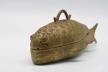
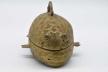
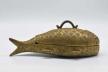
Accession Number
ETH.CAM2.962
Edo designations
English designations
Lidded bowl
Categories
Containers
Location
Quex Park, Birchington-on-Sea CT7 0BH, United Kingdom
Loading...
Lidded bowl
Lidded bowl
Lidded bowl

Iconographies

1 annotations
Ehẹn
Fish

Ehẹn is a general term used to describe various types of fish (Ọbazee 2025, p. 90; ). Although mudfish are one of the most common motifs in Benin art, other kinds of fish are also represented. According to Blackmun ( ), a greater variety of fish are represented on the Aken'ni Elao (carved tusks) than on other types of royal artefacts. According to Kathy Curnow ( ), fish appear on 70 Ama-Ẹrọnmwọn (bronze relief plaques), making them the most commonly represented animal. Despite their prevalence, the precise species of fish are not easy to identify due to their “generic renderings”, possibly indicating that artists did not always distinguish between specific varieties ( ). Fish are represented on the Ama-Ẹrọnmwọn both in profile and from above.

1 annotation
Ehẹn

Provenance

2 events
Commission
January 30, 1931
The object was commissioned by Unknown member(s) of the Igun-Ẹrọnmwọn guild from Percy Horace Gordon Powell-Cotton through Alfred Holt and Company and Harry Maddocks in Benin City.
Donation
January 30, 1931 to 1932
The object was donated by Percy Horace Gordon Powell-Cotton to the Powell-Cotton Museum with its destination in Birchington-on-Sea.

Institution data

Powell-Cotton Museum
The data was transferred directly by the institution.
Last updated: 2021-11-03
Language: english
Institution fieldValue
Accession Number
object id
ETH.CAM2.962
Description
description
object type
Brass box, shaped like a fish, finished
Provenance Information
provenance
Purchased on 30/01/1931 in Benin City
Additional Notes
notes
See Diary entry for Percy Horace Powell-Cotton visit to Benin
Sensitive Content

Digital Benin collates digital material from institutions, and some of this material is inherently colonial and contains words, terms and phrases that are inaccurate, derogatory and harmful towards African and African diasporic communities. Catalogue transcriptions, book titles, exhibition titles and museum titles may contain harmful terms. We recognise the potential for the material to cause physical and mental distress as well as evoke strong emotions. Owing to the scale of the collection’s data, a process to implement sensitive-content warnings in the displayed data is still incomplete. The material within the catalogue does not represent Digital Benin’s views. Digital Benin maintains a strong anti-colonial, anti-racist position and affirms its support for centring the humanity of historically marginalised and disenfranchised communities. Read more about the background of this statement here