



Iconographies


Provenance
Institution data
| Institution field | Value |
|---|---|
Registration number object id | Af1898,1025.1 |
PRN object id | EAF14572 |
Object Type designation | helmet mask |
Description description | Odudua helmet mask; lost-wax cast in brass. In form of human head with central crest; tiered hairstyle and beaded headband. Four raised scarification marks over each eye; pupils inlaid with iron. Teeth bared. Pierced with holes around base. |
Ethnic name (made by) ethnic attribution | Edo |
Date | 18thC(late) (circa) |
Production place production place | Made in: Benin City |
Findspot place collected | Found/Acquired: Benin City |
Materials material | brass ~iron |
Technique production technique | lost-wax cast ~inlaid |
Dimensions dimensions | Height: 34.00 cm~Width: 20.00 cm~Depth: 25.00 cm~Weight: 7.00 kg |
Curator’s comments provenance | This brass helmet is used in the Ododua ritual, in honour of the father of Oranmiyan, the legendary founder of the ruling dynasty. The dance is performed by seven masqueraders who wear brass helmets and carry ceremonial swords to signify their high status. They dance back and forth before the Oba seven times as a sign of their commitment and loyalty. P. Girshick Ben-Amos, The art of Benin (London, The British Museum Press, 1995); Read & Dalton 1899: Life-sized model of the head of a native in brass. The hair is cut in parallel lines, and the brows are encircled by a fillet of coral beads, to which are attached larger beads. On the top is a high crest with three groups of tubes (beads ?), and an openwork border formed of a plaited strip supporting fusiform beads. On either side of the head are four plaits and on each eyebrow four cicatrices. The pupils of the eyes are of iron. |
Bibliographic references bibliography | Read & Dalton 1899: pl X.3 |
Exhibition history exhibition history | Exhibited: 1970-1973, London, Museum of Mankind, Divine Kingship in Africa 1991 Feb-Apr, Norwich, Sainsbury Centre for Visual Arts, Man and Metal in Ancient Nigeria |
Condition condition | Good. |
Associated events event | Associated Event: British Expedition to Benin City - Feb 1897 |
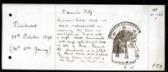
Acquisition name (acquisition) provenance | William Young |
Acquisition date accession date | 1898 |
Acquisition notes (excavation) provenance | Looted during British Expedition to Benin City, 1897. |
Digital Benin collates digital material from institutions, and some of this material is inherently colonial and contains words, terms and phrases that are inaccurate, derogatory and harmful towards African and African diasporic communities. Catalogue transcriptions, book titles, exhibition titles and museum titles may contain harmful terms. We recognise the potential for the material to cause physical and mental distress as well as evoke strong emotions. Owing to the scale of the collection’s data, a process to implement sensitive-content warnings in the displayed data is still incomplete. The material within the catalogue does not represent Digital Benin’s views. Digital Benin maintains a strong anti-colonial, anti-racist position and affirms its support for centring the humanity of historically marginalised and disenfranchised communities. Read more about the background of this statement here