



Registration number
Af1898,0115.144
Institution
British Museum
Edo designations
English designations
Relief Plaque
Categories
Palace Architecture & Ornamentation
Location
Great Russell St, Bloomsbury, London WC1B 3DG, United Kingdom
Loading...

Iconographies

19 annotations
Colar Bead
Odigba
Coral beaded collar

Odigba (coral-beaded collar) is a rigid neck collar made of coral beads, worn as part of ceremonial attire only by senior princes who have been made Enigie (Inneh 2007, p. 107). Although Ibafe (2007, p. 43) argued that the Odigba was introduced during the Ogiso period (c. 900–c. 1170 AD) by Ogiso Ere, along with other symbolically important Emwin Arhe, such as the Ada (ceremonial sword) and the Ẹbẹn (ceremonial sword), this seems unlikely, as coral was only introduced in the late 15th century through trade with Portuguese merchants.

3 annotations
Odigba
Odigba
Odigba
hairstyles
Eto
hairstyles

Hairstyles are used to determine a person's status in the society, as chiefs, common folks, chief's wives and the wives of the Ọba all wear different hairstyles. We have Okuku, Ikpe~okhokho, Idu~akpata

1 annotation
Eto
Round Neck Bead
Ikele
Coral bead circlet

Ikele is a single stiff string or circlet of coral beads. It is worn by chiefs, such as senior chiefs who have been made Enigie (Inneh 2007, p.107), and is a sign of nobility and rank. The Ikele may only be worn once the Ọba has conferred a person with the right to wear the beads, and the Ikele must always be worn when appearing before the Ọba. According to Ekhaguosa Aisien (in Plankensteiner 2007, cat. nr. 301, p.512) when a chief is wearing the Ikele, they may not eat nor drink in public, and they “constitute an embassy of the Benin Palace wherever he might be.”

3 annotations
Ikele
Ikele
Ikele
Orhiẹvbẹ
Kola Nut Bowl

Orhiẹvbẹ are boxes or bowls used to store and present kola nuts and other items for offering, particularly in ceremonial and ritual contexts. Kola nuts were, and continue to be, presented to guests by hosts as a gesture of courtesy and friendship, as well as a symbol of peace, order, and civilisation ( ; ).

Orhiẹvbẹ are incorporated into the imagery of Ama-Ẹrọnmwọn (bronze relief plaques), where they are often held by attendants, indicating the presentation of offerings, particularly to the Ọba. Those depicted among the Emwin Arre (royal treasures) take a variety of forms, ranging from simple round or oval bowls and lidded vessels to examples shaped as antelope heads.

1 annotation
Orhiẹvbẹ
Uhunmwu-Ẹkuẹ
Pendant Mask

Uhunmwu-Ẹkuẹ (pendant masks) formed part of the ceremonial regalia worn by court dignitaries to indicate their rank or function and are frequently represented among the Emwin Arhe (royal treasures), particularly those made of brass, bronze, or ivory.

Different animals were depicted on Uhunmwu-Ẹkuẹ, particularly the heads of leopards and crocodiles. The most common type features the face or head of an Ọba. Other examples take the form of an elephant head incorporating the trunk-hand motif, a ram’s head, or, in a very small number of cases, the face of a Portuguese man. Different figures appear to have worn Uhunmwu-Ẹkuẹ with different imagery. For example, warrior chiefs are often depicted wearing leopard-head pendant masks, whereas crocodile-head Uhunmwu-Ẹkuẹ are generally shown being worn only by the Ọba and his Enọbare (Blackmun 2007, cat. no. 137, p. 365).

3 annotations
Uhunmwu-Ẹkuẹ
Uhunmwu-Ẹkuẹ
Uhunmwu-Ẹkuẹ
Ikharo
Forehead markings

Ikharo are linear keloid markings depicted on the forehead of Uhunmwu-Elao (commemorative heads) in groups of three or four above each eye. The exact meaning of Ikharo is debated; some have argued that they relate to the gender or tribal identification of the person on whom they are depicted. For example, has argued that they were worn only by men; however, their use in depictions is not consistent with this, and the Iy’Ọba are also shown wearing them. argued that they are instead a stylistic feature employed by artists that varied over time.

The naming of these markings differs between publications. For example, describe these markings as “agbaguda n'ehae”, which they write translates literally as “blades of the forehead”. However, later went on to call these “ikharo”, as used here. referred to these forehead markings as ikharo, meaning “tribal mark [of eye]”.

3 annotations
Ikharo
Ikharo
Ikharo
Iru
Sacred jug

On the Ama-Ẹrọnmwọn (bronze relief plaques) and Aken'ni Elao (carved tusks), a particularly sacred type of brass Iru is shown being carried by members of the Emuru. These are globular jug-like vessels cast in brass with a long neck, topped with a ram’s head form. However, fragments of a similarly shaped bronze object (E 1902.457) have been identified, suggesting that this may have been a rattle rather than a vessel ( ).

Members of the Emuru guild, which dates back to the reign of Ọba Ẹwuare I, are shown holding Iru, particularly on the Ama-Ẹrọnmwọn. According to oral tradition, these Iru were taken by Ọba Ewuare from Olokun’s palace. Their spiritual powers were manifested through voices chanting “ise,” the affirmation used in Edo prayers. However, when Olua succeeded Ẹwuare I, he smashed the Uru and found nothing inside them. Only afterwards were the Emuru instructed to carry Uru resembling those taken by Ewuare ( ; ; Chief Osuma in Bradbury 1958, B.S. 113).

1 annotation
Iru
tribal marks
Iwu
Facial and Body Markings

Iwu are facial and body markings (scarifications) that were historically worn by Edo men and women. However, since the 1960s, the practice has been nearly extinct (Aisien 2011). In the past, Iwu were used as a way of proving that one was an Edo citizen, and the ceremony of having Iwu completed was an important rite of passage for men and women. The Osiwu, who also practised circumcision and other surgical procedures, would carry out the procedure of adding Iwu. There are different types of Iwu: ‘blades’ worn on the torso (Iwu-eko), and those worn on the face, such as Ikharo (three or four markings above the eyebrows), Irho (two narrow ‘blades’ worn on each cheek), Ovbihue (nasal ‘blades’), Ovbi-agbanmwen (chin ‘blade’), and Igho-okpa/Ukpgho (three forehead ‘blades’) (Aisien 2011, p. 22).

The number of Iwu also varied depending on the identity of the person wearing them. For example, royal men would wear six ‘blades’ on their torso, whilst men who were not royal would wear seven ‘blades’. Meanwhile, the Ọba’s female children would wear fifteen ‘blades’, and all other women would wear sixteen (Aisien 2011).

3 annotations
Iwu
Iwu
Iwu
Water fern
Ebe Amẹ
Water Fern

Ebe Amẹ refers to a wide variety of plants, particularly the leaves of the water fern or river leaf, found in riverine areas of southern Nigeria ( ). Artists from the Igun-Ẹrọnmwọn used these as a decorative motif in the background of most Ama-Ẹrọnmwọn (bronze relief plaques). The petals of the Ebe Amẹ, like the points of the ἀghàdàgháda (crossroads), represent the four cardinal directions: north, east, south, and west. The number four plays a foundational role in the Edo calendar, which is structured around four market days ( ).

1 annotation
Ebe Amẹ

Related oral histories

1 interviews

Provenance

7 events
Production
1504 (approximate) to 1550 (approximate)
The object was produced by Ine N’Igun-Ẹrọnmwọn in Benin City.
Looted
February 22, 1897 (day approximate) to June 1899 (year approximate)
The object was looted by Ralph Denham Rayment Moor from Benin Kingdom.
Transfer
March 19, 1897 (day approximate)
The object was transferred from Ralph Denham Rayment Moor to British Foreign Office from Benin City to London.
Loan
September 7, 1897 to January 1898 (month approximate)
The object was loaned by British Foreign Office to the British Museum through Crown Agents for the Colonies in London.
Donation
January 15, 1898
The object was donated by British Foreign Office to the British Museum in London.
Exhibition
1970 to 1973
The object was exhibited at London.
Exhibition
February 1, 1991 to April 30, 1991
The object was exhibited at Norwich.

Related archival documents

1 documents
See all
Date

Institution data

British Museum
The data was transferred directly by the institution.
Last updated: 2025-06-10
Language: english
Institution fieldValue
Registration number
object id
Af1898,0115.144
Additional IDs
object id
157 (Foreign Office number)
PRN
object id
EAF26566
Object Type
designation
plaque
Description
description
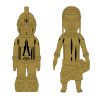
Relief plaque, lost-wax cast in brass. Wide plaque, rectangular in form with side flanges. Background surface decorated with river leaf patterns and stippling. Three (?) nail holes along top right and centre, partial hole at top left. Depicts three standing figures, facing front, each holding vessel in both hands. Figure on right holds handled cup with projections, central figure holds shallow bowl, figure on left holds small handled jug. Figures have tiered hairstyles with coils of plaited hair on either side of heads. Wear short beaded collars, two beaded necklaces, armlets, anklets, and patterned wrap-around skirts.
Ethnic name (made by)
ethnic attribution
Edo
Date
16thC-17thC
Production place
production place
Made in: Benin City
Findspot
place collected
Found/Acquired: Benin City
Materials
material
brass
Technique
production technique
lost-wax cast
Dimensions
dimensions
Height: 45.00 cm~Width: 36.00 cm~Depth: 13.00 cm
Curator’s comments
provenance
The relief brass plaques that used to decorate the Oba's (king's) palace are among the most well-known of all the royal arts of Benin. Although frequently described as 'Benin Bronzes' most plaques are made of leaded brass in various compositions. It is widely accepted that they date to the 16th-17th centuries. In the years prior to the British royal influence in Benin was increasingly under threat from rival powers, both internal and external, with a focus on economic power and control of the important trading monopolies. However, the court and palace remained the political and spiritual centre of the Benin Kingdom. Earlier accounts written by Europeans visiting the city describe its size and scale. The palace complex was set up around atrium courtyards; some had galleries with wooden pillars supporting the roof. Brass plaques, probably made in matching pairs, were fixed to these pillars. The Benin brass plaques represent a distinct and unique corpus of work, unparalleled elsewhere on the continent. They are cast using the cire perdue (lost wax) technique and show significant variation in the depth of the relief. Some of the plaques portray historical events or commemorate successful wars, while others are a vivid depiction of Benin court life and ritual. Several groups of plaques show clear stylistic similarities. William B. Fagg suggested that these plaques represent the work of master brass casters. Fagg, William, 1973, 'Nigerian Images', London: Lund Humphries Gunsch, Kathryn, 2018, 'Benin plaques: a 16th century imperial monument', London: Routledge, Taylor and Francis Group ; Read & Dalton 1899: Three figures with the hair dressed in overlapping layers, and with spiral coils at the sides, as in Af1898,0115.13 They are bare to the waist and wear loin-cloths. They wear anklets resembling the armlets of Af1898,0115.66. Each holds with both hands a vessel of a different shape, one a small jug, another a shallow bowl, the third a vessel with two handles and two projections.
Bibliographic references
bibliography
Gunsch 2018: ~Read & Dalton 1899: pl XXVIII.2
Exhibition history
exhibition history
Exhibited: 1970-1973, London, Museum of Mankind, Divine Kingship in Africa 1991 Feb-Apr, Norwich, Sainsbury Centre for Visual Arts, Man and Metal in Ancient Nigeria
Condition
condition
Fair; missing top left corner. Entire bottom edge missing sections; bottom left side missing. Hole at top of plaque above central figure's head.
Subjects
iconography
palace/mansion
Associated events
event
Associated Event: British to Benin City - Feb 1897
Acquisition name (acquisition)
provenance
Secretary of State for Foreign Affairs
Acquisition date
accession date
1898
Acquisition notes (excavation)
provenance
This plaque was looted during the British to Benin City in 1897.
Sensitive Content

Digital Benin collates digital material from institutions, and some of this material is inherently colonial and contains words, terms and phrases that are inaccurate, derogatory and harmful towards African and African diasporic communities. Catalogue transcriptions, book titles, exhibition titles and museum titles may contain harmful terms. We recognise the potential for the material to cause physical and mental distress as well as evoke strong emotions. Owing to the scale of the collection’s data, a process to implement sensitive-content warnings in the displayed data is still incomplete. The material within the catalogue does not represent Digital Benin’s views. Digital Benin maintains a strong anti-colonial, anti-racist position and affirms its support for centring the humanity of historically marginalised and disenfranchised communities. Read more about the background of this statement here