




Iconographies





Provenance
Institution data
| Institution field | Value |
|---|---|
Registration number object id | Af1898,0115.10 |
Additional IDs object id | 307 (Foreign Office number) |
PRN object id | EAF26476 |
Object Type designation | plaque |
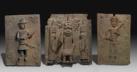
Description description | Relief plaque, lost-wax cast in brass. Wide plaque, rectangular in form with side flanges. Background surface decorated with river leaf patterns and stippling. Two (possibly three) nail holes at top of plaque, two holes at centre (one filled in), three holes at bottom. Depicts standing European (Portuguese) soldier in low relief. Holds crossbow in left hand, three crossbow feathered bolts in right hand and cric at wiast. Fork to tighten strings on crossbow hangs from left side of belt. Figure has long hair and wears domed helmet. Dressed in sleeveless doublet, with long-sleeved part-patterned tunic below. Short pleated patterned 'skirt' with patterned breeches and hose. |
Ethnic name (made by) ethnic attribution | Edo |
Date | 16thC-17thC |
Production place production place | Made in: Benin City |
Findspot place collected | Found/Acquired: Benin City |
Materials material | brass |
Technique production technique | lost-wax cast |
Dimensions dimensions | Height: 46.40 cm~Width: 31.20 cm~Depth: 5.20 cm~Weight: 6.54 kg |
Curator’s comments provenance | The relief brass plaques that used to decorate the Oba's (king's) palace are among the most well-known of all the royal arts of Benin. Although frequently described as 'Benin Bronzes' most plaques are made of leaded brass in various compositions. It is widely accepted that they date to the 16th-17th centuries. In the years prior to the British Expedition royal influence in Benin was increasingly under threat from rival powers, both internal and external, with a focus on economic power and control of the important trading monopolies. However, the court and palace remained the political and spiritual centre of the Benin Kingdom. Earlier accounts written by Europeans visiting the city describe its size and scale. The palace complex was set up around atrium courtyards; some had galleries with wooden pillars supporting the roof. Brass plaques, probably made in matching pairs, were fixed to these pillars. The Benin brass plaques represent a distinct and unique corpus of work, unparalleled elsewhere on the continent. They are cast using the cire perdue (lost wax) technique and show significant variation in the depth of the relief. Some of the plaques portray historical events or commemorate successful wars, while others are a vivid depiction of Benin court life and ritual. Several groups of plaques show clear stylistic similarities. William B. Fagg suggested that these plaques represent the work of master brass casters. Fagg, William, 1973, 'Nigerian Images', London: Lund Humphries Gunsch, Kathryn, 2018, 'Benin plaques: a 16th century imperial monument', London: Routledge, Taylor and Francis Group ; Folllowing Gunsch (2018) the flange patterns on this plaque belong to the single-woven curve flange pattern group. ; Read & Dalton 1899: 'Standing figure of a long-haired European holding a crossbow over his left shoulder, and three feathered bolts in his right hand. Each bolt is of a different kind, one having a point, the second a chisel edge, and the third a blunt head like a bird-arrow. He wears a hemispherical hat and frontal band, a sleeveless surcoat over a sleeved jerkin, a short pleated skirt, short breeches and boots. At his left side hangs the cranequin or cric for bending his crossbow.' |
Bibliographic references bibliography | Gunsch 2018: p.75; p.86; fig.5.19~Read & Dalton 1899: pl XIV.1 |
Exhibition history exhibition history | 1965, Oxford, Pitt Rivers Museum, Art from the Guinea Coast 1970-1973, London, Museum of Mankind, Divine Kingship in Africa 1997-1998 Sep-Jan, Osaka, National Museum of Ethnology, Images of Other Cultures 1998, Feb-Apr, Tokyo, Setagaya Art Museum, Images of Other Cultures 2003, Apr-Sep, BM, 'Museum of the Mind: Art and Memory in World Cultures' 2007 23 Jun-16 Sep, USA, Washington DC, Freer Gallery of Art & Arthur M Sackler Gallery, Encompassing the Globe: Portugal and the World in the 16th and 17th Centuries 2007 27 Oct-2008 3 Feb, Belgium, Brussels, Palais des Beaux-Arts, Encompassing the Globe: Portugal and the World in the 16th and 17th Centuries 2014 23 Apr-01 Aug, Manarat Al Saadiyat, Abu Dhabi, 'A History of the World in 100 Objects' 2014-2015 13 Dec-15 Mar, National Palace Museum, Taipei, 'A History of the World in 100 Objects' 2019 15 May-9 Sep, Hong Kong Heritage Museum, 'A History of the World in 100 Objects' 2015 18 Apr–28 Jun, Tokyo Metropolitan Art Museum, Tokyo, 'A History of the World in 100 Objects' 2015 14 Jul–6 Sep, Kyushu National Museum, Dazaifu, 'A History of the World in 100 Objects' 2015-2016 20 Sep-11 Jan, Kobe City Museum, Kobe, 'A History of the World in 100 Objects' 2016 13 Feb-18 Jun, National Museum of Western Australia, Perth, 'A History of the World in 100 Objects' 2016-2017 08 Sep-29 Jan, National Museum of Australia, Canberra, 'A History of the World in 100 Objects' 2017 1 Mar-31 May, National Museum of China, Beijing, 'A History of the World in 100 Objects' 2017 28 Jun-08 Oct, Shanghai Museum, Shanghai, 'A History of the World in 100 Objects' 2018 19 Apr-22 Jul, Musée des Beaux-Arts, Valenciennes, 'A History of the World in 100 Objects' 2019 15 May-9 Sept, Hong Kong Heritage Museum, 'A History of the World in 100 Objects' |
Condition condition | Good; missing section from centre top edge. Crack in top edge at right side. Crack around figure's helmet. Crack at lower left edge. |
Subjects iconography | european ~palace/mansion ~arms/armour |
Associated events event | Associated Event: British Expedition to Benin City - Feb 1897 |
Acquisition name (acquisition) provenance | Secretary of State for Foreign Affairs |
Acquisition date accession date | 1898 |
Acquisition notes (excavation) provenance | This plaque was looted during the British Expedition to Benin City in 1897. |
Digital Benin collates digital material from institutions, and some of this material is inherently colonial and contains words, terms and phrases that are inaccurate, derogatory and harmful towards African and African diasporic communities. Catalogue transcriptions, book titles, exhibition titles and museum titles may contain harmful terms. We recognise the potential for the material to cause physical and mental distress as well as evoke strong emotions. Owing to the scale of the collection’s data, a process to implement sensitive-content warnings in the displayed data is still incomplete. The material within the catalogue does not represent Digital Benin’s views. Digital Benin maintains a strong anti-colonial, anti-racist position and affirms its support for centring the humanity of historically marginalised and disenfranchised communities. Read more about the background of this statement here