


Iconographies








Provenance
Institution data
| Institution field | Value |
|---|---|
INV_NR object id | MAf 34587 |
OBJEKTE_ID object id | 1795324 |
KURZTITEL designation | Reliefplatte |
Object-name-and-materials designation material | Reliefplatte: Drei Würdenträger mit Gefäßen Gelbguss (Messing) |
TITEL designation | Reliefplatte: Drei Würdenträger mit Gefäßen |
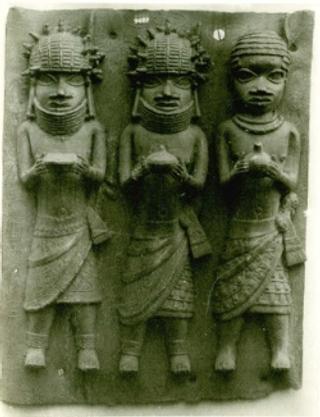
INTERNETKOMMENTAR description notes | Die Reliefplatte ist Bestandteil des kulturellen und künstlerischen Erbe des vermutlich 800jährigen Königreiches von Benin. Das Königreich, welches auf dem Gebiet des heutigen südwestlichen Nigeria gelegen hat, wurde 1897 von den Briten erobert und die höfischen Kunstwerke gelangten als Kriegsbeute nach Europa. Bronzene Reliefplatten überzogen die Säulen des Palastes des Oba in Benin City. Die Tafeln zeigen Aspekte des höfischen Lebens und sind Zeugen der Geschichte des Königreiches. Dargestellt sind hier drei frontal abgebildete Würdenträger mit jeweils einem bronzenes Gefäß vor ihrer Brust, welches von ihren Händen umschlossen wird. Die zwei linken Figuren gleichen sich in ihrer Darstellung. So besitzen sie perlenverzierte Helme mit einer Feder, einen siebenreihigen Perlenkragen sowie weiteren Perlenschmuck um Hand- und Fußgelenke. Die rechte Figur trägt keinen Helm und so ist ihr in überlappende Ringlagen geschnittenes Haar zu erkennen. Auffällig sind bei dieser Figur auch die Gesichtsskarifikationen über den Augenbrauen. Alle drei Figuren tragen verzierte Schurze, wobei der rechte eine rein geometrische Musterung aufweist und die beiden übrigen zusätzlich auch Köpfe von Europäern abbilden. Den Hintergrund der Platte zieren florale Ornamente.|(SB) |
KATALOGTEXT description | |
MATERIAL material | Messing |
MASSEBEMERKUNG dimensions | 44,5 x 34 x 9 cm |
MASSETABANGABE dimensions | Gesamt |
MASSETABBEMERKUNG dimensions | |
MASSETABBREITE dimensions | 34 |
MASSETABDURCHMESSER dimensions | |
MASSETABEINHEITLAENGE dimensions | cm |
MASSETABEINHEITLAENGE_IDS dimensions | 1 |
MASSETABHOEHE dimensions | 44,5 |
MASSETABTIEFE dimensions | 9 |
Dimensions_weight weight | H: 44,5 cm W: 34 cm X: 9 cm |
MASSETABEINHEITGEWICHT weight | |
MASSETABEINHEITGEWICHT_ID weight | |
MASSETABGEWICHT weight | |
OBJEKTBEZ object type | Plastik |
KONVOLUT provenance object count | SES Benin-Objekte; SES Dossier Benin-Objekte, Überlieferung an die Kontaktstelle für Sammlungsgut aus kolonialen Kontexten |
ORT_DATUM_BIS date made | 1699;1897 |
ORT_DATUM_KONKRET date made | ';' |
ORT_DATUM_VON date made | 1500; |
MATTECHBEMERKUNG production technique | Gelbguss|Bronze (Gelbguß)|Ms (Restaurierung, Import 2016) |
TECHNIK production technique | gegossen |
ORTE production place | Federal Republic of Nigeria;Benin City |
ORTZEITBEMERKUNG production place | Königreich Benin, vor 1897, wohl 16./17.Jh.| |
Ort_Zeit-Bemerkung production place | Königreich Benin, vor 1897, wohl 16./17.Jh. |
REGIONEN production place | Benin |
Collector/Previous-owner prior source | Hans Meyer |
ERWERBUNG prior source | Ankauf 2001 von Erbengemeinschaft Meyer mittels Finanzierungsverbund (u. a. Kulturstiftung der Länder, Freistaat Sachsen, BKM, Ernst von Siemens-Stiftung und Stadt Leipzig) |
PERSON prior source | unbekannt;Webster, William Downing;Meyer, Hans |
Acquisition-Details provenance | Purchased by Finanzierungsverbund (Kulturstiftung der Länder, der Freistaat Sachsen, usw.) |
EIGENTUEMER provenance | |
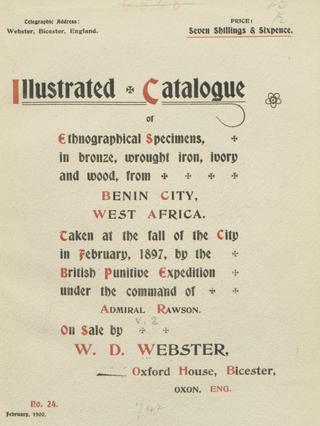
PROVENIENZ provenance | Händler: W. D. Webster (bis ?); Sammler: Hans Meyer (bis 1929); Elisabeth Meyer (bis 1946); Erbengemeinschaft Meyer (bis 2001) |
PROVENIENZSTATUS provenance | |
EREIGNISSE event | ;; |
ETHNIEN ethnic attribution | |
Institution department and institution | Staatliche Ethnographische Sammlungen Sachsen - GRASSI Museum für Völkerkunde Leipzig |
MUSEUM department and institution | MVL |
Institutional-acquisition-date accession date | 2001 |
Comments notes | Hans Heinrich Joseph Meyer, 1858-1929, German Explorer, Editor, Africanist, professor of colonial history in Leipzig |
PRAESENZ display status | ausgestellt |
BIBLIOGRAPHIE bibliography | '- Ben-Amos, 1980, S. 18; |- Blier, 1998, S. 64; |- Duchâteau, 1993, 9b H. Meyer; |- Göbel, 1994, S.70; |- von Luschan, 1919, VIII, S. 98; |- Patrimonia 220, 2002, S. 102f; |- Kunstwerke der Welt, Afrika, Leipzig, 2008, S. 30f. |
ERWAEHNTIN bibliography | |
LITERATUR bibliography | Gunsch, K.W.: The Benin Plaques: A Singular Monument. in: Tribal Art. N° 88 Summer 2018. S. 98-113|| |
LIT_LITERATUR bibliography | Göbel 2002 [Kunst aus Benin - Sa...];Meyer 1994;Gunsch 2018;Wysocki Gunsch 2018;Deimel 2008 |
BILDUNTERSCHRIFT images | |
ALTINVENTARE | lfd. Nr. Leihliste: 52; Hans Meyer (s. L 1929/2) |
AUTHENTIZITAETSZUSATZ | ;; |
AUTHZUSAETZE_IDS | ;; |
Additional-IDs | 9487; 9 b (H. Meyer number) |
Dokumentname | MAf 34587_v |
EREIGNISSE_IDS | ;; |
ETHNIEN_IDS | |
ETH_AUTHZUSAETZE | |
ETH_AUTHZUSAETZE_IDS | |
ETH_EREIGNISSE | |
ETH_EREIGNIS_IDS | |
FERTIG | 1 |
FLAG | EXP |
FOTOFELD | Neg. Af Obj. 5841|Publ.Dia: PD 354 |
FUNKTION | Hersteller;Händler;Sammler |
GEAENDERT_AM | |
GLEICHRANGIG | |
GND_ID_OBEZ | 22955 |
GND_ID_SCHLAGWORT | 9470;116012;42159;20280;22955;24148 |
GRUNDDATEN | 1 |
INTERNETFREIGABE | 1 |
INVENTURDATUM | 11.10.05;19.03.18 |
INVNR_MERKMALE_IDS | 577;581;581;581;577;577 |
KONVOLUTE_IDS | 959;1409 |
KOORDINATEN | (10 8);(6,33504 5,62749) |
LEIHVERKEHR | |
LIT_ABBILDUNG | Tafel XX;;;Fig. 6.14; |
LIT_BAND_SEITE | Bd. 220/S.103;S. 70;S. 98-113;S. 131;S. 30-31 |
LIT_BEMERKUNG | schwarz-weiss;schwarz-weiss;;s/w; |
LIT_LITERATUR_IDS | 184;681;2783;3121;1563 |
LIT_NUMMERE | ;;;; |
LIT_STA_INETFREIGABE | 1;1;1;1;1 |
MAND_ID | 1 |
MATERIALIEN_IDS | 1074 |
MERKMAL | Aktenstück;Originalnummer;Originalnummer;Originalnummer;Aktenstück;Aktenstück |
MUSEEN_ID | 34 |
ORTE_IDS | 2328926;2347283 |
ORT_AUTHZUSAETZE | ; |
ORT_AUTHZUSAETZE_IDS | ; |
ORT_BEZUG | ; |
ORT_EREIGNISSE | Herstellung;Sammelereignis |
ORT_EREIGNISSE_IDS | 12;17 |
PND_BEZUG | ;; |
PND_FUNKTIONEN_IDS | -2;645;642 |
PND_INETFREIGABE | 1;1;1 |
PND_PERSONEN_IDS | 12797488;12821279;11145307 |
PRAESENZEN_WERT_ID | -38 |
PROVSTATUS_WERT_ID | |
REGIONEN_IDS | 612 |
REG_EREIGNISSE | Sammelereignis |
REG_EREIGNIS_IDS | 17 |
SAMMLUNG | Afrika |
SAMMLUNGEN_ID | 534 |
SCHLAGWORT | Architektur;Hofstaat;Kunst;Mann;Plastik;Relief |
TECHNIKEN_IDS | 75 |
UNTERGEORDNET | |
VORLAGEN | |
WEITERE_NUMMERN | 2001/14;9487 (Webster);9 b H. Meyer;1919/18;L 1929/2;1989/21 |
WISSENSCHAFT | 1 |
XRAY | ### |
Digital Benin collates digital material from institutions, and some of this material is inherently colonial and contains words, terms and phrases that are inaccurate, derogatory and harmful towards African and African diasporic communities. Catalogue transcriptions, book titles, exhibition titles and museum titles may contain harmful terms. We recognise the potential for the material to cause physical and mental distress as well as evoke strong emotions. Owing to the scale of the collection’s data, a process to implement sensitive-content warnings in the displayed data is still incomplete. The material within the catalogue does not represent Digital Benin’s views. Digital Benin maintains a strong anti-colonial, anti-racist position and affirms its support for centring the humanity of historically marginalised and disenfranchised communities. Read more about the background of this statement here