
Reg No.
RAF 606
English designations
Figure Group
Categories
Altar & Shrine Objects
Ceremonial Objects
Location
Gablerstrasse 15, 8002 Zürich, Switzerland
Loading...
Figure Group
Figure Group

Iconographies

5 annotations
Ubanu'hi / Obanu'hi
Ubanu'hi / Obanu'hi
Inifinity Symbol

The Ubanu'hi (infinity symbol) is a kind of guilloche or interlaced strapwork motif that can be angular or rounded. It was used by Edo artists in the decoration of many Emwin Arhe (royal treasures) and is ubiquitous in Benin royal arts. Ubanu'hi is a shortened form of “uba no Ọba ya de agbon ke ehimwin yi”, which means “the rope with which the Ọba ties the heaven and earth together” (pers. comm. Chief John Igbineweka Inneh n’Igbesawman, 2022). Similarly, Paula Ben-Amos Girshick (in Plankensteiner 2007, pp. 339, 341) described this as “Ọba n’iri agbon”, or the “rope of the world” pattern.

According to Ọbabanmu Ineh (in Blackmun 1984, p. 51), the use of this motif indicates that objects were carved by members of the Igbesanmwan. However, the motif is found on all types of Emwin Arhe (royal treasures), not only those made of ivory or wood. On the flanges of the Ama (relief plaques) alone, Kathryn Gunsch (2018, pp. 75–77) identified three different versions of the Ubanu'hi and, through her analysis of over 850 plaques, found that these different Ubanu'hi forms align with other characteristics, such as dimensions, the prevalence of ornamental motifs, and stylistic qualities. Together, these provide evidence, she argues, of different production groups among the plaque makers .

Kate Ezra (1992, pp. 209, 264) went on to argue that the use of these motifs indicates that certain objects were used in a “royal context” and were associated with “royal patronage”.

1 annotation
Ubanu'hi / Obanu'hi
Oro
Headdress/crown with single projection

Figures wearing a headdress with a single protrusion from the crown of the head, known as the Oro, are found only among the Ọba and a select category of palace dignitaries whose ancestors originated in ancient Ile Ife ( ; Ọbazee 2025, p. 407). Only the Osa and Osuan, custodians of the Uwen and Ora deities, as well as members of the Emuru, who are responsible for the care of Iru vessels, may wear a headdress with the Oro. The identification of different figures is therefore interpreted based on the combination of the Oro with other items of regalia. Artists in the Igun-Ẹrọnmwọn and Igbesamwan depicted figures with the Oro on Ama-Ẹrọnmwọn (bronze relief plaques) and Aken'ni Elao (carved tusks), respectively. The Oro would either be made of coral beads as part of the crown or headdress, or be woven from itoto fibre ( ).

1 annotation
Oro
Ukpan obọ eva
Crossed Beaded Baldrics

The Ukpan obọ eva (coral-bead crossed baldrics) were worn as part of the ehaingbehia, the full ceremonial regalia, by only high-ranking members of the palace, including the Ọba himself, the Iy’Ọba, the Edaiken, and the Ezọmọ (Ben-Amos 1999, pp. 68, 141; Osadolor in Plankensteiner 2007, cat. no. 70, pp. 322–323).

1 annotation
Ukpan obọ eva
Colar Bead
Odigba
Coral beaded collar

Odigba (coral-beaded collar) is a rigid neck collar made of coral beads, worn as part of ceremonial attire only by senior princes who have been made Enigie (Inneh 2007, p. 107). Although Ibafe (2007, p. 43) argued that the Odigba was introduced during the Ogiso period (c. 900–c. 1170 AD) by Ogiso Ere, along with other symbolically important Emwin Arhe, such as the Ada (ceremonial sword) and the Ẹbẹn (ceremonial sword), this seems unlikely, as coral was only introduced in the late 15th century through trade with Portuguese merchants.

1 annotation
Odigba
Iviawẹ
Stacked Beaded Anklet

Ọba gha ye Ivie gie ọwan, ẹ ghi tama rẹn ehe nọ gha bae yi (When the Ọba gifts you a bead, he doesn’t tell you how to wear it) (Daniel Inneh, pers. comm., 27 September 2025).

Iviawẹ (also spelled ĺvîowẹ) are coral-beaded anklets, often worn stacked together (Aigbe 1985, p. 28; Okpokunu, Agbontaen-Eghafona & Ojo 2005, p. 162; Ọbazee 2025, p. 279). Many of the figures depicted on the Emwin Arhe (royal treasures) in brass, bronze, ivory, and wood are shown wearing these. According to Daniel Inneh (pers. comm., 27 September 2025), beads were sent to people whom the Ọba wished to honour, although there was no directive on how to wear them.

Mostly, people who wear Iviawẹ are identified as palace chiefs or priests and priestesses. However, today anyone can wear them as cultural identifiers or fashion pieces.

1 annotation
Iviawẹ

Provenance

4 events
Production
unknown to February 22, 1897 (day approximate)
The object was produced by Unknown member(s) of the Igbesamwan guild in Benin City.
Looted
February 22, 1897 (day approximate) to June 1899 (year approximate)
The object was looted by Unknown member of the British colonial military campaign on Benin - February 1897 from Benin Kingdom.
Purchase
1965
The object was purchased by Elisabeth Zink-Niehus through Zürich Africa-Exhibition at Globus from Zurich to Bern.
Gift
1991
The object was given as a gift by Elisabeth Zink-Niehus to the Museum Rietberg Zürich from Bern to Zurich.

Related archival documents

6 documents
See all
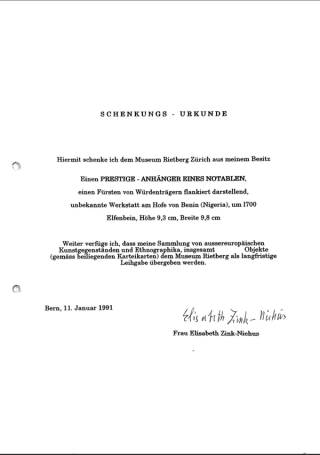
Receipt
Museum Rietberg Zürich
Object Documentation - Museum Rietberg Zürich
Date
January 11, 1991
An archival document representing a Inventories of 2 page(s)
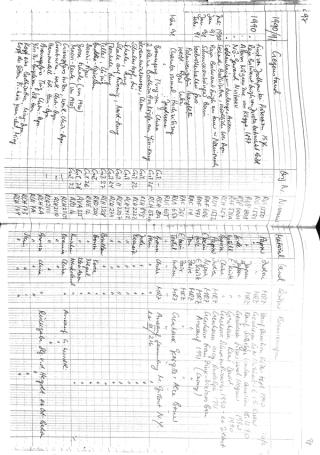
Inventory
Museum Rietberg Zürich
Written Archive - Museum Rietberg Zürich
Date
January 1, 1990
An archival document representing a Catalogue Cards of 1 page(s)
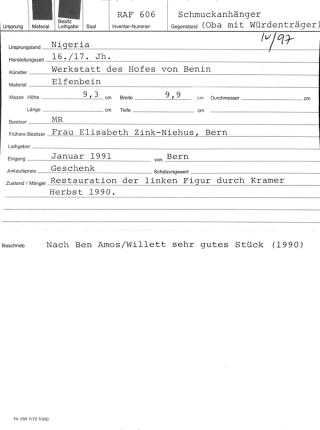
Catalogue Card
Museum Rietberg Zürich
File Cards - Museum Rietberg Zürich
Date
January 1, 1991

Institution data

Museum Rietberg Zürich
The data was transferred directly through the Swiss Benin Initiative.
Last updated: 2022-07-04
Language: english
Institution fieldValue
Reg No.
object id
RAF 606
Object name and materials
designation
Pendant showing an Oba (king) and two dignitaries
Material
material
ivory
Dimension/s
dimensions
H. 9.5 cm W. 9.5 cm D. 4.5 cm
Provisional dating
date made
16th/17th century
Creditline
prior source
Gift from: Elisabeth Zink-Niehus, Bern
Provenances
provenance
16th / 17th century comissioned from the Royal Ivory-sculptors Guild (Igbesanmwan) by the Royal Palace of Benin; possibly looted from the Royal Palace during the British military occupation of Benin; [...]; until 1965, unknown Nigerian trader;1965 purchased by Elisabeth Zink-Niehus (collector) at Globus Department Store (Zürich) from unknown Nigerian trader at the temporary exhibition "Verschenkt die Schweiz Geld"; 1965-1991, Elisabeth Zink-Nieuhus, Bern; 1991, gifted to Museum Rietberg Zürich
Institution
department and institution
MRZ Museum Rietberg Zürich
Institution acquisition date
accession date
January 1991
Additional IDs
Sensitive Content

Digital Benin collates digital material from institutions, and some of this material is inherently colonial and contains words, terms and phrases that are inaccurate, derogatory and harmful towards African and African diasporic communities. Catalogue transcriptions, book titles, exhibition titles and museum titles may contain harmful terms. We recognise the potential for the material to cause physical and mental distress as well as evoke strong emotions. Owing to the scale of the collection’s data, a process to implement sensitive-content warnings in the displayed data is still incomplete. The material within the catalogue does not represent Digital Benin’s views. Digital Benin maintains a strong anti-colonial, anti-racist position and affirms its support for centring the humanity of historically marginalised and disenfranchised communities. Read more about the background of this statement here