

Reg No.
RAF 603
Edo designations
English designations
Relief Plaque
Categories
Palace Architecture & Ornamentation
Location
Gablerstrasse 15, 8002 Zürich, Switzerland
Loading...

Iconographies

3 annotations
tribal marks
Iwu
Facial and Body Markings

Iwu are facial and body markings (scarifications) that were historically worn by Edo men and women. However, since the 1960s, the practice has been nearly extinct (Aisien 2011). In the past, Iwu were used as a way of proving that one was an Edo citizen, and the ceremony of having Iwu completed was an important rite of passage for men and women. The Osiwu, who also practised circumcision and other surgical procedures, would carry out the procedure of adding Iwu. There are different types of Iwu: ‘blades’ worn on the torso (Iwu-eko), and those worn on the face, such as Ikharo (three or four markings above the eyebrows), Irho (two narrow ‘blades’ worn on each cheek), Ovbihue (nasal ‘blades’), Ovbi-agbanmwen (chin ‘blade’), and Igho-okpa/Ukpgho (three forehead ‘blades’) (Aisien 2011, p. 22).

The number of Iwu also varied depending on the identity of the person wearing them. For example, royal men would wear six ‘blades’ on their torso, whilst men who were not royal would wear seven ‘blades’. Meanwhile, the Ọba’s female children would wear fifteen ‘blades’, and all other women would wear sixteen (Aisien 2011).

1 annotation
Iwu
Water fern
Ebe Amẹ
Water Fern

Ebe Amẹ refers to a wide variety of plants, particularly the leaves of the water fern or river leaf, found in riverine areas of southern Nigeria ( ). Artists from the Igun-Ẹrọnmwọn used these as a decorative motif in the background of most Ama-Ẹrọnmwọn (bronze relief plaques). The petals of the Ebe Amẹ, like the points of the ἀghàdàgháda (crossroads), represent the four cardinal directions: north, east, south, and west. The number four plays a foundational role in the Edo calendar, which is structured around four market days ( ).

1 annotation
Ebe Amẹ
Colar Bead
Odigba
Coral beaded collar

Odigba (coral-beaded collar) is a rigid neck collar made of coral beads, worn as part of ceremonial attire only by senior princes who have been made Enigie (Inneh 2007, p. 107). Although Ibafe (2007, p. 43) argued that the Odigba was introduced during the Ogiso period (c. 900–c. 1170 AD) by Ogiso Ere, along with other symbolically important Emwin Arhe, such as the Ada (ceremonial sword) and the Ẹbẹn (ceremonial sword), this seems unlikely, as coral was only introduced in the late 15th century through trade with Portuguese merchants.

1 annotation
Odigba

Provenance

9 events
Production
1504 (approximate) to 1550 (approximate)
The object was produced by Unknown member(s) of the Igun-Ẹrọnmwọn guild in Benin City.
Looted
February 22, 1897 (day approximate) to June 1899 (year approximate)
The object was looted by Unknown member of the British colonial military campaign on Benin - February 1897 from Benin Kingdom.
Unknown
1925 (approximate)
The object is known to have come into contact with Paul Éluard, later in Paris.
Auction
1931
The object was auctioned to Charles Alfred Marius Ratton through Hôtel Drouot in Paris.
Unknown
1932
The object is known to have come into contact with Eduard von der Heydt, later in Ascona.
Gift
1952
The object was given as a gift by Eduard von der Heydt to the Museum Rietberg Zürich from Ascona to Zurich.
Stolen
1968
The object was stolen by the Museum Rietberg Zürich from Zurich.
Unknown
1993
The object is known to have come into contact with Frank Paulig, later in Wiesbaden.
Purchase
1993
The object was purchased by the Museum Rietberg Zürich from Frank Paulig from Wiesbaden to Zurich.

Related archival documents

6 documents
See all
An archival document representing a Scans of published works of 3 page(s)
Scan of published works
Museum Rietberg Zürich
Publications - Museum Rietberg Zürich
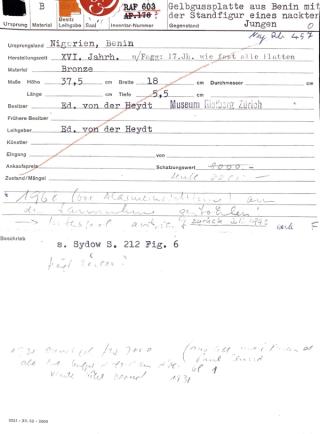
An archival document representing a Catalogue Cards of 1 page(s)
Catalogue Card
Museum Rietberg Zürich
File Cards - Museum Rietberg Zürich
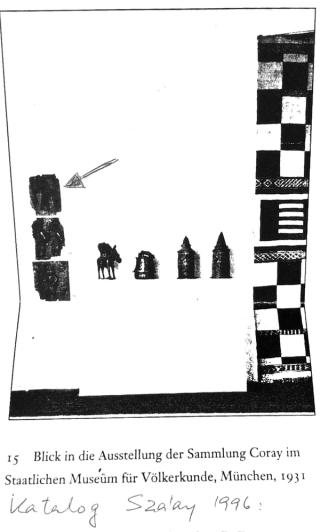
An archival document representing a Scans of published works of 2 page(s)
Scan of published works
Museum Rietberg Zürich
File Cards - Museum Rietberg Zürich

Institution data

Museum Rietberg Zürich
The data was transferred directly through the Swiss Benin Initiative.
Last updated: 2022-07-04
Language: english
Institution fieldValue
Reg No.
object id
RAF 603
Object name and materials
designation
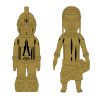
Relief plaque showing a naked boy
Material
material
brass
Dimension/s
dimensions
H. 37.5 cm W. 18 cm D. 5.5 cm
Provisional dating
date made
16th/17th century
Creditline
prior source
Gift from: Eduard von der Heydt
Provenances
provenance
16th/17th century commissioned from the Royal Bronze-casting Guild (Igun Eronmwon) by the Royal Palace of Benin; by descent to Oba Ovonramwen (Ovonramwen Nogbaisi, b. about 1857 - d. about 1914; r. 1888 - 1897); 1897, probably looted from the Royal Palace during the British military occupation of Benin; [...] ; ca. 1925-1931, Paul Eluard (artist, Paris); 1931, Hôtel Drouot auction; 1931, Charles Ratton (dealer, Paris); 1932-1952 Eduard von der Heydt (collector, Ascona); 1952, gifted to Museum Rietberg Züich; 1968, stolen from Museum Rietberg Zürich; [...]; 1993, acquired by Frank Paulig (Weisbaden); 1993, purchased by Museum Rietberg Zürich with funds from Pierre Uldry
Institution
department and institution
MRZ Museum Rietberg Zürich
Institution acquisition date
accession date
1952
Additional IDs
Sensitive Content

Digital Benin collates digital material from institutions, and some of this material is inherently colonial and contains words, terms and phrases that are inaccurate, derogatory and harmful towards African and African diasporic communities. Catalogue transcriptions, book titles, exhibition titles and museum titles may contain harmful terms. We recognise the potential for the material to cause physical and mental distress as well as evoke strong emotions. Owing to the scale of the collection’s data, a process to implement sensitive-content warnings in the displayed data is still incomplete. The material within the catalogue does not represent Digital Benin’s views. Digital Benin maintains a strong anti-colonial, anti-racist position and affirms its support for centring the humanity of historically marginalised and disenfranchised communities. Read more about the background of this statement here