
Reg No.
5241
Edo designations
English designations
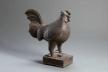
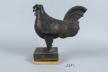
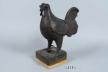
Rooster Figure
Categories
Altar & Shrine Objects
Figures
Location
1 Adesogbe (Plymouth) Road, P.M.B. 1115, Benin City , Edo State
Loading...
Rooster Figure
Rooster Figure

Iconographies

1 annotations
Ubanu'hi / Obanu'hi
Ubanu'hi / Obanu'hi
Inifinity Symbol

The Ubanu'hi (infinity symbol) is a kind of guilloche or interlaced strapwork motif that can be angular or rounded. It was used by Edo artists in the decoration of many Emwin Arhe (royal treasures) and is ubiquitous in Benin royal arts. Ubanu'hi is a shortened form of “uba no Ọba ya de agbon ke ehimwin yi”, which means “the rope with which the Ọba ties the heaven and earth together” (pers. comm. Chief John Igbineweka Inneh n’Igbesawman, 2022). Similarly, Paula Ben-Amos Girshick (in Plankensteiner 2007, pp. 339, 341) described this as “Ọba n’iri agbon”, or the “rope of the world” pattern.

According to Ọbabanmu Ineh (in Blackmun 1984, p. 51), the use of this motif indicates that objects were carved by members of the Igbesanmwan. However, the motif is found on all types of Emwin Arhe (royal treasures), not only those made of ivory or wood. On the flanges of the Ama (relief plaques) alone, Kathryn Gunsch (2018, pp. 75–77) identified three different versions of the Ubanu'hi and, through her analysis of over 850 plaques, found that these different Ubanu'hi forms align with other characteristics, such as dimensions, the prevalence of ornamental motifs, and stylistic qualities. Together, these provide evidence, she argues, of different production groups among the plaque makers .

Kate Ezra (1992, pp. 209, 264) went on to argue that the use of these motifs indicates that certain objects were used in a “royal context” and were associated with “royal patronage”.

1 annotation
Ubanu'hi / Obanu'hi

Provenance

6 events
Production
unknown to February 22, 1897 (day approximate)
The object was produced by Unknown member(s) of the Igun-Ẹrọnmwọn guild in Benin City.
Looted
February 22, 1897 (day approximate) to June 1899 (year approximate)
The object was looted by February 1897 Unknown member of the British colonial military campaign on Benin from Benin Kingdom.
Auction
1900
The object was auctioned to William Downing Webster through Stevens Auction Rooms in London.
Auction
June 30, 1902
The object was auctioned to Theodor 'Theo' Rautenstrauch by William Downing Webster through Stevens Auction Rooms in London.
Donation
November 21, 1902
The object was donated by Theodor 'Theo' Rautenstrauch to the Rautenstrauch-Joest-Museum in Cologne.
Restitution
December 8, 2022
The object was restituted by the Rautenstrauch-Joest-Museum to the Omo n'Oba n'Edo Uku Akpolokpolo, Ọba of Benin & National Commission for Museums and Monuments, Nigeria from Cologne to Nigeria.

Related archival documents

2 documents
See all
Date
Date

Institution data

Rautenstrauch-Joest-Museum
The data was transferred directly by the institution.
Last updated: 2022-07-27
Language: english
Institution fieldValue
Additional Ids
object id
190219
Additional Ids / bundle
object id
RJM 1902/19
Other numbers
object id
10137 (old inventory number)
Reg No.
object id
5241
Reg. No / Inventory number
object id
RJM 5241
Object name
designation
object type
rooster
Object name / Title
designation
Rooster
materials
material
copper alloy
Dimension/s
dimensions
H.43cm W.20cm X. 41cm
previous owner/collector
prior source
Theodor Rautenstrauch, son of Adele and Eugen Rautenstrauch, Member of Deutsche Kolonialgesellschaft - Dep. Köln Collection Wilhelm Joest 1909
provenance
provenance
30.06.1902 to 21.11.1902, Theodor Rautenstrauch (1873-1907) (auction); from 21.11.1902, Rautenstrauch-Joest Museum (donation); 1902 - 30.06.1902, J.C. Stevens, London (location), Stevens' Auction Rooms; auction in 1900, W. D. Webster, London, Bicester (commission)
Institution
department and institution
Rautenstrauch-Joest Museum - Cultures of the World, Cologne
Institution acquisition date
accession date
11/21/02
Acquisition details
accession method
donation
comments
notes
Theodor Rautenstrauch got the objects at an auction of Mr. J.C. Stevens on 03.06.1902 in London. The auction named "Benin brass" and embraced a collection of the British Punitive from 1897.
Copyright
license
© Museumsgesellschaft RJM Köln, Foto Uli Grohs
notes concerning "other numbers"
inventory number W.D. Webster, Webster catalogue 27/1901, figure 72
Sensitive Content

Digital Benin collates digital material from institutions, and some of this material is inherently colonial and contains words, terms and phrases that are inaccurate, derogatory and harmful towards African and African diasporic communities. Catalogue transcriptions, book titles, exhibition titles and museum titles may contain harmful terms. We recognise the potential for the material to cause physical and mental distress as well as evoke strong emotions. Owing to the scale of the collection’s data, a process to implement sensitive-content warnings in the displayed data is still incomplete. The material within the catalogue does not represent Digital Benin’s views. Digital Benin maintains a strong anti-colonial, anti-racist position and affirms its support for centring the humanity of historically marginalised and disenfranchised communities. Read more about the background of this statement here