idno
Z 20330
Edo designations
English designations
Ancestral Staff
Categories
Altar & Shrine Objects
Staffs
Location
Downing St, Cambridge CB2 3DZ, United Kingdom
Loading...

Iconographies

4 annotations
Ikharo
Forehead markings

Ikharo are linear keloid markings depicted on the forehead of Uhunmwu-Elao (commemorative heads) in groups of three or four above each eye. The exact meaning of Ikharo is debated; some have argued that they relate to the gender or tribal identification of the person on whom they are depicted. For example, has argued that they were worn only by men; however, their use in depictions is not consistent with this, and the Iy’Ọba are also shown wearing them. argued that they are instead a stylistic feature employed by artists that varied over time.

The naming of these markings differs between publications. For example, describe these markings as “agbaguda n'ehae”, which they write translates literally as “blades of the forehead”. However, later went on to call these “ikharo”, as used here. referred to these forehead markings as ikharo, meaning “tribal mark [of eye]”.

1 annotation
Ikharo
TBC_Ukuse
Rattle

Spherical rattles made from gourds and covered with nets, known as Ukuse, are held in both hands by some figures depicted on Emwin Arre (royal treasures). Barbara Blackmun ( ) noted that these rattles are unusually spherical and smaller than the gourd rattles used today, suggesting that they may have had a particular significance. The Ọba is sometimes depicted holding such a rattle while “wearing an empowering necklace and his most elaborate crown.” On this basis, Blackmun argued that the “spherical rattle of diminutive size and shape may have been employed to heal, or to bring about other transformation” ( ).

1 annotation
TBC_Ukuse
Ẹrhu
Headwear

Many different kinds of Ẹrhu (headwear) are worn by the various figures depicted in the imagery of Benin royal artefacts. Through comparisons with ceremonial regalia still worn by chiefs and members of the royal court, including the Ọba himself, some Ẹrhu have been used to identify the different figures depicted. For example, the conical hat worn by high-ranking town chiefs as part of the pangolin regalia, still worn at ceremonies, is also visible on figures on some Ama-Ẹrọnmwọn (bronze relief plaques) ( ). Other examples include the distinctive bell-shaped helmet associated with the Iyasẹ ( ). Figures who wear a shallow-brimmed hat and a cross have been identified as Ewua or Ohensa priests ( ).

Different kinds of helmets and headwear were worn by warriors, reflecting the many different ranks and roles in the army at any given time, as well as developing trends that were in turn represented on Emwin Arhe created at different points in time. Warrior figures wearing helmets covered in cowrie shells were carved on the Aken'ni Elao (carved tusks) (Blackmun 1984, p. 330), yet on the brass Ama, warriors are sometimes depicted wearing helmets made from crocodile hide or horsehair with a front plate (Osadolor in Plankensteiner 2007, cat. no. 238, p. 457). Helmets made from horsehair with a front plate are one of the more common types represented on the Ama-Ẹrọnmwọn, and the demand for black horse tails was noted by both Portuguese and British traders during the late 17th and 18th centuries (Osadolor in Plankensteiner 2007, cat. no. 238, p. 457). Other warriors depicted on Ama-Ẹrọnmwọn wear helmets with a rounded top, chinstrap, and sometimes also a feather tucked into the left side. These types of headwear are known as Ẹrhu Iyokuo.

Attire worn for battle also differed from that worn for ceremonial occasions, such as the pointed headwear worn in combination with an ornate leopard-head tunic by war chiefs. Depictions of figures wearing this attire on brass Ama-Ẹrọnmwọn (bronze relief plaques) have been interpreted as representing the war chiefs’ participation in the war-ritual Isiokuo festival (Osadolor in Plankensteiner 2007, cat. no. 238, p. 457).

Another distinctive form of headwear is that worn by figures identified as leopard hunters on the brass Ama-Ẹrọnmwọn (relief plaques). These large helmets cover almost all of the leopard hunters’ faces except for their noses, eyes, and upper lips, and are made of an unusual material that remains unidentifiable (Plankensteiner 2007, cat. nos. 68–69, p. 322).

European figures are also portrayed with distinctive hats, such as Portuguese three-cornered hats. These depictions reflect the artists’ keen observation and highlight the impact of European trade and military assistance (Ezra 1992).

1 annotation
Ẹrhu
tribal marks
Iwu
Facial and Body Markings

Iwu are facial and body markings (scarifications) that were historically worn by Edo men and women. However, since the 1960s, the practice has been nearly extinct (Aisien 2011). In the past, Iwu were used as a way of proving that one was an Edo citizen, and the ceremony of having Iwu completed was an important rite of passage for men and women. The Osiwu, who also practised circumcision and other surgical procedures, would carry out the procedure of adding Iwu. There are different types of Iwu: ‘blades’ worn on the torso (Iwu-eko), and those worn on the face, such as Ikharo (three or four markings above the eyebrows), Irho (two narrow ‘blades’ worn on each cheek), Ovbihue (nasal ‘blades’), Ovbi-agbanmwen (chin ‘blade’), and Igho-okpa/Ukpgho (three forehead ‘blades’) (Aisien 2011, p. 22).

The number of Iwu also varied depending on the identity of the person wearing them. For example, royal men would wear six ‘blades’ on their torso, whilst men who were not royal would wear seven ‘blades’. Meanwhile, the Ọba’s female children would wear fifteen ‘blades’, and all other women would wear sixteen (Aisien 2011).

1 annotation
Iwu

Provenance

2 events
Unknown
1909 to 1913
The object is known to have come into contact with Northcote Whitridge Thomas, in Edo State.
Purchase
1911 to 1914
The object was purchased by the Museum of Archaeology and Anthropology, University of Cambridge from Northcote Whitridge Thomas through Anthony Ashley Bevan with its destination in Cambridge.

Institution data

Museum of Archaeology and Anthropology, University of Cambridge
The data was transferred directly by the institution.
Last updated: 2022-07-18
Language: english
Institution fieldValue
idno
object id
Z 20330
local
edo designation
osalobua
Physical description/0
description
Stave (Osalobua) with elaborate puzzle-carving terminating in human figure holding 'orb and sceptre.' Labelled 'Thomas Colln, S. Nigeria 1910-13, 2236.290'
Physical description/1
description
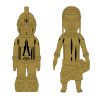
Wooden staff with central rattle section and a human figure standing on top. The figure holds a staff in one hand and an orb in the other and has scarification marks on the forehead. The rattle section in carved with geometric patterns.
Physical description/2
description
Physical description/3
description
Physical description/4
description
d_Description Name
description
Wooden staff with central rattle section and a human figure standing on top. The figure holds a staff in one hand and an orb in the other and has scarification marks on the forehead. The rattle section in carved with geometric patterns.
height
dimensions
length
dimensions
width
dimensions
weight
weight
Inscription
inscriptions
Labels - Markings/0
inscriptions
Thomas label adhered to base of object reads: '2236 | 290 / Stave (osalobua) highly carved.'
Labels - Markings/1
inscriptions
Labels - Markings/2
inscriptions
Labels - Markings/3
inscriptions
Labels - Markings/4
inscriptions
Labels - Markings/5
inscriptions
period
date made
maker
producer
d_Place
production place
Africa; West Africa; Nigeria; Edo State; Benin City [Bini]
Other owners
prior source
source
prior source
Thomas, Northcote Whitridge [field collector]; Bevan, Anthony Ashley (Prof.) [monetary donor]
Collection or Excavation Year
date collected
culture group
ethnic attribution
Edo
source date
accession date
Amendments - updates/0
notes
Record updated as part of the Museum Affordances project 2018-2020
Amendments - updates/1
notes
Amendments - updates/2
notes
Amendments - updates/3
notes
Amendments - updates/4
notes
Exhibition/0
exhibition history
Brunei Gallery, SOAS, London, 14/10/2020 to 19/12/2020, [Re:]Entanglements
Exhibition/1
exhibition history
Reference Numbers
bibliography
Z 20330 Other: 290 (Thomas Collection Number - 1st catalogue); 2236 [left side of Thomas Collection label]; 1910-13, 2236.290 [on Catalogue card]
References/0
bibliography
During the collections-based phase of the Museum Affordances Project 2018, photographs of some of these rattle staffs were shared on the project Facebook group (https://www.facebook.com/groups/reentanglements/). In a comment on 01/10/2018, Adenike Cosgrove wrote: ' This looks to be an Edo ukhurhe rattle staff. You can read more about them here: https://www.imodara.com/.../nigeria-edo-ukhurhe-rattle.../'
References/0 2
bibliography
References/1
bibliography
Related Documents/0
bibliography
1st Thomas Catalogue notes numbers 1-249 as " Bini (Benin City)" [R.Hand]
Related Documents/1
bibliography
See E 1910.118 and E 1913.3 records for further details about the Thomas Collection from Nigeria. [T.Cotterill]
Related Documents/2
bibliography
Related Documents/3
bibliography
Related Documents/4
bibliography
Related Documents/5
bibliography
Related Documents/6
bibliography
Acquisition Details/0
Acquisition Details/1
Acquisition Details/2
Analysis/0
Analysis/1
Archaeology
Auction - Sale/0
Auction - Sale/1
CMS Context/0
CMS Description
Catalogue
Display/0
Display/1
Display/2
Display/3
Field_collection/0
Field_collection/1
Found_together - assemblage
Freezing
Online Only
Other/0
These staffs (Z 20317 - Z 20342) appear to have been carved by the same hand, or in the same workshop and were collected by N.W. Thomas as a group. They are listed in Thomas' 1st catalogue (Doc.413) as entries 308-335, which are situated at the very back of the catalogue.
Other/1
Production - use
Remedial/0
CON.2020.4957 | Remedial
Remedial/1
Surface Clean
unknown
Sensitive Content

Digital Benin collates digital material from institutions, and some of this material is inherently colonial and contains words, terms and phrases that are inaccurate, derogatory and harmful towards African and African diasporic communities. Catalogue transcriptions, book titles, exhibition titles and museum titles may contain harmful terms. We recognise the potential for the material to cause physical and mental distress as well as evoke strong emotions. Owing to the scale of the collection’s data, a process to implement sensitive-content warnings in the displayed data is still incomplete. The material within the catalogue does not represent Digital Benin’s views. Digital Benin maintains a strong anti-colonial, anti-racist position and affirms its support for centring the humanity of historically marginalised and disenfranchised communities. Read more about the background of this statement here