



Iconographies




Provenance
Institution data
| Institution field | Value |
|---|---|
idno object id | Z 20317 |
local edo designation | |
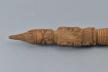
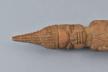
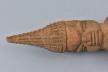
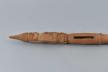
Physical description/0 description | Catalogue card: Stave (Izuku of Oga), highly carved with puzzle-carving, culminating in elaborate human figure holding snake Labelled 'Thomas Colln, S. Nigeria 1910-13, 2222.308' |
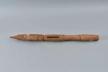
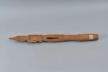
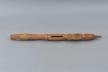
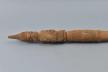
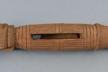
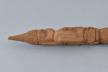
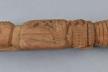
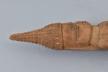
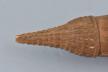
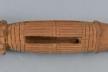
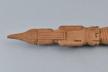
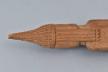
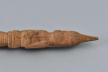
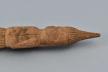
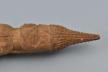
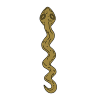
Physical description/1 description | Carved wooden staff with central rattle section and seated figure above this. The figure is wearing a conical hat, has long braids of hair at the rear, scarification marks on the face and body, and is holding a snake in one hand and an orb in the other. The rattle section is incised with geometric patterns and has three slits in it through which the rattle can be seen. |
Physical description/2 description | |
Physical description/3 description | |
Physical description/4 description | |
d_Description Name description | Carved wooden staff with central rattle section and seated figure above this. The figure is wearing a conical hat, has long braids of hair at the rear, scarification marks on the face and body, and is holding a snake in one hand and an orb in the other. The rattle section is incised with geometric patterns and has three slits in it through which the rattle can be seen. |
height dimensions | 765 mm |
length dimensions | 60 mm |
width dimensions | 55 mm |
weight weight | |
Inscription inscriptions | |
Labels - Markings/0 inscriptions | Written in pencil on base of staff: '308' |
Labels - Markings/1 inscriptions | Thomas label adhered to base of staff reads: '2222 | 308 / Stave (Izuku of Oga), highly carved. / Bini.' |
Labels - Markings/2 inscriptions | |
Labels - Markings/3 inscriptions | |
Labels - Markings/4 inscriptions | |
Labels - Markings/5 inscriptions | |
period date made | |
maker producer | |
d_Place production place | Africa; West Africa; Nigeria; Edo State; Benin City [Bini] |
Other owners prior source | |
source prior source | Thomas, Northcote Whitridge [field collector]; Bevan, Anthony Ashley (Prof.) [monetary donor] |
Collection or Excavation Year date collected | |
culture group ethnic attribution | Edo |
source date accession date | |
Amendments - updates/0 notes | Object not yet checked, but the 308 may refer to the 1st Thomas Catalogue which notes "Izuku og Oga". [R.Hand] '[Object now checked and this has been verified. Katrina Dring, 28/09/2018]' |
Amendments - updates/1 notes | Record updated as part of the Museum Affordances project 2018-2020 |
Amendments - updates/2 notes | |
Amendments - updates/3 notes | |
Amendments - updates/4 notes | |
Exhibition/0 exhibition history | Brunei Gallery, SOAS, London, 14/10/2020 to 19/12/2020, [Re:]Entanglements |
Exhibition/1 exhibition history | |
Reference Numbers bibliography | Z 20317 Other: 308 (Thomas Collection Number - 1st Catalogue); 2222 [left of Thomas Collection label]; 1910-13, 2222.308 [on Catalogue card] |
References/0 bibliography | During the collections-based phase of the Museum Affordances Project 2018, photographs of some of these rattle staffs were shared on the project Facebook group (https://www.facebook.com/groups/reentanglements/). In a comment on 01/10/2018, Adenike Cosgrove wrote: ' This looks to be an Edo ukhurhe rattle staff. You can read more about them here: https://www.imodara.com/.../nigeria-edo-ukhurhe-rattle.../' |
References/0 2 bibliography | |
References/1 bibliography | |
Related Documents/0 bibliography | See E 1910.118 and E 1913.3 records for further details about the Thomas Collection from Nigeria. [T.Cotterill] |
Related Documents/1 bibliography | |
Related Documents/2 bibliography | |
Related Documents/3 bibliography | |
Related Documents/4 bibliography | |
Related Documents/5 bibliography | |
Related Documents/6 bibliography | |
Acquisition Details/0 | |
Acquisition Details/1 | |
Acquisition Details/2 | |
Analysis/0 | |
Analysis/1 | |
Archaeology | |
Auction - Sale/0 | |
Auction - Sale/1 | |
CMS Context/0 | |
CMS Description | |
Catalogue | |
Display/0 | |
Display/1 | |
Display/2 | |
Display/3 | |
Field_collection/0 | |
Field_collection/1 | |
Found_together - assemblage | |
Freezing | |
Online Only | |
Other/0 | These staffs (Z 20317 - Z 20342) appear to have been carved by the same hand, or in the same workshop and were collected by N.W. Thomas as a group. They are listed in Thomas' 1st catalogue (Doc.413) as entries 308-335, which are situated at the very back of the catalogue. |
Other/1 | A selection of rattle staff collected by Northcote Thomas are shown together in Image 390447. |
Production - use | |
Remedial/0 | CON.2020.4907 | Remedial |
Remedial/1 | |
Surface Clean | |
unknown |
Digital Benin collates digital material from institutions, and some of this material is inherently colonial and contains words, terms and phrases that are inaccurate, derogatory and harmful towards African and African diasporic communities. Catalogue transcriptions, book titles, exhibition titles and museum titles may contain harmful terms. We recognise the potential for the material to cause physical and mental distress as well as evoke strong emotions. Owing to the scale of the collection’s data, a process to implement sensitive-content warnings in the displayed data is still incomplete. The material within the catalogue does not represent Digital Benin’s views. Digital Benin maintains a strong anti-colonial, anti-racist position and affirms its support for centring the humanity of historically marginalised and disenfranchised communities. Read more about the background of this statement here