
Identifikationsnummer
C 3983
Edo designations
English designations
Fragment
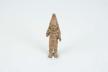
Altar Tableau
Queen Mother Figure
Categories
Figures
Location
1 Adesogbe (Plymouth) Road, P.M.B. 1115, Benin City , Edo State
Loading...
Fragment
Fragment
Fragment
Fragment
Fragment
Fragment
Fragment
Fragment
Fragment

Iconographies

7 annotations
Ikharo
Forehead markings

Ikharo are linear keloid markings depicted on the forehead of Uhunmwu-Elao (commemorative heads) in groups of three or four above each eye. The exact meaning of Ikharo is debated; some have argued that they relate to the gender or tribal identification of the person on whom they are depicted. For example, has argued that they were worn only by men; however, their use in depictions is not consistent with this, and the Iy’Ọba are also shown wearing them. argued that they are instead a stylistic feature employed by artists that varied over time.

The naming of these markings differs between publications. For example, describe these markings as “agbaguda n'ehae”, which they write translates literally as “blades of the forehead”. However, later went on to call these “ikharo”, as used here. referred to these forehead markings as ikharo, meaning “tribal mark [of eye]”.

1 annotation
Ikharo
Ikan Aro
Incised forehead markings

Ikan Aro are two linear markings in the centre of the forehead, located in between the eyes. These are usually inset with iron on depictions otherwise made of brass, bronze, ivory or wood.The use of iron was significant due the association of this metal with Ogun, who is god of iron and metal. These markings appear on both men and women, however are a common feature of representations of Iy'Oba Idia. Flora Kaplan (1993, 59) argued these are not tattoos, unlike the Ikharo. According to Nevadomsky (1986, 42), these incisions "signify determination, firmness, resolve, or even maturity". Kaplan (1993, 59) has also made a link between these markings and oral history told to her by Oba Erediauwa describing the events leading up to Idia (before she was Iy’Ọba) becoming the wife of Ọba Ozolua, whereby her parents tried to disfigure her to “repel” the Ọba. According to this history, the Ọba “sensing something was wrong”, called his doctors to intervene and treat her quickly, and as so she still became his wife.

1 annotation
Ikan Aro
Ẹguẹn
Anklet

Ẹguẹn are worn by the Ọba and chiefs as part of their Ehaengbehia, the full regalia worn during special ceremonies. Ẹguẹn are worn around the ankles or calves and can be made from beads, ivory, brass or even iron. A separate category, called Elubase, refers to those which have integrated rattles or crotal bell attachments, however both are described as anklets in English.

As early as 1899, Read and Dalton commented that the anklets worn by figures shown on plaques were a signifier of high rank. Today, anklets continue to signify social status, with the Ọba wearing many ivory and coral anklets stretching up his calves as part of his ceremonial regalia (Okpokunu, Agbontaen‐Eghafona & Ojo, 2005, p.162[106]). However, anklets were not the preserve of the Ọba alone, and different kinds and quantities were worn by other members of the royal court and Edo people. For example, Flora Kaplan (2006, p.85[107]) described a photograph of Iy’Ọba Aghahowa N’Errua, who took her title in 1981, in which she wears coral anklets as one of a number of insignia of her newly invested high rank. In contrast, brass anklets would be worn by young male attendants to the Ọba (see attendant figure), such as sword bearers or Emada pages (Kaplan, 2006, p.90[107]).

2 annotations
Ẹguẹn
Ẹguẹn
Colar Bead
Odigba
Coral beaded collar

Odigba (coral-beaded collar) is a rigid neck collar made of coral beads, worn as part of ceremonial attire only by senior princes who have been made Enigie (Inneh 2007, p. 107). Although Ibafe (2007, p. 43) argued that the Odigba was introduced during the Ogiso period (c. 900–c. 1170 AD) by Ogiso Ere, along with other symbolically important Emwin Arhe, such as the Ada (ceremonial sword) and the Ẹbẹn (ceremonial sword), this seems unlikely, as coral was only introduced in the late 15th century through trade with Portuguese merchants.

1 annotation
Odigba
Ukpan obọ eva
Crossed Beaded Baldrics

The Ukpan obọ eva (coral-bead crossed baldrics) were worn as part of the ehaingbehia, the full ceremonial regalia, by only high-ranking members of the palace, including the Ọba himself, the Iy’Ọba, the Edaiken, and the Ezọmọ (Ben-Amos 1999, pp. 68, 141; Osadolor in Plankensteiner 2007, cat. no. 70, pp. 322–323).

1 annotation
Ukpan obọ eva
Ukpẹ ọkhọkhọ
Curved conical hairstyle worn by Iy'Ọba

The Ukpẹ ọkhọkhọ is a distinctive hairstyle and coral-beaded headdress worn by the Iy’Ọba. The headdress includes a projection called the ‘ede Iy’Ọba’, which indicates that “her spiritual potentialities are closer in quality to those of her ruling son than they are to the powers of the nobles” (Aigbe Eson and Ihama Iguneronmwon in Blackmun 1991, p. 60). The Iy’Ọba’s hairstyle and headdress are meant to resemble ukpe-okhue, or the curved parrot’s beak (Kaplan 1993).

Barbara Blackmun (1991, p. 60) argued that “Benin art is multivocal, and any depiction of the Iye Ọba [sic] is a reference to Idia. Every woman who holds the office of lye Ọba plays the part of Idia, the ideal model of an Ọba’s mother.” Wearing the Ukpẹ ọkhọkhọ is one of the ways the Iy’Ọba plays the role of Idia.

1 annotation
Ukpẹ ọkhọkhọ

Provenance

5 events
Production
unknown to February 22, 1897 (day approximate)
The object was produced by Unknown member(s) of the Igun-Ẹrọnmwọn guild in Benin City.
Looted
February 22, 1897 (day approximate) to June 1899 (year approximate)
The object was looted by February 1897 Unknown member of the British colonial military campaign on Benin from Benin Kingdom.
Unknown
February 22, 1897 (year approximate) to 1904
The object is known to have come into contact with Albert Engelhardt.
Purchase
1904
The object was purchased by the MARKK Museum am Rothenbaum Kulturen und Künste der Welt from Albert Engelhardt with its destination in Hamburg.
Restitution
December 16, 2022
The object was restituted by the MARKK Museum am Rothenbaum Kulturen und Künste der Welt to the Omo n'Oba n'Edo Uku Akpolokpolo, Ọba of Benin & National Commission for Museums and Monuments, Nigeria through Carsten Brosda, S.E. Yusuf Maitama Tuggar, Abba Isa Tijani and Barbara Plankensteiner from Hamburg to Nigeria.

Institution data

MARKK Museum am Rothenbaum Kulturen und Künste der Welt
The data was transferred directly by the institution.
Last updated: 2022-06-10
Languages: german, english
Institution fieldValue
Identifikationsnummer
object id
C 3983
Titel
designation
Figürchen einer Königinmutter aus Bronze
Materialien
material
ANORGANISCH/Metall/Gelbguß
Heutiges Staatsgebiet des Herstellungsortes
production place
Afrika/Westafrika/Nigeria/Benin-Reich
Provenienz/Name
prior source
provenance
Engelhardt
Provenienz Objektitinerar Akteure Orte Daten
provenance
Albert Engelhardt
Provenienz/Affiliation
provenance
Provenienz/Country
provenance
Germany
Provenienz/Date of Birth
provenance
unknown
Provenienz/Date of Death
provenance
unknown
Provenienz/First Name
provenance
Albert
Provenienz/No
provenance
9
Provenienz/Place of Birth
provenance
unknown
Provenienz/Place of Death
provenance
unknown
Provenienz/Profession
provenance
presumably Merchant
Provenienz/Role-Function/0
provenance
Consignor
Provenienz/Role-Function/1
provenance
Provenienz/Sex
provenance
male
Provenienz/Short Biography
provenance
Albert Engelhardt was presumably a merchant and offered exactly one object from the Benin Kingdom and nothing else for sale to the Museum für Völkerkunde (today MARKK) in 1904. Beyond that, this person does not appear in any othr documentation.
Provenienz/Street
provenance
Provenienz/Town
provenance
Hamburg
Hersteller kulturhist. Herkunftsgesellschaft
ethnic attribution
--/Edo
Heutiger Aufbewahrungsort Sammlung
department and institution
Museum am Rothenbaum. Kulturen und Künste der Welt (MARKK)
Akquisitionsdatum
accession date
1904
Alte Inventarnummer
Inventurdatum
23.07.2009
Label Text (deu)
Figur einer Königinmutter Unbekannte Werkstatt der Bronzegießergilde Igun Eronmwon / Königreich Benin, Nigeria, 18. Jh. / Gelbguss / Ankauf von Albert Engelhardt, 1904, Inv. Nr. C 3983 Charakteristisch für Darstellungen der Königinmutter ist die hohe, leicht nach vorne gebogene und mit einem Korallennetz überzogene Frisur. Die Iyoba trägt Insignien aus Korallenperlen wie hochrangige männliche Würdenträger, denen sie gleichgestellt ist. Das Amt der Königinmutter wurde im frühen 16. Jh. durch Oba Esigie zum Dank für die Unterstützung seiner Mutter Idia eingeführt, die ihm durch Geistesschärfe und spirituelle Kraft bei Feldzügen zur Seite gestanden hatte.
Label Text (eng)
Figure of a Queen Mother Unidentified workshop of the Bronze Casters Guild Igun Eronmwon / Benin Kingdom, Nigeria, 18th century / Brass / Acquired from Albert Engelhardt, 1904, Inv. no. C 3983 Characteristic of representations of the queen mother is the tall hairstyle, slightly bent forward and covered with a coral net. The Iyoba wears insignia of coral beads like high-ranking male dignitaries, which denotes her as equal to them. The office of queen mother was instituted in the early 16th century by Oba Esigie in gratitude for the support of his mother Idia, who had assisted him in military campaigns through sharpness of mind and spiritual strength.
Maße
Höhe: 19,50 cm
Sensitive Content

Digital Benin collates digital material from institutions, and some of this material is inherently colonial and contains words, terms and phrases that are inaccurate, derogatory and harmful towards African and African diasporic communities. Catalogue transcriptions, book titles, exhibition titles and museum titles may contain harmful terms. We recognise the potential for the material to cause physical and mental distress as well as evoke strong emotions. Owing to the scale of the collection’s data, a process to implement sensitive-content warnings in the displayed data is still incomplete. The material within the catalogue does not represent Digital Benin’s views. Digital Benin maintains a strong anti-colonial, anti-racist position and affirms its support for centring the humanity of historically marginalised and disenfranchised communities. Read more about the background of this statement here