

Identifikationsnummer
C 2304
Edo designations
English designations
Relief Plaque
Categories
Palace Architecture & Ornamentation
Location
1 Adesogbe (Plymouth) Road, P.M.B. 1115, Benin City , Edo State
Loading...
Relief Plaque
Relief Plaque
Relief Plaque

Iconographies

5 annotations
Ikpotoki
Portuguese Figure

Ikpotoki figures (Portuguese figures) are easily distinguished by their European-style clothing, including hats and helmets, as well as by their facial features, particularly their thin, straight noses and straight hair. The objects Ikpotoki figures are shown wearing or holding provide further indications of their relationship with the Benin Kingdom. When they hold or are positioned alongside Ugianran (manillas), for example, they indicate trade, commerce, and wealth, while weaponry such as firearms, swords, or spears indicates their role as mercenaries in the service of the Ọba. In 1515, Ọba Ẹsigie went to war against the Attah of Idah, the ruler of a neighbouring kingdom. Portuguese mercenaries and weapons assisted the Edo in winning the battle, enabling the further expansion of the Kingdom. Ẹsigie’s reign was particularly important for strengthening ties between the Benin Kingdom and the Portuguese Empire, and he is believed to have spoken fluent Portuguese. With Ẹsigie’s encouragement, Portuguese missionaries established churches in the Benin Kingdom ( ; ), while Portuguese trading factories were also established ( ). Ọba Ẹsigie allowed his son to be baptised and sent him to Portugal to be educated; following his return, he became Ọba Orhogbua ( ).

1 annotation
Ikpotoki
Osisi
Gun

Osisi is the general Edo word for guns. Osisi were initially introduced to the Benin Kingdom by the Portuguese from the late 16th century onwards and were again traded by the Dutch from the early 17th century (Osadolor 2007, p. 80). Osisi are usually represented as being carried by, or positioned close to, figures identified as Portuguese based on their attire and hairstyles. There are a small number of exceptions, including two wooden carved examples. One is a possible chair seat where a figure is holding a gun upright, and another is a carved wooden panel where a gun is shown next to an Edo dignitary. Additionally, a more recent work produced by the artist H. I. Erhabor includes an Edo figure holding a gun.

These weapons quickly became a potent symbol in the work of artists from the royal guilds, representing the Ọba’s military might, expansionist policies, and the wealth derived from foreign trade (Plankensteiner 2007, p. 208). Three different kinds of European-manufactured guns were used by the Edo army: the flintlock, the wheellock, and later the matchlock, which was used from the 1600s until around 1850. However, Ọba Akengbuda became increasingly wary of Edo dependence on European firearms and encouraged the production of firearms by the Igun Ematon. During the 19th century, the trade in firearms from Europe resumed, with Dane guns, so named because they were made in Denmark. However, from 1890, European imperial powers banned the trade in firearms to West Africa (Osadolor 2007, pp. 80–81).

1 annotation
Osisi
hairstyles
Eto
hairstyles

Hairstyles are used to determine a person's status in the society, as chiefs, common folks, chief's wives and the wives of the Ọba all wear different hairstyles. We have Okuku, Ikpe~okhokho, Idu~akpata

1 annotation
Eto
Water fern
Ebe Amẹ
Water Fern

Ebe Amẹ refers to a wide variety of plants, particularly the leaves of the water fern or river leaf, found in riverine areas of southern Nigeria ( ). Artists from the Igun-Ẹrọnmwọn used these as a decorative motif in the background of most Ama-Ẹrọnmwọn (bronze relief plaques). The petals of the Ebe Amẹ, like the points of the ἀghàdàgháda (crossroads), represent the four cardinal directions: north, east, south, and west. The number four plays a foundational role in the Edo calendar, which is structured around four market days ( ).

1 annotation
Ebe Amẹ
Ewu ivie
Coral Beaded Shirt

The Ewu ivie (coral bead shirt) is made of strings of coral beads. This heavy shirt was part of the ceremonial regalia worn only by a small number of high-ranking members of the palace: the Ọba, the Edaiken, the Iy’Ọba, and the Ezọmọ (Girshick Ben-Amos 1999, p. 68). The Ewu ivie would be worn along with the Odigba (coral bead collar).

1 annotation
Ewu ivie

Provenance

6 events
Production
1504 (approximate) to 1550 (approximate)
The object was produced by Unknown member(s) of the Igun-Ẹrọnmwọn guild in Benin City.
Looted
February 22, 1897 (day approximate) to June 1899 (year approximate)
The object was looted by February 1897 Unknown member of the British colonial military campaign on Benin from Benin Kingdom.
Unknown
January 1898 to July 1898
The object is known to have come into contact with Friedrich Erdmann, in Benin City.
Transfer
July 1898 (year approximate)
The object was transferred from Friedrich Erdmann through Bey & Co. from Benin City to Hamburg.
Purchase
July 1898 (year approximate) to December 1898
The object was purchased by the MARKK Museum am Rothenbaum Kulturen und Künste der Welt from Bey & Co. in Hamburg.
Restitution
December 16, 2022
The object was restituted by the MARKK Museum am Rothenbaum Kulturen und Künste der Welt to the Omo n'Oba n'Edo Uku Akpolokpolo, Ọba of Benin & National Commission for Museums and Monuments, Nigeria through Carsten Brosda, S.E. Yusuf Maitama Tuggar, Abba Isa Tijani and Barbara Plankensteiner from Hamburg to Nigeria.

Related archival documents

1 documents
See all
Date

Institution data

MARKK Museum am Rothenbaum Kulturen und Künste der Welt
The data was transferred directly by the institution.
Last updated: 2022-06-10
Languages: german, english
Institution fieldValue
Identifikationsnummer
object id
C 2304
Titel
designation
Bronzereliefplatte, Portugiese mit Gewehr
Materialien
material
ANORGANISCH/Metall/Gelbguß
Heutiges Staatsgebiet des Herstellungsortes
production place
Afrika/Westafrika/Nigeria/Benin-Reich
Provenienz/Name
prior source
provenance
Erdmann
Provenienz Objektitinerar Akteure Orte Daten
provenance
Friedrich Erdmann
Provenienz/Affiliation
provenance
H. Bey & Co., Bey & Zimmer
Provenienz/Country
provenance
Germany
Provenienz/Date of Birth
provenance
23.10.1866
Provenienz/Date of Death
provenance
presumably 1907
Provenienz/First Name
provenance
Friedrich
Provenienz/No
provenance
10
Provenienz/Place of Birth
provenance
Altona (today Hamburg)
Provenienz/Place of Death
provenance
presumably South Africa
Provenienz/Profession
provenance
Merchant
Provenienz/Role-Function/0
provenance
Consignor
Provenienz/Role-Function/1
provenance
Collector
Provenienz/Sex
provenance
male
Provenienz/Short Biography
provenance
Friedrich Erdmann (1866-presumably 1907) was a merchant from Hamburg and worked as a managing director for the trading company Bey & Zimmer in Lagos, Warri and Sapele in southern Nigeria. Erdmann is known to have visited Benin City after it was conquered by British troops, taking the artefacts that remained there to sell with the permission of the British military, as well as photographing the area. Erdmann was one of the key figures in Bey’s Benin business, selling a total of 13 objects from the Kingdom of Benin to the museum in 1898. His widow, Alma, corresponded with Felix von Luschan (1854–1924) in Berlin, and later sold objects from her husband’s collection. His son Kurt (1901–1964) was an art historian; he also sold pieces from his father’s estate.
Provenienz/Street
provenance
Große Bäckerstraße 24
Provenienz/Town
provenance
Hamburg
Hersteller kulturhist. Herkunftsgesellschaft
ethnic attribution
--/Edo
Heutiger Aufbewahrungsort Sammlung
department and institution
Museum am Rothenbaum. Kulturen und Künste der Welt (MARKK)
Akquisitionsdatum
accession date
1898
Alte Inventarnummer
Inventurdatum
23.07.2015
Label Text (deu)
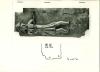
Reliefplatte: Portugiese mit Gewehr Unbekannte Werkstatt der Bronzegießergilde Igun Eronmwon / Königreich Benin, Nigeria, 16./17. Jh. / Gelbguss / Ankauf von Friedrich Erdmann, 1906, Inv. Nr. C 2304 Portugiesische Soldaten sind häufiges Thema der höfischen Kunst, da Benin-Herrscher im 16. Jh. sie an ihren Expansionszügen beteiligten. Importierte Musketen und Kanonen trugen zu bedeutenden Siegen gegen Nachbarreiche bei, wie jenen entscheidenden gegen Idah um 1515/16. Der dargestellte Soldat trägt eine Uniform und Waffen des frühen 16. Jhs.
Label Text (eng)
Relief Plaque: Portuguese with a Musket Unidentified workshop of the Bronze Casters Guild Igun Eronmwon / Benin Kingdom, Nigeria, 16th/17th century / Brass / Acquired from Friedrich Erdmann, 1906, Inv. no. C 2304 Portuguese soldiers are a frequent subject in Benin court art, since 16th century Benin rulers involved them in their expansion wars. Imported muskets and cannons contributed to significant victories against neighbouring empires, such as the decisive defeat of Idah around 1515/16. The portrayed soldier is wearing an early 16th century uniform and weapons.
Maße
Höhe: 41,20 cm; Breite: 16,20 cm
Sensitive Content

Digital Benin collates digital material from institutions, and some of this material is inherently colonial and contains words, terms and phrases that are inaccurate, derogatory and harmful towards African and African diasporic communities. Catalogue transcriptions, book titles, exhibition titles and museum titles may contain harmful terms. We recognise the potential for the material to cause physical and mental distress as well as evoke strong emotions. Owing to the scale of the collection’s data, a process to implement sensitive-content warnings in the displayed data is still incomplete. The material within the catalogue does not represent Digital Benin’s views. Digital Benin maintains a strong anti-colonial, anti-racist position and affirms its support for centring the humanity of historically marginalised and disenfranchised communities. Read more about the background of this statement here