
Reg No.
MEG ETHAF 022818
English designations
Figure Group
Categories
Figures
Location
Boulevard Carl-Vogt 65, 1205 Genève, Switzerland
Loading...
Figure Group
Figure Group

Iconographies

7 annotations
Igan
Feather

Igan (feathers) are commonly depicted tucked into the headdresses and hats of chiefs represented on Emwin Arre (royal treasures). These feathers are from the Oɛɣohɔ (vulturine fish eagle) and symbolise respected old age and proper chieftaincy ( ).

1 annotation
Igan
Udahae
Beaded forehead band

The Udahae is a forehead band made from coral beads and worn by chiefs. Sometimes a white Igan (feather) from the Oɛɣohɔ (vulturine fish eagle) is tucked into the left side of the Udahae. According to Benin oral tradition, the Udahae was introduced by Ọba Ezoti, the first son of Ọba Ewuare I. During his coronation, Ezoti was shot in the forehead with a poisoned arrow. To stop the bleeding, a band of red beads was wrapped around his forehead while he made public appearances. Fourteen days later, he died from his wound. Since then, Benin chiefs have worn the red-beaded Udahae around their foreheads to commemorate the cap used by Ezoti to stop the bleeding (Egharevba 1968, p. 21).

1 annotation
Udahae
Round Neck Bead
Ikele
Coral bead circlet

Ikele is a single stiff string or circlet of coral beads. It is worn by chiefs, such as senior chiefs who have been made Enigie (Inneh 2007, p.107), and is a sign of nobility and rank. The Ikele may only be worn once the Ọba has conferred a person with the right to wear the beads, and the Ikele must always be worn when appearing before the Ọba. According to Ekhaguosa Aisien (in Plankensteiner 2007, cat. nr. 301, p.512) when a chief is wearing the Ikele, they may not eat nor drink in public, and they “constitute an embassy of the Benin Palace wherever he might be.”

1 annotation
Ikele
tribal marks
Iwu
Facial and Body Markings

Iwu are facial and body markings (scarifications) that were historically worn by Edo men and women. However, since the 1960s, the practice has been nearly extinct (Aisien 2011). In the past, Iwu were used as a way of proving that one was an Edo citizen, and the ceremony of having Iwu completed was an important rite of passage for men and women. The Osiwu, who also practised circumcision and other surgical procedures, would carry out the procedure of adding Iwu. There are different types of Iwu: ‘blades’ worn on the torso (Iwu-eko), and those worn on the face, such as Ikharo (three or four markings above the eyebrows), Irho (two narrow ‘blades’ worn on each cheek), Ovbihue (nasal ‘blades’), Ovbi-agbanmwen (chin ‘blade’), and Igho-okpa/Ukpgho (three forehead ‘blades’) (Aisien 2011, p. 22).

The number of Iwu also varied depending on the identity of the person wearing them. For example, royal men would wear six ‘blades’ on their torso, whilst men who were not royal would wear seven ‘blades’. Meanwhile, the Ọba’s female children would wear fifteen ‘blades’, and all other women would wear sixteen (Aisien 2011).

1 annotation
Iwu
Ada
Ceremonial sword

The Ada is a symbol of authority usually borne in the presence of the Ọba by a designated holder, the Omada, which translates as ‘Ada bearer’. The Ọba has almost exclusive rights to the use of the Ada, except when he permits titled chiefs, such as the Oliha, to possess one. During the Ogiso period, predating the current Ọba dynasty, the Ada is said to have been a symbol of ancestral power, with the ability to control the future (Ben-Amos 1995, p. 25). The Ada is ranked higher than the Ẹbẹn, another symbolically important ceremonial sword.

1 annotation
Ada
Ukpan obọ eva
Crossed Beaded Baldrics

The Ukpan obọ eva (coral-bead crossed baldrics) were worn as part of the ehaingbehia, the full ceremonial regalia, by only high-ranking members of the palace, including the Ọba himself, the Iy’Ọba, the Edaiken, and the Ezọmọ (Ben-Amos 1999, pp. 68, 141; Osadolor in Plankensteiner 2007, cat. no. 70, pp. 322–323).

1 annotation
Ukpan obọ eva
Ẹbẹn
Ceremonial Sword

Ẹbẹn are a type of ceremonial sword of significant importance in the Benin Kingdom. During ceremonies, titled chiefs would hold them or toss them during dances, thereby paying homage to the Ọba at these public events, particularly when a chief receives a certain status. It is forbidden for Ẹbẹn to touch the ground, so the chief must take extra precautions to avoid dropping the Ẹbẹn during the dance. Therefore, the Okae-Odionmwan (head of executioners) dances with the Umozo (warfare or executioner’s sword) behind the dancing chief.

There are two central ceremonial swords used in the royal court of the Benin Kingdom, one of which is the Ẹbẹn, along with the Ada (ceremonial swords). They are distinguished by their blades: the Ẹbẹn blade reflects the shape of a leaf or an oar. Sometimes, it is decorated with openwork designs and/or brass inlays, most commonly shaped as small Ẹbẹn and Ẹkpẹn (leopards). The handle of the Ẹbẹn also has an unusual ring-shaped form, which further differentiates it from the Ada.

1 annotation
Ẹbẹn

Provenance

5 events
Production
unknown to February 22, 1897 (day approximate)
The object was produced by Unknown member(s) of the Igun-Ẹrọnmwọn guild in Benin City.
Looted
February 22, 1897 (day approximate) to June 1899 (year approximate)
The object was looted by Unknown member of the British colonial military campaign on Benin - February 1897 from Benin Kingdom.
Unknown
1915 (approximate) to 1932
The object is known to have come into contact with Ernst Ascher, later in Paris.
Unknown
1938 to 1950
The object is known to have come into contact with Galerie La Reine Margot, in Paris.
Purchase
1950
The object was purchased by the Musée d'Ethnographie de Genève from Galerie La Reine Margot through Eugène Pittard and Marguerite Lobsiger-Dellenbach from Paris to Geneva.

Institution data

Musée d'Ethnographie de Genève
The data was transferred directly through the Swiss Benin Initiative.
Last updated: 2022-07-04
Language: english
Institution fieldValue
Reg No.
object id
MEG ETHAF 022818
Object name and materials
designation
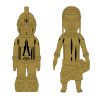
Group of three joined figures
Material
material
brass
Dimension/s
dimensions
H. 25 cm
Provisional dating
date made
19th/20th century
Creditline
prior source
Purchased from: « À la Reine Margot » Gallery, Paris
Provenances
provenance
Circa late 19th - early 20th century, possibly produced by the Royal Bronze-casting Guild (Igun Eronmwon) in Benin City, [...]; 1932 Ernst Ascher, Paris; [...] until 1950 Reine Margot Gallery, Paris; 1950 purchased with piece MEG ETHAF 022819 for 125000 -Frs.f by E. Pittard and Mme Lobsiger-Dellenbach for the Musée d'Ethnographie de Genève
Institution
department and institution
MEG Musée d'ethnographie de Genève
Institution acquisition date
accession date
July 1950
Additional IDs
Sensitive Content

Digital Benin collates digital material from institutions, and some of this material is inherently colonial and contains words, terms and phrases that are inaccurate, derogatory and harmful towards African and African diasporic communities. Catalogue transcriptions, book titles, exhibition titles and museum titles may contain harmful terms. We recognise the potential for the material to cause physical and mental distress as well as evoke strong emotions. Owing to the scale of the collection’s data, a process to implement sensitive-content warnings in the displayed data is still incomplete. The material within the catalogue does not represent Digital Benin’s views. Digital Benin maintains a strong anti-colonial, anti-racist position and affirms its support for centring the humanity of historically marginalised and disenfranchised communities. Read more about the background of this statement here