
Iconographies



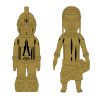

Provenance
Institution data
| Institution field | Value |
|---|---|
Number object id | МАЭ № 595-12 |
Title designation | Warrior plaque |
Annotation description | |
Material material | bronze |
The size dimensions | Height - 46.0; width - 19.0; maximum thickness - 4.5. |
Date date made | XVI-XVII centuries |
Geographical localization of the place of creation production place | Nigeria |
Place of creation production place | Nigeria |
Collectors-person prior source | Meyer Hans (22 March 1858 - 5 July 1929) |
Ethnicity ethnic attribution | edo |
Publications bibliography | Olderogge Dmitry Alekseevich Antiquities of Benin, II (uhuv-elao of Benin kings) // Collection of the Museum of Anthropology and Ethnography / otv. ed. S.P. Tolstov. - M .; L .: Publishing house of the Academy of Sciences of the USSR, 1955. - 461 p .: ill. - (Collection of the Museum of Anthropology and Ethnography; vol. 16) 1955 Olderogge Dmitry Alekseevich Antiquities of Benin (from the collections of the Museum of Anthropology and Ethnography) // Collection of the Museum of Anthropology and Ethnography / otv. ed. S.P. Tolstov. - M .; L .: Publishing house of the Academy of Sciences of the USSR, 1953 .-- 554 p .: ill. - (Collection of the Museum of Anthropology and Ethnography; vol. 15). |
URL weblink | https://collection.kunstkamera.ru/en/entity/OBJECT/14652 |
Albums | Great Benin |
Collection | Ethnography of Africa |
Keywords | peoples of africa, benue-congo, edo |
| Institution field | Value |
|---|---|
Музейный номер object id | МАЭ № 595-12 |
Наименование, название designation | Плакетка с изображением воина |
Материал material | бронза |
Размер dimensions | Высота - 46,0; ширина - 19,0; толщина максимальная - 4,5. |
Время создания date made | XVI-XVII вв. |
Географическая локализация места создания production place | Нигерия |
Место создания production place | Нигерия |
Собиратель-частное лицо prior source | Мейер Ганс (22 марта 1858 - 5 июля 1929) |
Этническая принадлежность ethnic attribution | эдо |
Аннотация notes | |
Публикации bibliography | Ольдерогге Дмитрий Алексеевич Древности Бенина, II (ухув-элао бенинских царей) // Сборник Музея антропологии и этнографии / отв. ред. С.П. Толстов. - М.; Л.: Изд-во АН СССР, 1955. - 461 с.: ил. - (Сборник Музея антропологии и этнографии; т. 16) 1955 Ольдерогге Дмитрий Алексеевич Древности Бенина (по коллекциям Музея антропологии и этнографии) // Сборник Музея антропологии и этнографии / отв. ред. С.П. Толстов. - М.; Л.: Изд-во АН СССР, 1953. - 554 с.: ил. - (Сборник Музея антропологии и этнографии; т. 15). |
URL weblink | https://collection.kunstkamera.ru/entity/OBJECT/14652 |
Альбомы | Великий Бенин |
Ключевые слова | народы Африки, бенуэ-конго, эдо |
Собрание | Этнография Африки |
Digital Benin collates digital material from institutions, and some of this material is inherently colonial and contains words, terms and phrases that are inaccurate, derogatory and harmful towards African and African diasporic communities. Catalogue transcriptions, book titles, exhibition titles and museum titles may contain harmful terms. We recognise the potential for the material to cause physical and mental distress as well as evoke strong emotions. Owing to the scale of the collection’s data, a process to implement sensitive-content warnings in the displayed data is still incomplete. The material within the catalogue does not represent Digital Benin’s views. Digital Benin maintains a strong anti-colonial, anti-racist position and affirms its support for centring the humanity of historically marginalised and disenfranchised communities. Read more about the background of this statement here