

Iconographies








Provenance
Institution data
| Institution field | Value |
|---|---|
IMDAS ID object id | 13AE9A46A4484490ACBAB16E2F516158 |
Inventarnummer object id | I/0051 |
Indigene Bezeichnung (Museumsobjekt) edo designation | Ama |
Titel (Museumsobjekt) designation object type | Reliefplatte |
Titel engl. designation object type | Relief plate |
Titel franz. designation object type | Plaque de relief |
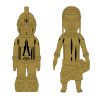
Text kurz Online-Sammlung dt. description | Bronze-Relief mit zwei reich geschmückten Figuren. Derartige im Wachsausschmelzverfahren gefertigte Reliefplatten befanden sich an hölzernen Pfählen der langen, viereckigen Galerien des Palastes im alten Königreich Benin (etwa 900 n. Chr. bis Ende des 19. Jh.). |
Text kurz Online-Sammlung engl. description | Bronze relief with two richly decorated figures. Relief plates of this type, using the lost-wax casting process, were placed on wooden poles of the long, square galleries of the palace in the old Kingdom of Benin (around 900 CE until the end of the 19th century). |
Text kurz Online-Sammlung franz. description | Relief en bronze montrant deux figurines richement décorées. Créées par le procédé de la cire perdue, les plaques en relief de ce genre avaient leur place sur les poteaux en bois des longues galeries rectangulaires du palais dans l’ancien royaume du Bénin (environ 900 après J.-C. jusqu’à la fin du XIXe siècle). |
Text lang Online-Sammlung dt. description | Die Reliefplatte zeigt zwei reich geschmückte, höfische Würdenträger in der typischen gemessenen Haltung. Vor der Brust die Rassel Ukuse, erkenntlich an der Handstellung: der gebeugte rechte Mittelfinger verschließt das Musikinstrument. Der hohe Kragen sowie die Bänder um die Hand- und Fußgelenke deuten Korallenschmuck an. Die Fischadlerfeder an der Kopfbedeckung weist auf die Häuptlingswürde hin. Die vierblättrigen im Hintergrund eingravierten Blüten von Wasserpflanzen symbolisieren den Bezug des Herrschers zum Gott des Wassers Olokun und zur Sonne, die im Reich Olokuns untergeht. Die Zahl der Blätter verweist auf die Ordnung der Benin-Welt in einem Vierersystem: Vier Himmelsrichtungen, vier Wochentage, vier Tageszeiten bestimmten das Leben. Formal zeigt das Motiv auch auf den Einfluss der europäischen und islamischen Ornamentik. Etwa 900 n. Chr. begründet, war das Königreich Benin über Jahrhunderte einer der bedeutendsten Staaten Westafrikas. Der König, Oba, übte große Macht auf sein Volk und die Region aus. Er galt als Vermittler zwischen der irdischen und der geistigen Welt und als Herrscher mit übermenschlicher Kraft. Die Gier der Europäer nach den Schätzen Afrikas brachte dem Königshaus anfänglich großen Reichtum. Seine Lage am Delta des Nigers, der über 4000 km in das Inland führt, begünstigte seine Vormachtstellung. Die Obas kontrollierten den Handel mit Rohstoffen und Sklaven an der Küste und im Inland. Sie erreichten so im 16. und 17. Jh. den Höhepunkt ihrer Macht. Der Expansion des britischen Empires konnte der König Benins jedoch Ende des 19. Jh. nicht standhalten. Die Briten eroberten 1897 dessen Hauptsitz und das Reich galt als zerschlagen. Zur Stärkung der indirekten Herrschaft über die Kolonie setzte der englische König 1914 Eweka II als Thronfolger der Oba-Dynastie wieder ein. Die Autorität des Oba blieb jedoch für immer verloren. Noch heute führen Obas den königlichen Hof Benins fort, bis 2016 regierte Oba Erediauwa I, der besonders vom Volk der Edo / Binis als spiritueller und lokalpolitischer Führer verehrt wurde. |
Text lang Online-Sammlung engl. description | The relief plate shows two richly decorated courtly dignitaries in typically measured posture. In front of the chest we see the Ukuse rattle, recognisable by the hand position: the bent right middle finger closes the musical instrument. The high collar and the bands around the wrists and ankles suggest coral jewellery. The osprey feather on the headdress indicates the rank of chieftain. The four-petalled flowers of water plants engraved in the background symbolise the ruler's relationship to the god of water, Olokun and the sun setting in Olokun's kingdom. The number of leaves refers to the order of the Benin world based on a system of four: four cardinal points, four days of the week, four times of the day determined the flow and passage of life. Formally, the motif also shows the influence of European and Islamic ornamentation. Founded around 900 CE, the Kingdom of Benin was one of the most important states in West Africa for centuries. The king, Oba, exercised great power over his people and the region. He was regarded as a mediator between the earthly and the spiritual world and as a ruler with superhuman strength. European greed for the treasures of Africa initially brought great wealth to the royal house. Its location on the delta of the Niger River, which runs over 4,000 km inland, favoured its supremacy. The Obas controlled the trade in raw materials and slaves on the coast and inland. As a result of this, they reached the peak of their power in the 16th and 17th centuries. However, at the end of the 19th century, the king of Benin was unable to withstand the expansion of the British Empire. The British forces conquered its capital in 1897 and the empire was effectively broken up. To strengthen indirect rule over the colony, the English king reinstated Eweka II as heir to the Oba dynasty in 1914. However, the Oba's authority was lost forever. Even today, Obas continue to hold the royal court of Benin. Until 2016, Oba Erediauwa I ruled, who was particularly revered by the Edo/Bini people as a spiritual and local political leader. Translation: Timothy Connell |
Text lang Online-Sammlung franz. description | Ce relief montre deux dignitaires richement ornés de la cour, dans la posture typique mesurée. Devant leur poitrine, ils tiennent le hochet ukuse, reconnaissable à la position de la main : le majeur droit replié bouche l’orifice de l’instrument de musique. Le haut col ainsi que les lanières autour des articulations des mains et des pieds semblent indiquent des parures faites de coraux. La plume de balbuzard pêcheur sur la coiffe fait référence au rang d’un chef de tribu. Les fleurs à quatre feuilles de plantes aquatiques, gravées dans la plaque du relief, symbolisent le lien du souverain au dieu de l’eau Olokun et au soleil qui se couche dans l’empire d’Olokun. Le nombre de feuilles fait référence à l’ordre de la société du Bénin, un système à quatre éléments : la vie au Bénin était déterminée par quatre orientations célestes, quatre jours de la semaine et quatre saisons. Au niveau formel, le motif évoque également l’influence de l’ornementation européenne et islamique. Fondé vers 900 après J.-C., le royaume du Bénin fut pendant des siècles l’un des plus pays les plus importants d’Afrique de l’Ouest. Le roi, appelé Oba, exerçait un grand pouvoir sur son peuple et sur la région. Il était considéré comme un entremetteur entre le monde terrestre et spirituel et comme un souverain doté d’un pouvoir surhumain. L’avidité des Européens visant à exploiter les trésors africains assura la prospérité de la maison royale dans un premier temps. Son hégémonie était favorisée par sa situation sur le delta du Niger, fleuve qui irrigue le pays sur plus de 4000 km. Les Obas contrôlaient le commerce des matières premières et des esclaves sur la côte, ainsi que dans le pays. Ils atteignirent le sommet de leur pouvoir entre le XVIe et le XVIIe siècle. Le roi du Bénin ne cependant freiner l’expansion de l’Empire britannique à la fin du XIXe siècle. Les Britanniques prirent possession de son siège principal en 1897, ce qui mit fin au royaume du Bénin. Afin de renforcer la domination indirecte de la colonie, en 1914, le roi anglais nomma Eweka II comme successeur de la dynastie des Obas. Cependant l’autorité initiale de l’Oba était perdue à jamais. Les Obas dirigent encore à présent la cour royale du Bénin. Oba Erediauwa I a régné jusqu’en 2016, vénéré à titre de leader spirituel et politique d’ordre local, en particulier par le peuple des Edos / Binis. Traduction: Julia Walter |
Trägermaterial material | Bronze |
Maße zum Objekt dimensions | Breite: 360,00 mm; Höhe: 550,00 mm |
Objektbezeichnung object type | Relief |
Objektbezeichnung engl. object type | Relief |
Objektbezeichnung franz. object type | Relief |
Datierung date made | 16. Jahrhundert; 17. Jahrhundert |
Datierung bis date made | 31.12.1699 |
Datierung von date made | 01.01.1500 |
Entstehungszeit date made | 16. Jahrhundert; 17. Jahrhundert |
Technik production technique | Gelbguss |
Fundort/Herkunft production place | Benin <Königreich>; Nigeria; Westafrika |
Sammler/in öffentlich prior source | Heemke, Bernhard Adolf |
Voreigentümer prior source | Heemke, Bernhard Adolf |
Objektgeschichte provenance | Ausstellungsbereich |
Ethnie ethnic attribution | Edo |
Institution department and institution | Ethnologische Sammlung MNM |
Eingangsdatum accession date | 13.10.1904 |
Eingangsart accession method | Kauf |
Digitaler Katalog Standort display status | Nicht ausgestellt |
Nutzungsrechte (Medienobjekt) license | CC BY-NC-SA 4.0 |
URL-Digitalisat weblink | https://onlinesammlung.freiburg.de/de/object/13AE9A46A4484490ACBAB16E2F516158 |
Fotograf (Medienobjekt) | Killian, Axel |
Sammlung | Afrika |
Schlagworte | Ethnologie (außereuropäische); Benin-Bronze |
Digital Benin collates digital material from institutions, and some of this material is inherently colonial and contains words, terms and phrases that are inaccurate, derogatory and harmful towards African and African diasporic communities. Catalogue transcriptions, book titles, exhibition titles and museum titles may contain harmful terms. We recognise the potential for the material to cause physical and mental distress as well as evoke strong emotions. Owing to the scale of the collection’s data, a process to implement sensitive-content warnings in the displayed data is still incomplete. The material within the catalogue does not represent Digital Benin’s views. Digital Benin maintains a strong anti-colonial, anti-racist position and affirms its support for centring the humanity of historically marginalised and disenfranchised communities. Read more about the background of this statement here