

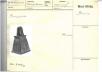
Iconographies

Provenance
Institution data
| Institution field | Value |
|---|---|
Inventory no. [ObjInventarNrS] object id | 02299 |
Object designation [ObjTitelOriginalS] designation object type | Bell |
Description [ObjReserve02M] description | 02299. Strong copper content. Clapper and clasp to hang iron. On one side applied spiral clasp, otherwise diamond mesh. Back side without ornament. Casting defects esp. inside. |
Mat./Technique [ObjTechMatM] material | Yellow cast iron, iron; Very pure brass with extremely high zinc content, no tin, low lead content, extremely low trace element concentrations and significantly increased cadmium |
Dimensions [ObjMasse1S] dimensions | H 10.4 |
Dating [ObjDatierungS] date made | late 19th century |
Year from [ObjJahrVonL] date made | |
Year until [ObjJahrBisL] date made | |
Geographical reference [ObjGeografieS] production place | Kingdom of Benin (Africa->West Africa->Nigeria) |
Name sorting [KueSortierungS_0] prior source | Umlauff Johann Friederich Gustav |
Name sorting [KueSortierungS_1] prior source | |
First Name 2 [KueVorNameS_1] provenance | |
First name [KueVorNameS_0] provenance | Johann Friederich Gustav |
Function collector 2 [OkuFunktionS_1] provenance | |
Function collector [OkuFunktionS_0] provenance | Collector |
Inventory note [ObjFeld07M] provenance | |
Last Name 2 [KueNameS_1] provenance | |
Last name [KueNameS_0] provenance | Umlauff |
Date of acquisition[ObjFeld04M] accession date | c. 1904 |
Acquisition type [ObjFeld02M] accession method | |
Comemnts[ObjCreditlineM] notes | |
Exhibition exhibition history | |
Literature bibliography | |
Type [ObjSystematikS] | Idiophone |
Type of ownership [ObjFeld01M] | |
Type of person 2 [KueTypS_1] | |
Type of person [KueTypS_0] | Person |
| Institution field | Value |
|---|---|
Inventarnr. [ObjInventarNrS] object id | 02299 |
Beschreibung [ObjReserve02M] description | 02299. Stark kupferhaltig. Klöppel und Spange zum Einhängen Eisen. Auf einer Seite aufgelegte Spiralspange, sonst Rautennetz. Rückseite ohne Ornament. Gußfehler bes. innen. |
Mat./Technik [ObjTechMatM] material production technique | Gelbguß, Eisen; Sehr reines Messing mit extrem hohem Zinkgehalt, ohne Zinn, geringem Bleigehalt, extrem niedrigen Spurenelementkonzentrationen und deutlich erhöhtem Cadmiumwert |
Maßangaben [ObjMasse1S] dimensions | H 10.4 |
Gattung [ObjSystematikS] object type | Idiophon |
Objektbezeichnung [ObjTitelOriginalS] object type | Glocke |
Datierung [ObjDatierungS] date made | spätes 19. Jh |
Jahr bis [ObjJahrBisL] date made | |
Jahr von [ObjJahrVonL] date made | |
Geogr. Bezug [ObjGeografieS] production place | Königtum Benin (Afrika->Westafrika->Nigeria) |
Nachname 2 [KueNameS_1] prior source | |
Nachname [KueNameS_0] prior source | Umlauff |
Namensortierung [KueSortierungS_0] prior source | Umlauff Johann Friederich Gustav |
Namenssortierung [KueSortierungS_1] prior source | |
Vorname 2 [KueVorNameS_1] prior source | |
Vorname [KueVorNameS_0] prior source | Johann Friederich Gustav |
Funktion Sammler 2 [OkuFunktionS_1] prior source role | |
Funktion Sammler [OkuFunktionS_0] prior source role | Sammler |
Erwerbsdatum [ObjFeld04M] accession date | c. 1904 |
Besitzart [ObjFeld01M] accession method | |
Erwerbungsart [ObjFeld02M] accession method | |
Bemerkungen [ObjCreditlineM] notes | |
Inventar Notiz [ObjFeld07M] notes | |
Ausstellung exhibition history | |
Literatur bibliography | |
Personentyp 2 [KueTypS_1] | |
Personentyp [KueTypS_0] | Person |
Digital Benin collates digital material from institutions, and some of this material is inherently colonial and contains words, terms and phrases that are inaccurate, derogatory and harmful towards African and African diasporic communities. Catalogue transcriptions, book titles, exhibition titles and museum titles may contain harmful terms. We recognise the potential for the material to cause physical and mental distress as well as evoke strong emotions. Owing to the scale of the collection’s data, a process to implement sensitive-content warnings in the displayed data is still incomplete. The material within the catalogue does not represent Digital Benin’s views. Digital Benin maintains a strong anti-colonial, anti-racist position and affirms its support for centring the humanity of historically marginalised and disenfranchised communities. Read more about the background of this statement here