
Inventarnummer
A III c 329
Edo designations
English designations
Relief Plaque
Categories
Palace Architecture & Ornamentation
Location
Steintorwall 14, 38100 Braunschweig, Germany
Loading...
Relief Plaque
Relief Plaque

Iconographies

4 annotations
Ikharo
Forehead markings

Ikharo are linear keloid markings depicted on the forehead of Uhunmwu-Elao (commemorative heads) in groups of three or four above each eye. The exact meaning of Ikharo is debated; some have argued that they relate to the gender or tribal identification of the person on whom they are depicted. For example, has argued that they were worn only by men; however, their use in depictions is not consistent with this, and the Iy’Ọba are also shown wearing them. argued that they are instead a stylistic feature employed by artists that varied over time.

The naming of these markings differs between publications. For example, describe these markings as “agbaguda n'ehae”, which they write translates literally as “blades of the forehead”. However, later went on to call these “ikharo”, as used here. referred to these forehead markings as ikharo, meaning “tribal mark [of eye]”.

1 annotation
Ikharo
Colar Bead
Odigba
Coral beaded collar

Odigba (coral-beaded collar) is a rigid neck collar made of coral beads, worn as part of ceremonial attire only by senior princes who have been made Enigie (Inneh 2007, p. 107). Although Ibafe (2007, p. 43) argued that the Odigba was introduced during the Ogiso period (c. 900–c. 1170 AD) by Ogiso Ere, along with other symbolically important Emwin Arhe, such as the Ada (ceremonial sword) and the Ẹbẹn (ceremonial sword), this seems unlikely, as coral was only introduced in the late 15th century through trade with Portuguese merchants.

1 annotation
Odigba
tribal marks
Iwu
Facial and Body Markings

Iwu are facial and body markings (scarifications) that were historically worn by Edo men and women. However, since the 1960s, the practice has been nearly extinct (Aisien 2011). In the past, Iwu were used as a way of proving that one was an Edo citizen, and the ceremony of having Iwu completed was an important rite of passage for men and women. The Osiwu, who also practised circumcision and other surgical procedures, would carry out the procedure of adding Iwu. There are different types of Iwu: ‘blades’ worn on the torso (Iwu-eko), and those worn on the face, such as Ikharo (three or four markings above the eyebrows), Irho (two narrow ‘blades’ worn on each cheek), Ovbihue (nasal ‘blades’), Ovbi-agbanmwen (chin ‘blade’), and Igho-okpa/Ukpgho (three forehead ‘blades’) (Aisien 2011, p. 22).

The number of Iwu also varied depending on the identity of the person wearing them. For example, royal men would wear six ‘blades’ on their torso, whilst men who were not royal would wear seven ‘blades’. Meanwhile, the Ọba’s female children would wear fifteen ‘blades’, and all other women would wear sixteen (Aisien 2011).

1 annotation
Iwu
Iviawẹ
Stacked Beaded Anklet

Ọba gha ye Ivie gie ọwan, ẹ ghi tama rẹn ehe nọ gha bae yi (When the Ọba gifts you a bead, he doesn’t tell you how to wear it) (Daniel Inneh, pers. comm., 27 September 2025).

Iviawẹ (also spelled ĺvîowẹ) are coral-beaded anklets, often worn stacked together (Aigbe 1985, p. 28; Okpokunu, Agbontaen-Eghafona & Ojo 2005, p. 162; Ọbazee 2025, p. 279). Many of the figures depicted on the Emwin Arhe (royal treasures) in brass, bronze, ivory, and wood are shown wearing these. According to Daniel Inneh (pers. comm., 27 September 2025), beads were sent to people whom the Ọba wished to honour, although there was no directive on how to wear them.

Mostly, people who wear Iviawẹ are identified as palace chiefs or priests and priestesses. However, today anyone can wear them as cultural identifiers or fashion pieces.

1 annotation
Iviawẹ

Provenance

4 events
Production
1504 (approximate) to 1550 (approximate)
The object was produced by Unknown member(s) of the Igun-Ẹrọnmwọn guild in Benin City.
Looted
February 22, 1897 (day approximate) to June 1899 (year approximate)
The object was looted by February 1897 Unknown member of the British colonial military campaign on Benin from Benin Kingdom.
Unknown
February 22, 1897 (day approximate) to 1901
The object is known to have come into contact with William Downing Webster, later in London.
Purchase
1901
The object was purchased by the Städtisches Museum Braunschweig from William Downing Webster through Richard Andree from London to Brunswick.

Related archival documents

1 documents
See all
Date

Institution data

Städtisches Museum Braunschweig
The data was transferred directly by the institution.
Last updated: 2021-03-31
Language: german
Institution fieldValue
Inventarnummer
object id
A III c 329
Material
material
> Metall > Bronze > Bronzelegierung
Maße
dimensions
Höhe: 34.00 cm Breite: 15.50 cm
Titel
object type
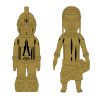
Reliefplatte, Adliger mit Diener, Benin Nigeria
Datierungen
date made
Entstehungsdatum ca. 1500 bis exakt 1700
Provenienz/Zugang von
prior source
Webster, London
Objektgeschichte
provenance
Durch die Initiative von Richard Andree 1901 bei Webster in London angekauft
Provenienz/Zugangsdatum
accession date
1901
Provenienz/Zugangsart
accession method
Kauf
Standort
display status
> Braunschweig > Städtisches Museum Braunschweig > Braunschweig > Städtisches Museum Braunschweig > Haupthaus > 1. OG > 02
Bemerkungen
bibliography
Katalog von William Downing Webster, London, Nr. 29, Fig. 47
Geonames-Link
weblink
http://www.geonames.org/2328926
Alte Inventarnummern / andere Nummern
Vw 7.0-62/2 (Hecht-Nummer)
Beschreibung intern (deutsch)
Darstellung eines Adligen mit Diener aus dem Königreich Benin. Der Hintergrund ist mit Gravierungen versehen. Ethnografie A III c 329
Georeferenzierter Ort (international)
Nigeria (Herstellungsort) (altes Königreich Benin)
Sensitive Content

Digital Benin collates digital material from institutions, and some of this material is inherently colonial and contains words, terms and phrases that are inaccurate, derogatory and harmful towards African and African diasporic communities. Catalogue transcriptions, book titles, exhibition titles and museum titles may contain harmful terms. We recognise the potential for the material to cause physical and mental distress as well as evoke strong emotions. Owing to the scale of the collection’s data, a process to implement sensitive-content warnings in the displayed data is still incomplete. The material within the catalogue does not represent Digital Benin’s views. Digital Benin maintains a strong anti-colonial, anti-racist position and affirms its support for centring the humanity of historically marginalised and disenfranchised communities. Read more about the background of this statement here