

ObjectID
102200
Edo designations
English designations
Commemorative Head
Categories
Altar & Shrine Objects
Heads
Location
2400 3rd Ave S, Minneapolis, MN 55404, United States
Loading...
Commemorative Head
Commemorative Head
Commemorative Head
Commemorative Head
Commemorative Head
Commemorative Head
Commemorative Head
Commemorative Head
Commemorative Head
Commemorative Head

Iconographies

4 annotations
Colar Bead
Odigba
Coral beaded collar

Odigba (coral-beaded collar) is a rigid neck collar made of coral beads, worn as part of ceremonial attire only by senior princes who have been made Enigie (Inneh 2007, p. 107). Although Ibafe (2007, p. 43) argued that the Odigba was introduced during the Ogiso period (c. 900–c. 1170 AD) by Ogiso Ere, along with other symbolically important Emwin Arhe, such as the Ada (ceremonial sword) and the Ẹbẹn (ceremonial sword), this seems unlikely, as coral was only introduced in the late 15th century through trade with Portuguese merchants.

1 annotation
Odigba
Ititi ako
Star beads

The Ititi ako is a cluster of coral beads, usually three or four, attached to a pin and used to embellish the royal crowns on Uhunmwu-Elao (commemorative heads) and Uhunmwu-Ẹkuẹ (pendant masks). These bead clusters are also known as star beads, which indicate the prosperous destiny of an individual or wearer. Apart from enhancing the appearance of the wearer, they also represent the individual’s high social status. Judging from their presence on a variety of head sculptures, both men and women wore Ititi ako.

1 annotation
Ititi ako
Beaded Crown
Ẹde
Beaded Crown

Although many other members of the Benin royal court wore a variety of hats and forms of headwear, only the Ọba may wear the Ẹde (beaded crown). The Ọba must never be seen bare-headed, and successive Ọbas introduced different styles and types of crowns ( ).

Across different media and objects, Ọbas are depicted wearing various types of crowns, all elaborately crafted from coral beads. Some feature tall projections rising from the crown, known as Oro, while others have curved projections extending from either side of the head, known as the winged cap. The latter was introduced only in the 19th century, most likely by Ọba Osẹmwẹndẹ ( ). Depictions of Ọba Esigie on Ama-Ẹrọnmwọn (bronze relief plaques) show him wearing an elaborate crown decorated with large jasper or coral beads ( ).

1 annotation
Ẹde
Ikharo
Forehead markings

Ikharo are linear keloid markings depicted on the forehead of Uhunmwu-Elao (commemorative heads) in groups of three or four above each eye. The exact meaning of Ikharo is debated; some have argued that they relate to the gender or tribal identification of the person on whom they are depicted. For example, has argued that they were worn only by men; however, their use in depictions is not consistent with this, and the Iy’Ọba are also shown wearing them. argued that they are instead a stylistic feature employed by artists that varied over time.

The naming of these markings differs between publications. For example, describe these markings as “agbaguda n'ehae”, which they write translates literally as “blades of the forehead”. However, later went on to call these “ikharo”, as used here. referred to these forehead markings as ikharo, meaning “tribal mark [of eye]”.

1 annotation
Ikharo

Provenance

7 events
Production
unknown to February 22, 1897 (day approximate)
The object was produced by Unknown member(s) of the Igun-Ẹrọnmwọn guild in Benin City.
Looted
February 22, 1897 (day approximate) to June 1899 (year approximate)
The object was looted by February 1897 Unknown member of the British colonial military campaign on Benin from Benin Kingdom.
Auction
March 30, 1981
The object was auctioned to Robert Lauder through Sotheby's in London.
Purchase
March 30, 1981 to 1999
The object was purchased by Albert Nehama from Robert Lauder through Lance & Roberta Entwistle and Entwistle Gallery from London.
Purchase
1999
The object was purchased by Alain de Monbrison with its destination in Paris.
Purchase
1999 (approximate)
The object was purchased from Galerie Monbrison and Alain de Monbrison from Paris to Europe.
Purchase
2007
The object was purchased by the Minneapolis Institute of Arts through Alain de Monbrison and John R. Van Derlip Fund from Europe to Minneapolis.

Institution data

Minneapolis Institute of Arts
The data was transferred directly by the institution.
Last updated: 2021-08-30
Language: english
Institution fieldValue
ObjectID
object id
102200
ObjectName
designation
object type
Memorial head
Description
description
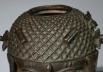
Male head wearing thick collar up to lower lip; openwork caplike headdress with hanging braids and beaded cords around ears; two "beads" on forehead; flower-like beaded elements at temples--one at PR ear, two at PL ear; open circle at top of head
Medium
material
Bronze
Dimensions
dimensions
11 1/2 x 8 11/16 x 8 5/16 in. (29.21 x 22.07 x 21.11 cm)
Dated
date made
1550-1650
Country
production place
Nigeria (Benin Kingdom)
CreditLine
prior source
The John R. Van Derlip Fund
Provenance
prior source
provenance
[…?]; By 1981: Private collection, Germany; March 30, 1981: Sold by Sotheby's London, lot 292, to Robert Lauder, London; Date unknown: Sold by Lauder, with dealer Lance Entwistle, London, to Albert Nehama; 1999: Purchased by dealer Alain de Monbrison, Paris; About 1999: Sold by Monbrison to private collector, Europe; 2006: Offered for sale by Monbrison on behalf of private collector; 2007: Acquired by Mia
Culture
ethnic attribution
Edo
CuratorialRemarks
notes
So far (August 2021), provenance inquiries addressed to the dealers Alain de Monbrison and Lance Entwistle have remained unanswered.
Notes
notes
Exhibitions
exhibition history
Bibliography
bibliography
ObjectNumber
2007.13
Sensitive Content

Digital Benin collates digital material from institutions, and some of this material is inherently colonial and contains words, terms and phrases that are inaccurate, derogatory and harmful towards African and African diasporic communities. Catalogue transcriptions, book titles, exhibition titles and museum titles may contain harmful terms. We recognise the potential for the material to cause physical and mental distress as well as evoke strong emotions. Owing to the scale of the collection’s data, a process to implement sensitive-content warnings in the displayed data is still incomplete. The material within the catalogue does not represent Digital Benin’s views. Digital Benin maintains a strong anti-colonial, anti-racist position and affirms its support for centring the humanity of historically marginalised and disenfranchised communities. Read more about the background of this statement here