
Registration number
Af1954,23.370
Institution
British Museum
Edo designations
English designations
Altar Ring
Categories
Altar & Shrine Objects
Location
Great Russell St, Bloomsbury, London WC1B 3DG, United Kingdom
Loading...
Altar Ring
Altar Ring
Altar Ring
Altar Ring
Altar Ring
Altar Ring

Iconographies

2 annotations
Ẹgogo
Gong

Ẹgogo (gongs) hold significant importance in Benin art and ritual, serving as powerful instruments with both practical and symbolic roles. Ivory gongs, especially “double-bell” types, were highly prized and reserved for the royal court, particularly those made entirely of ivory, which were used exclusively by the Ọba. The whiteness of ivory Ẹgogo symbolises purity and peace and is linked to sacred Orhue (white kaolin chalk) and the deity Olokun (Blackmun 2007, cat. no. 60, p. 315).

When depicted in the imagery of the Emwin Arhe (royal treasures), Ẹgogo are usually held by figures such as the Ọba or high-ranking chiefs, illustrating their historical and ongoing use as idiophones during ceremonies and festivals. The Ọba dances with an ornately carved ivory Ẹgogo during the Emobo festival, which takes place three days after the Iguẹ festival (Ben-Amos 1995, p. 108).

1 annotation
Ẹgogo
Round Neck Bead
Ikele
Coral bead circlet

Ikele is a single stiff string or circlet of coral beads. It is worn by chiefs, such as senior chiefs who have been made Enigie (Inneh 2007, p.107), and is a sign of nobility and rank. The Ikele may only be worn once the Ọba has conferred a person with the right to wear the beads, and the Ikele must always be worn when appearing before the Ọba. According to Ekhaguosa Aisien (in Plankensteiner 2007, cat. nr. 301, p.512) when a chief is wearing the Ikele, they may not eat nor drink in public, and they “constitute an embassy of the Benin Palace wherever he might be.”

1 annotation
Ikele

Provenance

4 events
Production
unknown to February 22, 1897 (day approximate)
The object was produced by Unknown member(s) of the Igun-Ẹrọnmwọn guild in Benin City.
Looted
February 22, 1897 (day approximate) to June 1899 (year approximate)
The object was looted by February 1897 Unknown member of the British colonial military campaign on Benin from Benin Kingdom.
Auction
October 20, 1932
The object was auctioned to the Wellcome Collection, Henry Solomon Wellcome and London Wellcome Institute for the History of Medicine by February 1897 Unknown member of the British colonial military campaign on Benin through Foster's and Harry Stow in London.
Donation
1954
The object was donated by the Wellcome Collection and London Wellcome Institute for the History of Medicine to the British Museum in London.

Institution data

British Museum
The data was transferred directly by the institution.
Last updated: 2025-06-10
Language: english
Institution fieldValue
Registration number
object id
Af1954,23.370
Additional IDs
object id
123338 (Wellcome Collection number)~86 (Dark number)
PRN
object id
EAF21292
Object Type
designation
altar-ornament (?)
Description
description
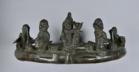
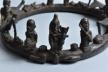
Brass altar-ring with human figures and birds.
Ethnic name (made by)
ethnic attribution
Edo
Date
16thC - 19thC
Findspot
place collected
Found/Acquired: Benin City
Materials
material
brass
Technique
production technique
lost-wax cast
Dimensions
dimensions
Height: 29.00 cm~Width: 26.50 cm~Depth: 9.10 cm~Weight: 3691.00 g
Curator’s comments
provenance
Register 1954 Brass ring on which are cast seven human figures, four birds and other objects. Foster. 20/10/32. £15.15.=.
Exhibition history
exhibition history
Exhibited: 1970-1973, London, Museum of Mankind, Divine Kingship in Africa
Subjects
iconography
bird
Associated events
event
Associated Event: British to Benin City - Feb 1897
Acquisition name (acquisition)
provenance
Wellcome Institute for the History of Medicine
Acquisition name (previous)
provenance
Previous owner/ex-collection: Foster's
Acquisition date
accession date
1954.0
Sensitive Content

Digital Benin collates digital material from institutions, and some of this material is inherently colonial and contains words, terms and phrases that are inaccurate, derogatory and harmful towards African and African diasporic communities. Catalogue transcriptions, book titles, exhibition titles and museum titles may contain harmful terms. We recognise the potential for the material to cause physical and mental distress as well as evoke strong emotions. Owing to the scale of the collection’s data, a process to implement sensitive-content warnings in the displayed data is still incomplete. The material within the catalogue does not represent Digital Benin’s views. Digital Benin maintains a strong anti-colonial, anti-racist position and affirms its support for centring the humanity of historically marginalised and disenfranchised communities. Read more about the background of this statement here