
Provenance
Institution data
| Institution field | Value |
|---|---|
Inventarisnummer object id | RV-1243-46 |
Objectnaam designation object type | Dolk; schede |
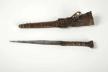
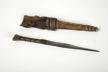
Titel designation object type | Dolk met schede |
Associatie/beschrijving (online getoond) description | Een metalen dolk met een leren schede. |
Materiaal en techniek (NB: ook thesaurustermen aanpassen!) material | ijzer ; brons en/of messing ; leer; gesmeed ; gegoten ('cire perdue'-techniek) |
Afmetingenlabel (H x B x D) dimensions | dolk: 27 x 3 x 1 cm schede: 25,2 x 5 x 2,5 cm |
Datering date made | voor 1900 |
Verzamelgeschiedenis (toelichting) provenance | The acquisition of 53 Benin objects (RV-1243-1 to -46 and RV-1295-2 to -7) from William Downing Webster (1868-1913), a British ethnographic art dealer and collector, known to have assembled a large collection from the Benin military campaign of 1897, is characterised by budgeting issues (Waterfield & King 2006: 55-63). When Johannes Schmeltz received a first letter from Webster on 7 December 1899 with a list of Benin objects offered for sale, he realised it would need fundraising on his part to acquire this important collection (NL-LdnRMV-A1-30-542/545). Schmeltz managed to secure funds from, amongst others, Her Majesty the Queen of the Netherlands, Queen Wilhelmina, and the Queen Mother, Princess Emma van Waldeck-Pyrmont. The Queen Mother’s secretary sent a letter to Schmeltz confirming the donation for the purchase of the Benin objects on 8 June 1900 (NL-LdnRMV-A1-31-344/345; CL-L: Nl- LdnRMV_A01_277_00109; AR-L 1899-1900: 13; MR-L: NL-LdnRMV_A03_007_0237). All the financial donors were listed in the Nederlandsche Staatscourant, the Dutch national state newspaper on 25 April 1902. Schmeltz and Webster remain connected through letters. On 14 October 1900 Schmeltz for example expresses the wish to buy a tusk (Webster catalogue 21, No. 203), but notes that if the price cannot be lowered he will not be able to buy it, which ends up being the case. Schmeltz and Webster met in Paris shortly after this letter, possibly at the World Exhibition. Schmeltz reports on this visit, which he commenced on 18 October 1900 (AR-L 1900-1901: annex). In a letter of 24 October 1900 from Webster to Schmeltz, it becomes clear that the two men made plans to meet for dinner in Paris (NL-Ldn-RMV-A1-32-531/532. During that meeting on 26 October 1900, Schmeltz secured three more Benin objects (1243-44 to -46) described as ‘Bought in Paris from W.D. Webster, Bicester. 1 ceremony staff and a rooster, both made of bronze and a dagger with amulets(?) in its leather belt, everything comes from Benin.’ (Excerpt from Provenance no. 2 'The Benin collections at the National Museum of World Cultures' written by Rosalie Hans with Annette Schmidt, 05-01-2021) |
Cultuur (NB: ook thesaurusterm aanpassen!) ethnic attribution | Bini |
Deelcollectie department and institution | Materiële cultuurcollectie |
Verwervingsdatum accession date | 1900-02-01 |
Wijze van verwerving accession method | Aankoop |
Literatuur bibliography | |
Publicaties over het object bibliography | For more information about the provenance, see <a href="https://issuu.com/tropenmuseum/docs/2021_provenance_2__benin__e-book" target="_blank"> Provenance #2 – the Benin collections at the National Museum of World Cultures </a> (NB: Issuu uses cookies). |
Objectstatus legal status | Eigendom |
Met dank aan (online getoond) | |
Periode (NB: ook thesaurusterm aanpassen!) | Benin |
Verkorte naam | AFRIK |
Digital Benin collates digital material from institutions, and some of this material is inherently colonial and contains words, terms and phrases that are inaccurate, derogatory and harmful towards African and African diasporic communities. Catalogue transcriptions, book titles, exhibition titles and museum titles may contain harmful terms. We recognise the potential for the material to cause physical and mental distress as well as evoke strong emotions. Owing to the scale of the collection’s data, a process to implement sensitive-content warnings in the displayed data is still incomplete. The material within the catalogue does not represent Digital Benin’s views. Digital Benin maintains a strong anti-colonial, anti-racist position and affirms its support for centring the humanity of historically marginalised and disenfranchised communities. Read more about the background of this statement here