
Iconographies

Provenance
Institution data
| Institution field | Value |
|---|---|
Accession No object id | |
Catalogue No. object id | EA1976.775 |
Old Accession No. object id | |
Other Id object id | EA1976.775, E1698.0, 3797 |
Primary Number object id | EA1976.775 |
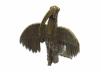
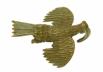
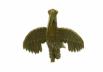
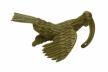
Brief Description description | Bronze bird with outstretched wings and a long beak, a fragment from a staff representing the 'bird of prophecy' with a kola nut in its beak. Although recorded as an emblem from a chief's staff it was more likely to have once been part of a ritual item frequently referred to as a 'clapper'. These staffs commemorate a legend relating to Oba Esigie who reigned in the early sixteenth century. A bird of prophecy is said to have warned against going to war, the oba killed the bird and went on to victory and is said to have admonished his troops with the words, "Whoever wishes to succeed in life should not heed the bird that cries disaster" |
Media Materials material | Bronze |
Measurement Notes Y N display dimensions | |
Measurement Precision Y N display dimensions | |
Measurement Reading primary system Y display only dimensions | |
Measurement Reading secondary system Y display only dimensions | |
Measurement Type Y display only dimensions | |
Name Title object type | Staff, bird |
Item Count object count | 1 |
Primary Prod Date date made | |
Primary Prod Date Notes date made | |
Primary Prod Place production place | Benin City/Nigeria/Africa |
Acquisition Source Role prior source role | Vendor |
Acq Source Report provenance | Websters |
Acquisition Notes provenance | London auction. |
Acquisition Source provenance | Websters |
Donor report provenance | Websters |
Provenance Notes provenance | |
Accession Date accession date | 30 August 1898 |
Acquisition Date accession date | 30 August 1898 |
Acquisition Method accession method | Purchase |
Associated Notes notes | |
Production Notes notes | |
Related Outward Loan exhibition history | |
Documentation Article bibliography | Roger Fyfe and Sarah Murray. “Benin Art in Canterbury Museum”. Records of the Canterbury Museum. Vol 28, 2014. Pg 7- 30. |
Condition Date condition | |
Condition Keyword condition | |
Condition Notes condition | |
Condition Part condition | |
Condition Person condition | |
Current Condition condition | |
Current Condition Date condition | |
Current Condition Description condition | |
Current Condition Part condition | |
Current Condition Person condition | |
Image Publication Status images | Has image(s) |
Image Ref - Full path images | \\cm-fp4\vernon images\Collection Images\Catalogue Numbers\EA nos\EA1976.775 Bird front.jpg, \\cm-fp4\vernon images\Collection Images\Catalogue Numbers\EA nos\EA1976.775 Bird profile.jpg, \\cm-fp4\vernon images\Collection Images\Catalogue Numbers\EA nos\EA1976.775 Bird side.jpg, \\cm-fp4\vernon images\Collection Images\Catalogue Numbers\EA nos\EA1976.775 Bird back.jpg, \\cm-fp4\vernon images\Collection Images\1971 - 1980\1976\ea1976_775_benin.jpg |
Image Ref - Relative path images | Catalogue Numbers\EA nos\EA1976.775 Bird front.jpg, Catalogue Numbers\EA nos\EA1976.775 Bird profile.jpg, Catalogue Numbers\EA nos\EA1976.775 Bird side.jpg, Catalogue Numbers\EA nos\EA1976.775 Bird back.jpg, 1971 - 1980\1976\ea1976_775_benin.jpg |
Photo Audio-Visual Ref images | Catalogue Numbers\EA nos\EA1976.775 Bird front.jpg (Image (Electronic)), Catalogue Numbers\EA nos\EA1976.775 Bird profile.jpg (Image (Electronic)), Catalogue Numbers\EA nos\EA1976.775 Bird side.jpg (Image (Electronic)), Catalogue Numbers\EA nos\EA1976.775 Bird back.jpg (Image (Electronic)), 1971 - 1980\1976\ea1976_775_benin.jpg (Image (Electronic)) |
Primary Image images | \\cm-fp4\vernon images\Collection Images\Catalogue Numbers\EA nos\EA1976.775 Bird front.jpg |
Cataloguer | Paul Hobson, Miss Natasha Carson |
Classification | Personal Gear |
Collecting Unit | Anthropology/Foreign |
Curator | |
Curator Comments Date | |
Curator Comments Remarks | |
Current | |
Date Catalogued | 26 June 2008, 23 March 2004 |
Loan In Details | |
Loan Out Details | |
Location General Notes | |
Other Id Notes | |
Other Id Type | Catalogue Number, Card Number, Other Number |
Procedural Status | Catalogued |
Record Created Date | 23-Mar-04 |
System ID | 229617 |
Treatment Date | |
Treatment Keyword | |
Treatment Notes | |
Treatment Part | |
Treatment Person |
Digital Benin collates digital material from institutions, and some of this material is inherently colonial and contains words, terms and phrases that are inaccurate, derogatory and harmful towards African and African diasporic communities. Catalogue transcriptions, book titles, exhibition titles and museum titles may contain harmful terms. We recognise the potential for the material to cause physical and mental distress as well as evoke strong emotions. Owing to the scale of the collection’s data, a process to implement sensitive-content warnings in the displayed data is still incomplete. The material within the catalogue does not represent Digital Benin’s views. Digital Benin maintains a strong anti-colonial, anti-racist position and affirms its support for centring the humanity of historically marginalised and disenfranchised communities. Read more about the background of this statement here