
Provenance
Institution data
| Institution field | Value |
|---|---|
idno object id | E 1902.114 |
local edo designation | |
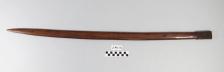
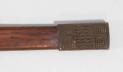
Physical description/0 description | Catalogue card notes: "Weaving stick with flat sword like blade, the handle a thick oblong plaque, both sides decorated with a deeply carved pattern. / Benin West Africa 1897 Expedition ." |
Physical description/1 description | |
Physical description/2 description | |
Physical description/3 description | |
Physical description/4 description | |
d_Description Name description | Weaving stick decorated on both sides of the handle with a deeply carved pattern. Collected on the British Expedition to Benin City, 1897. |
height dimensions | |
length dimensions | 910 mm |
width dimensions | 38 mm |
weight weight | |
Inscription inscriptions | |
Labels - Markings/0 inscriptions | The accession number is marked in two areas, one in black, directly on the wood, and the other in white near the handle. |
Labels - Markings/1 inscriptions | A label that reads '1902.114 / Weaving stick / Benin, West Africa / * Professor Bevan' is adhered to the object. |
Labels - Markings/2 inscriptions | |
Labels - Markings/3 inscriptions | |
Labels - Markings/4 inscriptions | |
Labels - Markings/5 inscriptions | |
period date made | |
maker producer | |
d_Place production place | Africa; West Africa; Nigeria; [Kingdom of Benin]; Edo State; Benin City; Oba's Palace |
Other owners prior source | |
source prior source | Benin Expedition [collector]; Stevens Auction Room [vendor]; Bevan, Anthony Ashley (Prof.) [monetary donor] |
Collection or Excavation Year date collected | 1897 |
culture group ethnic attribution | Edo |
source date accession date | 1902 |
Amendments - updates/0 notes | 'Edo' is both a language and cultural group but the catalogue is presumed to have been using the term 'Edo as a cultural group. The term 'Benin' has been removed from the cultural group field. Today Benin City is the capital of Edo State and so 'Edo State' has been used in the place field. |
Amendments - updates/1 notes | |
Amendments - updates/2 notes | |
Amendments - updates/3 notes | |
Amendments - updates/4 notes | |
Exhibition/0 exhibition history | |
Exhibition/1 exhibition history | |
Reference Numbers bibliography | E 1902.114 MAA: ?AR 1903.423 |
References/0 bibliography | |
References/0 2 bibliography | |
References/1 bibliography | |
Related Documents/0 bibliography | Catalogue card reads, in blue biro: "1902 E 114 | AFRICA | WEST AFRICA / NIGERIA / WEAVING STICK with flat sword like blade the handle a thick oblong plaque both sides decorated with a deeply carved pattern. / Benin, West Africa 1897 Expedition / purchased Stevens | R. 1903 423" Red circular sticker in bottom right corner of card. |
Related Documents/1 bibliography | |
Related Documents/2 bibliography | |
Related Documents/3 bibliography | |
Related Documents/4 bibliography | |
Related Documents/5 bibliography | |
Related Documents/6 bibliography | |
Acquisition Details/0 | |
Acquisition Details/1 | |
Acquisition Details/2 | |
Analysis/0 | |
Analysis/1 | |
Archaeology | |
Auction - Sale/0 | Catalogue card reads "Purchased Stevens" [Adjacent cards also note "Professor Bevan's donation", and it has been assumed that this is part of the same donation. Katrina Dring 24/08/2020] |
Auction - Sale/1 | |
CMS Context/0 | |
CMS Description | |
Catalogue | |
Display/0 | |
Display/1 | |
Display/2 | |
Display/3 | |
Field_collection/0 | E 1902.94- 115 are recorded in the Accession Register as acquired on the 'Benin, West Africa 1897 Expedition ’ indicating they formed part of the spoils taken during the looting of Oba Ovonramwen Nogbaisi’s royal palace by British troops led by Admiral Sir Henry Rawson. This punitive expedition was a response to the ambush of a British party led by Acting Consul General James Philips which had sought to enter Benin City during Ague (Igue), the new year festival of renewal, against the wishes of the Oba. E 1902.93- 115 are annotated in the Register as 'B. Stevens *Prof Bevan' indicating they were purchased at an undated 1902 auction at J.C. Stevens saleroom, 38 King Street Covent Garden, London, with money donated to the Museum’s Accessions Fund by Prof. Anthony Ashley Bevan. |
Field_collection/1 | Collected on the 1897 Punitive Expedition . |
Found_together - assemblage | |
Freezing | |
Online Only | |
Other/0 | |
Other/1 | |
Production - use | |
Remedial/0 | |
Remedial/1 | |
Surface Clean | |
unknown |
Digital Benin collates digital material from institutions, and some of this material is inherently colonial and contains words, terms and phrases that are inaccurate, derogatory and harmful towards African and African diasporic communities. Catalogue transcriptions, book titles, exhibition titles and museum titles may contain harmful terms. We recognise the potential for the material to cause physical and mental distress as well as evoke strong emotions. Owing to the scale of the collection’s data, a process to implement sensitive-content warnings in the displayed data is still incomplete. The material within the catalogue does not represent Digital Benin’s views. Digital Benin maintains a strong anti-colonial, anti-racist position and affirms its support for centring the humanity of historically marginalised and disenfranchised communities. Read more about the background of this statement here